Home
Class 10
CHEMISTRY
The position of three elements X, Y and ...

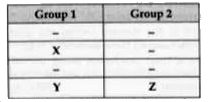
The position of three elements X, Y and Z in the periodic table are shown below:
(i) Which type of ion, cation or anion, will be formed by element X ?
(ii) Which element, Y or z, has the atom of comparatively larger size ?
Give reason in each case.

Text Solution

Verified by Experts

(i) The valency of X is one. It has tendency to lose one electron. Therefore, X will form cation.
(ii) Y, because atomic radius decreases across a period due to increase in the electrostatic force between electrons and nucleus.
Promotional Banner

Topper's Solved these Questions

  • PERIODIC CLASSIFICATION OF ELEMENTS

    OSWAAL PUBLICATION|Exercise TOPIC:2- SHORT ANSWER TYPE QUESTIONS-II|45 Videos
  • PERIODIC CLASSIFICATION OF ELEMENTS

    OSWAAL PUBLICATION|Exercise TOPIC:2- LONG ANSWER TYPE QUESTIONS|5 Videos
  • PERIODIC CLASSIFICATION OF ELEMENTS

    OSWAAL PUBLICATION|Exercise TOPIC:2- VERY SHORT ANSWER TYPE QUESTIONS|18 Videos
  • METALS AND NON-METALS

    OSWAAL PUBLICATION|Exercise NCERT CORNER (Textbook Exercises)|16 Videos
  • SOLVED PAPER SSLC KARNATAKA APRIL 2019

    OSWAAL PUBLICATION|Exercise QUESTIONS|49 Videos

Similar Questions

Explore conceptually related problems

The position of three elements A, B and C in the periodic table are shown below : Give reasons to explain the following: (i) Element 'A' is a metal. (ii) Element 'B' has larger size than 'C'. (iii) Element 'C' has a valency - 3.

The position of three elements A, B and C in the periodic Table is shown below: (a) State whether A is a metal or non-metal (b) State whether C is more reactive or less reactive than A ( c) Will C be larger or smaller in size than B? (d) Which type of ion, cation or anion, will be formed by element C?

Which elements still has dicey position in modern periodic table ?

The elements Li, Na and K, each having one valence electron, are in period 2, 3 and 4 respectively of modern periodic table. (1) In which group of the periodic table should they be? (ii) Which one of them is least reactive ? (iii) Which one of them has the largest atomic radius? Give reason to justify your answer in each case.

The atomic number of an element 'X' is 20. (i) Determine the position of the element 'X' in the periodic table. (ii) Write the formula of the compound formed when 'X' reacts/combines with another element 'Y' (atomic number 8). (iii) What would be the nature (acidic or basic) of the compound formed ? Justify your answer.

Consider two elements ‘A’ (Atomic number 17) and 'B' (Atomic number 19): (i) Write the positions of these elements in the modern periodic table giving justification. (ii) Write the formula of the compound formed when 'A' combines with 'B.' (iii) Draw the electron dot structure of the compound and state the nature of the bond formed between the two elements.

The atomic radii of three elements A, B and C of a periodic table are 186 pm, 104 pm and 143 pm respectively. Giving a reason, arrange these elements in the increasing order of atomic numbers in the period.

An element has atomic number 3. To which period of the periodic table does it belong?

OSWAAL PUBLICATION-PERIODIC CLASSIFICATION OF ELEMENTS-TOPIC:2-SHORT ANSWER TYPE QUESTIONS-I
  1. How would the tendency to lose electrons change as you go i] from le...

    Text Solution

    |

  2. How does the atomic radius change as we go : (i) from left to right ...

    Text Solution

    |

  3. (i) State the basis of classification of elements in the modern period...

    Text Solution

    |

  4. How does metallic character of elements vary on moving from : (i) Le...

    Text Solution

    |

  5. The atomic radii of three elements A, B and C of a periodic table are ...

    Text Solution

    |

  6. (i) Atomic number of Mg and Al are 12 and 13, respectively. Write down...

    Text Solution

    |

  7. Arrange the following elements in the descending order of atomic size ...

    Text Solution

    |

  8. Three elements X, Y and Z belong to 17^(th) group but 2^(nd),3^(rd)and...

    Text Solution

    |

  9. i] Atomic radius of hydrogen is 37 pm. Express it in metres. ii] How...

    Text Solution

    |

  10. Nitrogen (atomic number 7) and phosphorous (atomic number 15) belong t...

    Text Solution

    |

  11. Na, Mg, Al and P belong to 3^(rd) period but are placed in first, seco...

    Text Solution

    |

  12. (i) Element 'Y' with atomic number 3 combines with element 'A' with at...

    Text Solution

    |

  13. (i) How does the tendency to gain electrons change as we go down the g...

    Text Solution

    |

  14. Given below are atomic radii of same elements of second period. {:("...

    Text Solution

    |

  15. Out of the elements X and Y, which has bigger atomic radius? Give reas...

    Text Solution

    |

  16. Two elements X and Y have atomic numbers 12 and 16 respectively. To wh...

    Text Solution

    |

  17. The atomic number of elements A, B, C, D and E are given below: F...

    Text Solution

    |

  18. The position of three elements X, Y and Z in the periodic table are sh...

    Text Solution

    |

  19. (i) An element has electronic configuration 2, 8, 6. Explain its posit...

    Text Solution

    |

  20. Some of the elements and their atomic numbers are mentioned in the fol...

    Text Solution

    |
