Home
Class 10
CHEMISTRY
Consider two elements ‘A’ (Atomic number...

Consider two elements ‘A’ (Atomic number 17) and 'B' (Atomic number 19):
(i) Write the positions of these elements in the modern periodic table giving justification.
(ii) Write the formula of the compound formed when 'A' combines with 'B.'
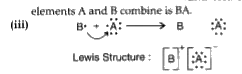
(iii) Draw the electron dot structure of the compound and state the nature of the bond formed between the two elements.

Text Solution

Verified by Experts
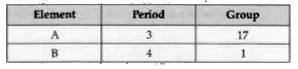
(i) Position of the elements in the periodic table :

(ii) Atomic number of A = 17
Electronic configuration A = 2, 8, 7
Number of valence electrons of A = 7
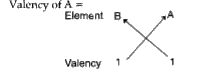
Valency of A = 8–7 = 1
Atomic number of B = 19
Electronic configuration B = 2,8,8,1
Number of valence electrons of B = 1
Valency of A =

So, the formula of the compound formed when elements A and B combine is BA.
(iii)
Promotional Banner

Topper's Solved these Questions

  • PERIODIC CLASSIFICATION OF ELEMENTS

    OSWAAL PUBLICATION|Exercise TOPIC:2- LONG ANSWER TYPE QUESTIONS|5 Videos
  • PERIODIC CLASSIFICATION OF ELEMENTS

    OSWAAL PUBLICATION|Exercise NCERT CORNER -INTEXT QUESTIONS|13 Videos
  • PERIODIC CLASSIFICATION OF ELEMENTS

    OSWAAL PUBLICATION|Exercise TOPIC:2-SHORT ANSWER TYPE QUESTIONS-I|25 Videos
  • METALS AND NON-METALS

    OSWAAL PUBLICATION|Exercise NCERT CORNER (Textbook Exercises)|16 Videos
  • SOLVED PAPER SSLC KARNATAKA APRIL 2019

    OSWAAL PUBLICATION|Exercise QUESTIONS|49 Videos

Similar Questions

Explore conceptually related problems

An element X (atomic number 17) reacts with an element Y (atomic number 20) to form a compound. (i) Write the position of these elements in the modern periodic table. (ii) Write the formula of the compound formed. Justify your answer in each case.

The atomic number of an element 'X' is 20. (i) Determine the position of the element 'X' in the periodic table. (ii) Write the formula of the compound formed when 'X' reacts/combines with another element 'Y' (atomic number 8). (iii) What would be the nature (acidic or basic) of the compound formed ? Justify your answer.

Write the formula of the product formed when the element A (atomic number 19) combines with the element B (atomic number 17). Draw its electron-dot structure. What is the nature of the bond formed?

An element X (atomic number 17) reacts with an element Y (atomic number 20) to form a Compound. i]Write the position of these elements in the Modern Periodic Table ii] Which one is a metal and which one is a non-metal? iii] Write the formula of the compound.

An element P (atomic number 20) reacts with an element Q (atomic number 17) to form a compound. Answer the following questions giving reason: Write the position of P and Q in the Modern Periodic Table and the molecular formula of the compound formed when P reacts with Q.

Write the molecular formula of the following compounds and draw their electron-dot structures : (i) Ethane (ii) Ethene (iii) Ethyne

Three elements 'X', 'Y' and 'Z' have atomic numbers 7, 8 and 9 respectively. (i) State their positions (Group number and period number both) in the Modern Periodic Table. (ii) Arrange these elements in the decreasing order of their atomic radii. (iii) Write the formula of the compound formed when 'X' combines with 'Z'.

Carbon (group 14), an element in the periodic table , forms compound with many elements . Write the example of a compound formed with (a) chlorine (group 17) " " (b) oxygen (group 16)

b) Atoms of element B form hep lattice and those of element A occupies 2//3^(rd) of tetrahedral voids. Calculate the formula of the compound formed by A and B.

OSWAAL PUBLICATION-PERIODIC CLASSIFICATION OF ELEMENTS-TOPIC:2- SHORT ANSWER TYPE QUESTIONS-II
  1. Two elements 'P' and 'Q' belong to the same period of the modern perio...

    Text Solution

    |

  2. The atomic number of an element 'X' is 20. (i) Determine the positio...

    Text Solution

    |

  3. Four elements P, Q, R and S belong to the third period of the Modern P...

    Text Solution

    |

  4. In the following table, the positions of six elements A, B, C, D, E an...

    Text Solution

    |

  5. The electrons in the atoms of four elements A, B, C and D are distribu...

    Text Solution

    |

  6. Based on the group valency of elements state the formula for the follo...

    Text Solution

    |

  7. Consider two elements ‘A’ (Atomic number 17) and 'B' (Atomic number 19...

    Text Solution

    |

  8. Study the following table in which positions of six elements A, B, C, ...

    Text Solution

    |

  9. The elements Li, Na and K, each having one valence electron, are in pe...

    Text Solution

    |

  10. An atom has electronic configuration 2, 8, 2. (i) What is the atomic...

    Text Solution

    |

  11. Two elements X and Y belong to group 1 and 2 respectively in the same ...

    Text Solution

    |

  12. Four elements A, B, C and D along with their electronic configuration ...

    Text Solution

    |

  13. Four elements A, B, C and D have atomic numbers 12, 13, 14 and 15 resp...

    Text Solution

    |

  14. Three elements X, Y and Z have atomic numbers 7, 10 and 14 respectivel...

    Text Solution

    |

  15. From the following part of the periodic table, answer the following qu...

    Text Solution

    |

  16. The position of three elements A, B and C in the periodic table are sh...

    Text Solution

    |

  17. Given below are some elements of the Modern Periodic Table: ""(4)Be,...

    Text Solution

    |

  18. Write the number of period the modern periodic table has. How do the v...

    Text Solution

    |

  19. An element X (atomic number 17) reacts with an element Y (atomic numbe...

    Text Solution

    |

  20. Using the given part of the periodic table, answer the following quest...

    Text Solution

    |