Home
Class 10
CHEMISTRY
From the following part of the periodic ...

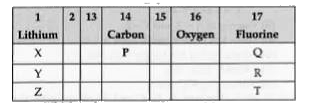
From the following part of the periodic table, answer the following questions:

(i) Which is the most reactive metal ?
(ii) Name the family of fluorine Q, R, T.
(iii) Name one element each of group 2 and 15.
(iv) Give the name of the element P placed below carbon.
(v) Compare X and P with respect to the size of atoms.

Text Solution

Verified by Experts

(i) Z.
(ii) Halogens.
(iii) Magnesium and nitrogen.
(iv) Silicon.
(v) X has bigger size than P because X has less effective nuclear charge.
Promotional Banner

Topper's Solved these Questions

  • PERIODIC CLASSIFICATION OF ELEMENTS

    OSWAAL PUBLICATION|Exercise TOPIC:2- LONG ANSWER TYPE QUESTIONS|5 Videos
  • PERIODIC CLASSIFICATION OF ELEMENTS

    OSWAAL PUBLICATION|Exercise NCERT CORNER -INTEXT QUESTIONS|13 Videos
  • PERIODIC CLASSIFICATION OF ELEMENTS

    OSWAAL PUBLICATION|Exercise TOPIC:2-SHORT ANSWER TYPE QUESTIONS-I|25 Videos
  • METALS AND NON-METALS

    OSWAAL PUBLICATION|Exercise NCERT CORNER (Textbook Exercises)|16 Videos
  • SOLVED PAPER SSLC KARNATAKA APRIL 2019

    OSWAAL PUBLICATION|Exercise QUESTIONS|49 Videos

Similar Questions

Explore conceptually related problems

Using the given part of the periodic table, answer the following questions with reason : (i) Name the element having smallest atomic size. (ii) Write electronic configuration of element E. (iii) Identify the elements which have similar physical and chemical properties as the element Y.

Study the following table in which positions of six elements A, B, C, D, E and F are shown as they are in the modern periodic table : On the basis of the above table, answer the following questions : (i) Name the element which forms only covalent compounds. (ii) Name the element which is a metal with valency three. (iii) Name the element which is a non-metal with valency three. (iv) Out of D and E, which is bigger is size and why ? (v) Write the common name for the family to which the elements C and F belong.

In the following table, the positions of six elements A, B, C, D, E and F are given as they are in the Modern Periodic Table : On the basis of the above table, answer the following questions : (i) Name the element which forms only covalent compounds. (ii) Name the element which is a metal with valency three. (iii) Name the element which is a non-metal with valency three. (iv) Out of B and C, whose atomic radius is bigger and why? (v) Write the common name for the family to which the elements D and F belong.

The elements _(4)Be,_(12)Mgand_(20)Ca each having two, valence electrons in their valence shells are in periods 2, 3 and 4 respectively of the modern periodic table. Answer the following questions associated with these elements, giving reason in each case, (i) In which group should they be? (ii) Which one of them is least reactive ? (iii) Which one of them has the largest atomic size ?

Four elements A, B, C and D along with their electronic configuration are given below: Now answer the following questions: (i) Which two elements belong to the same period ? (ii) Which two elements belong to the same group ? (iii) Which element out of A and C is more reactive and why?

The atomic number of elements A, B, C, D and E are given below: From the above table, answer the following questions : (i) Which two elements are chemically similar ? (ii) Which is an inert gas ? (iii) Which element belongs to 3 period of periodic table ? (iv) Which element among these is a non-metal ?

The position of eight elements in the modern periodic table is given below where atomic numbers of elements are given in the parenthesis. (i) Write the electronic configuration of Ca. (ii) Predict the number of valence electrons in Rb. (iii) What is the number of shells in Sr ? (iv) Predict whether K is a metal or a non-metal. (v) Which one of these elements has the largest atom in size ? (vi) Arrange Be, Ca, Mg and Rb in the increasing order of the size of their respective atoms.

Atoms of eight elements A, B, C, D, E, F, G and H have the same number of electronic shells but different in their outermost shells. It was found that elements A and G combine to form an ionic compound which can also be extracted from sea water. Oxides of the elements A and B are basic in nature while those of E and F are acidic. The oxide of elements D is almost neutral. Answer the following questions based on the information given here in : (i) To which group or period of the periodic table do the listed elements belong ? (ii) Which one of the eight elements is likely to be a noble gas? (iii) Which one of the eight elements would have the largest atomic radius ? (iv) Which two elements amongst these are likely to be the non-metals? (v) Which one of these eight elements is likely to be a semi-metal or metalloid ?

Distinguish between unisexual and bisexual flowers giving one example of each. Draw a neat diagram showing fertilisation in a flower and label: a] Pollen tube b] Male germ cell c] Female germ cell, on it. OR Draw the diagram showing the germination of pollen on stigma and label the part on which pollination takes place. Answer the following questions based on diagram given aside. i] Name the part marked 'P. in the diagram. ii] How does 'P. reach part 'B'? iii] State the importance of the part 'C'. iv] What happens to the part marked 'D' after fertilisation is over? Mention the role of gamete and zygote in sexually reproducing organisms.

OSWAAL PUBLICATION-PERIODIC CLASSIFICATION OF ELEMENTS-TOPIC:2- SHORT ANSWER TYPE QUESTIONS-II
  1. Two elements 'P' and 'Q' belong to the same period of the modern perio...

    Text Solution

    |

  2. The atomic number of an element 'X' is 20. (i) Determine the positio...

    Text Solution

    |

  3. Four elements P, Q, R and S belong to the third period of the Modern P...

    Text Solution

    |

  4. In the following table, the positions of six elements A, B, C, D, E an...

    Text Solution

    |

  5. The electrons in the atoms of four elements A, B, C and D are distribu...

    Text Solution

    |

  6. Based on the group valency of elements state the formula for the follo...

    Text Solution

    |

  7. Consider two elements ‘A’ (Atomic number 17) and 'B' (Atomic number 19...

    Text Solution

    |

  8. Study the following table in which positions of six elements A, B, C, ...

    Text Solution

    |

  9. The elements Li, Na and K, each having one valence electron, are in pe...

    Text Solution

    |

  10. An atom has electronic configuration 2, 8, 2. (i) What is the atomic...

    Text Solution

    |

  11. Two elements X and Y belong to group 1 and 2 respectively in the same ...

    Text Solution

    |

  12. Four elements A, B, C and D along with their electronic configuration ...

    Text Solution

    |

  13. Four elements A, B, C and D have atomic numbers 12, 13, 14 and 15 resp...

    Text Solution

    |

  14. Three elements X, Y and Z have atomic numbers 7, 10 and 14 respectivel...

    Text Solution

    |

  15. From the following part of the periodic table, answer the following qu...

    Text Solution

    |

  16. The position of three elements A, B and C in the periodic table are sh...

    Text Solution

    |

  17. Given below are some elements of the Modern Periodic Table: ""(4)Be,...

    Text Solution

    |

  18. Write the number of period the modern periodic table has. How do the v...

    Text Solution

    |

  19. An element X (atomic number 17) reacts with an element Y (atomic numbe...

    Text Solution

    |

  20. Using the given part of the periodic table, answer the following quest...

    Text Solution

    |
