

Home
Class 12
PHYSICS
A very thin prism has an apex angle A an...

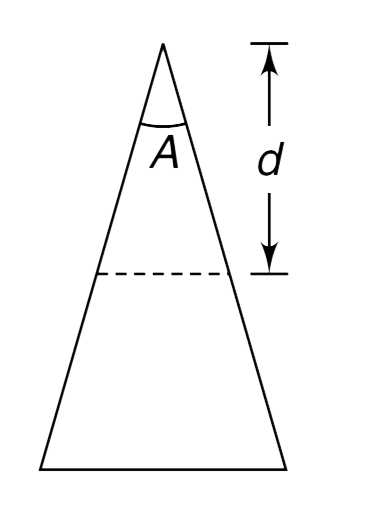
A very thin prism has an apex angle A and its material has refractive index` mu = 1.48` . Light is made to fall on one of the refracting faces at near normal incidence. Interference results from light reflected from the outer surface and that emerging after reflection at the inner surface. When violet light of wavelength `lambda "= 400 nm"` is used, the first construc- tive interference band is observed at a distance `"d = 3.0 cm"` from the apex of the prism.
(a) Find the apex angle A.
(b) If red light `(lambda" = 800 nm")` is used, at what distance from the apex will we observe the first constructive interfer- ence band.

Promotional Banner

Similar Questions

Explore conceptually related problems

A ray of light is incident normally on one of the refracting surfaces of a prism of refracting angle A,. The emergent ray grazes the other refracting surface. Find the refractive index of the material ofprism.

A ray of light is incident normally on one of the refracting surfaces of prism of refracting angle 60^@ . The emergent ray grazes the other refracting surface. The refractive index of the material of the prism is

The angle of a prism is A , One of its refracting surface is slivered . Light rays falling at an angle of incidence 2A on the first surface returns back through the same pathe after suffering reflection at the silvered surface. The refractive index mu of the prism is:

The angle of prism is 60^(@) and its refractive index is 1.5. There will be no emergent light if the angle of incidence on the first face is

An isosceles prism has one of the refracting surfaces silvered. A ray of light is incident normally on the refracting face AB. After two reflections, the ray emerges from the base of the prism perpendicular to it. Find the angle of the prism.

An isosceles prism has one of the refracting surfaces silvered. A ray of light is incident normally on the refracting face AB. After two reflections, the ray emerges from the base of the prism perpendicular to it. Find the angle of the prism.