

Home
Class 12
PHYSICS
Pull down in the middle a heavy chain, f...

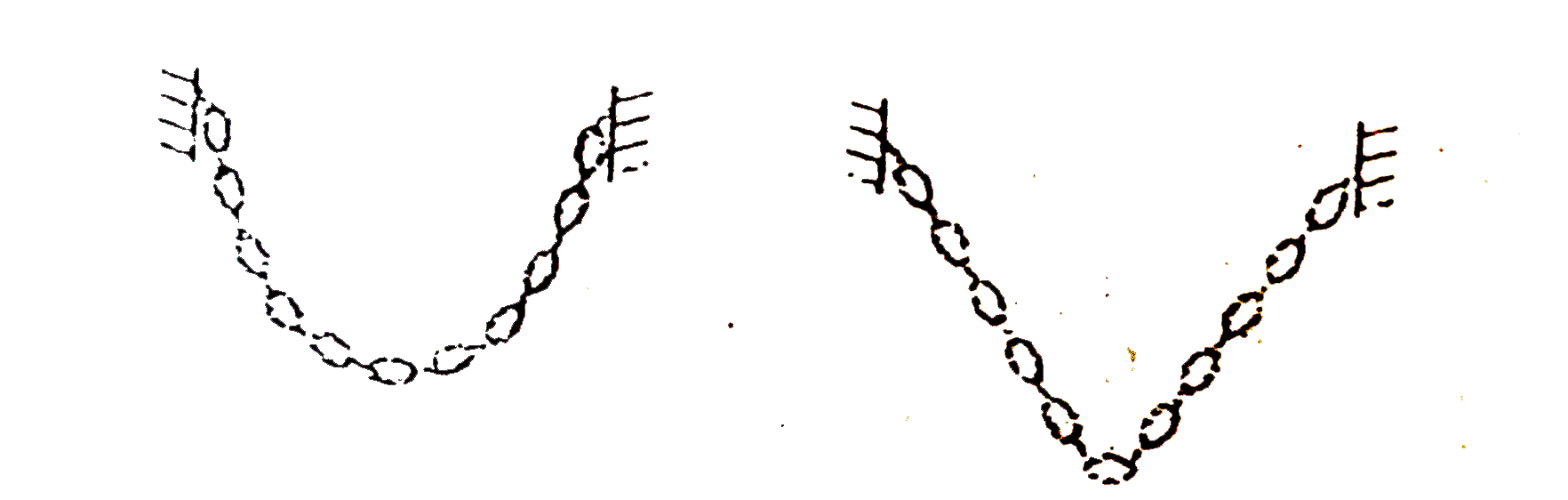
Pull down in the middle a heavy chain, fixed at both ends, in such a way that it forms a triangle. Does the centre of mass takes up a higher or lower position?

Promotional Banner

Similar Questions

Explore conceptually related problems

A rope of mass m is hung from a ceiling. The centre point is pulled down with a vertical force F. The tangent to the rope at its ends makes an angle alpha with horizontal ceiling. The two tangents at the lower point make an angle of theta with each other. Find theta .

A light rod of length l is pivoted at the upper end. Two masses (each m), are attached to the rod, one at the middle and the other at the free end. What horizontal velocity must be imparted to the lower end mass, so that the rod may just take up the horizontal position ?

A light rod of length l is pivoted at the upper end. Two masses (each m), are attached to the rod, one at the middle and the other at the free end. What horizontal velocity must be imparted to the lower end mass, so that the rod may just take up the horizontal position ?

A flexible rope is in the shape of a semicircle ACB with its centre at O. Ends A and B are fixed. Radius of the semicircle is R. The midpoint C is pulled so that the rope acquires V shape as shown in the figure. (a) Make a guess whether the centre of mass of the rope moves closer to O or moves away from it when it is pulled? (b) Calculate the shift in position of the centre of mass of the rope.

Two persons are pulling, the ends of a strong in such a way so that the string is stretched horizontally. When a weight of 10 kg is suspended in the middle of the string. The string does not remanin horizontal. Can the persons maken it horizontal again by pulling it with a greater force ?

Three identical metal balls, each of the radius r are placed touching each other on a horizontal surface such that an equilateral triangle is formed when centre of three balls are joined. Then where does their centre of mass?

A mass 2 m is fixed at one end of a light rod of length I . What horizontal velocity should be imparled to the lower end so that it may just take up the horizontal position ? If the mass is now rearanged with m at the lower end and the other m at the middle, what velocity is required ?