

Home
Class 12
PHYSICS
The breaking strength of the string conn...

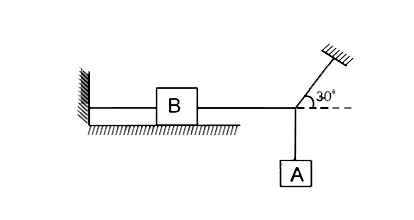
The breaking strength of the string connecting wall and block B is 175 N, find the magnitude of weight of block A for which the system will be stationary. The block B weighs 700 N.
`(g = 10 m//s^(2))`

Promotional Banner

Similar Questions

Explore conceptually related problems

Block B lying on a table weighs W. The coefficient of static between the back and the table is mu . Assume that the cord between B and the knot is horizontal. The maximum weight of the block A for which the system will be stationary is

Block B lying on a table weighs w. The coefficient of static friction between the block and the table is µ. Assume that the cord between B and the knot is horizontal. The maximum weight of the block A for which the system will be stationary is

Block B lying on a table weighs w. The coefficient of static friction between the block and the table is mu. Assume that the cord between B and the knot is horizontal. The maximum weight of the block A for which the system will be stationary is

A block is lying static on the floor.The maximum value of static frictional force on the block is 10N .If a horizontal force of 8N is applied to the block,what will be the frictional force on the block ________ (in N) (g = 10 m/s^(2))

Figure shows two block A and B , each having a mass of 320 g connected by a light string passing over a smooth light pulley. The horizontal surface on which the block A can slide is smooth. The block A is attached to spring constant 40 N//m whose other end is fixed to a support 40 cm above the horizontal surface. Initially, the spring is vertical and unstretched when the system is released to move. Find the velocity of the block A at the instant it breaks off the surface below it. Take g = 10 m//s^(2) .

Figure shows two block A and B , each having a mass of 320 g connected by a light string passing over a smooth light pulley. The horizontal surface on which the block A can slide is smooth. The block A is attached to spring constant 40 N//m whose other end is fixed to a support 40 cm above the horizontal surface. Initially, the spring is vertical and unstretched when the system is released to move. Find the velocity of the block A at the instant it breaks off the surface below it. Take g = 10 m//s^(2) .

Figure shows two block A and B , each having a mass of 320 g connected by a light string passing over a smooth light pulley. The horizontal surface on which the block A can slide is smooth. The block A is attached to spring constant 40 N//m whose other end is fixed to a support 40 cm above the horizontal surface. Initially, the spring is vertical and unstretched when the system is released to move. Find the velocity of the block A at the instant it breaks off the surface below it. Take g = 10 m//s^(2) .

An arrangement of the masses and pulleys is shown in the figure. Strings connecting masses A and B with pulley are horizontal and all pulleys and strings are light. Friction coefficient between the surface and the block B is 0.2 and between block A and B is 0.7 . The system is released from rest. (use g=10m//s^(2))