

Home
Class 11
PHYSICS
A glass tube of uniform internal radius(...

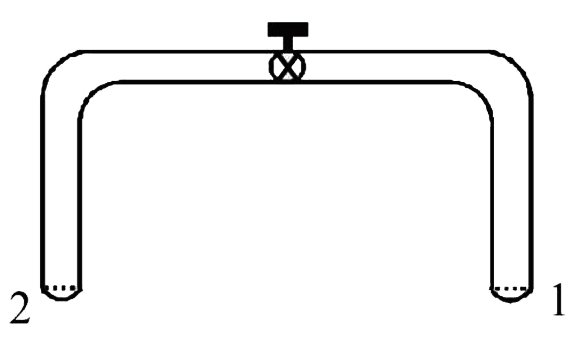
A glass tube of uniform internal radius(r) has a valve separating the two identical ends. Intially, the valve is in a tightly closed position. End 1 has a hemispherical soap bubble or radius r. End 2 has sub-hemispherical soap bubble as shown in figure. Just after opening the valve,

Promotional Banner

Similar Questions

Explore conceptually related problems

A glass tube of uniform internal radius (r) has a valve separating the two identical ends. Initially, the valve is in a tightly closed position. End 1 has a hemispherical soap bubble of radius r . End 2 has sub-hemispherical soap bubble as shown in figure. Just after opening the valve.

A glass tube of uniform internal radius (r) has a valve separating the two identical ends. Initially, the valve is in a tightly closed position. End 1 has a hemispherical soap bubble of radius r . End 2 has sub-hemispherical soap bubble as shown in figure. Just after opening the valve.

A glass tube of uniform internal radius ( R ) has a valve separating the two identical ends . Initially , the valve is in a tightly closed position . End 1 has hemispherical soap bubble of radius r. End 2 has sub-hemispherical soap bubble as shown in figure. just after opening the valve,

Two soap bubbles of radius R_1 and R_2 combine isothermally to form a new soap bubble. Find radius of new soap bubble

Two soap bubbles of radii r_(1) and r_(2) are attached as shown. Find the radius of curvature of the common film ACB.

Two soap bubbles with radius 2r and 3r come in contact. Their common surface has a radius of curvature nr , then find the value of n

Two spherical soap bubbles of radii r_1 and r_2 in vacuume collapse under isothermal condition. The resulting bubble has radius R such that