

Home
Class 11
PHYSICS
A block A has been placed symmetrically ...

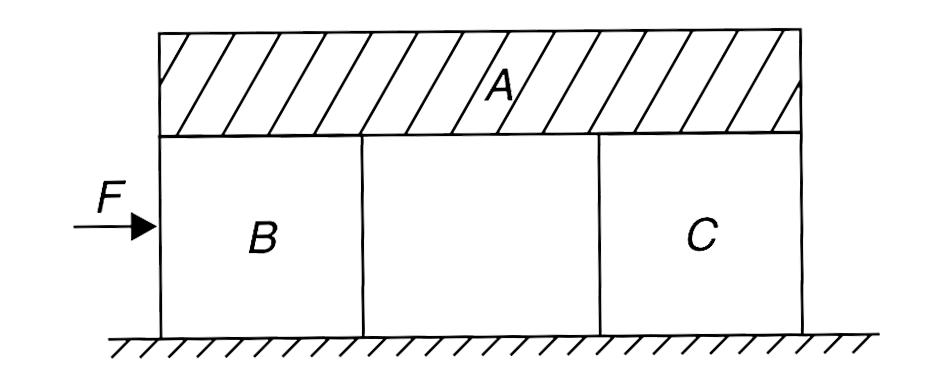
A block A has been placed symmetrically over two identical blocks B and C. All the three blocks have equal mass, M each, and the horizontal surface on which B and C are placed is smooth. The coefficient of friction between A and either of B and C is `mu`. The block A exerts equal pressure on B and C. A horizontal force F is applied to the block B.

(a) Find maximum value of F so that A does not slip on B or C and the three blocks move together.
(b) If F is increased beyond the maximum found in (a) where will we see slipping first- at contact of A and B or at the contact of A and C.
(c) If F is kept half the maximum found in (a), calculate the ratio of friction force between A and B to that between A and C. Does this ratio change if F is decreased further?

Promotional Banner

Similar Questions

Explore conceptually related problems

A 2kg block is placed over a 5kg block and both are placed on a smooth horizontal surface. The coefficient of friction between the blocks is 0.10. Find the acceleration of the two blocks if a horizontal force of 14N is applied to the upper block (g = 10ms^(-2) ).

A 2kg block is placed over a 5kg block and both are placed on a smooth horizontal surface. The coefficient of friction between the blocks is 0.10. Find the acceleration of the two blocks if a horizontal force of 14N is applied to the upper block (g = 10ms^(-2) ).

A 2kg block is placed over a 4kg block and both are placed on a smooth horizontal surface. The coefficient of friction between the blocks is 0.20. The acceleration of the two blocks if a horizontal force of 12N is applied to the lower block is (g= 10 ms^(-2))

A block A of mass 2 kg is placed over smooth block B of mass 4 kg which is placed over a smooth horizontal floor The coefficient of friction between A and B is 0.4 when a horizontal forces of magnitude 10 N is applied on A the acceleration of block of A and B are