

Home
Class 11
PHYSICS
Two light vertical springs with equal na...

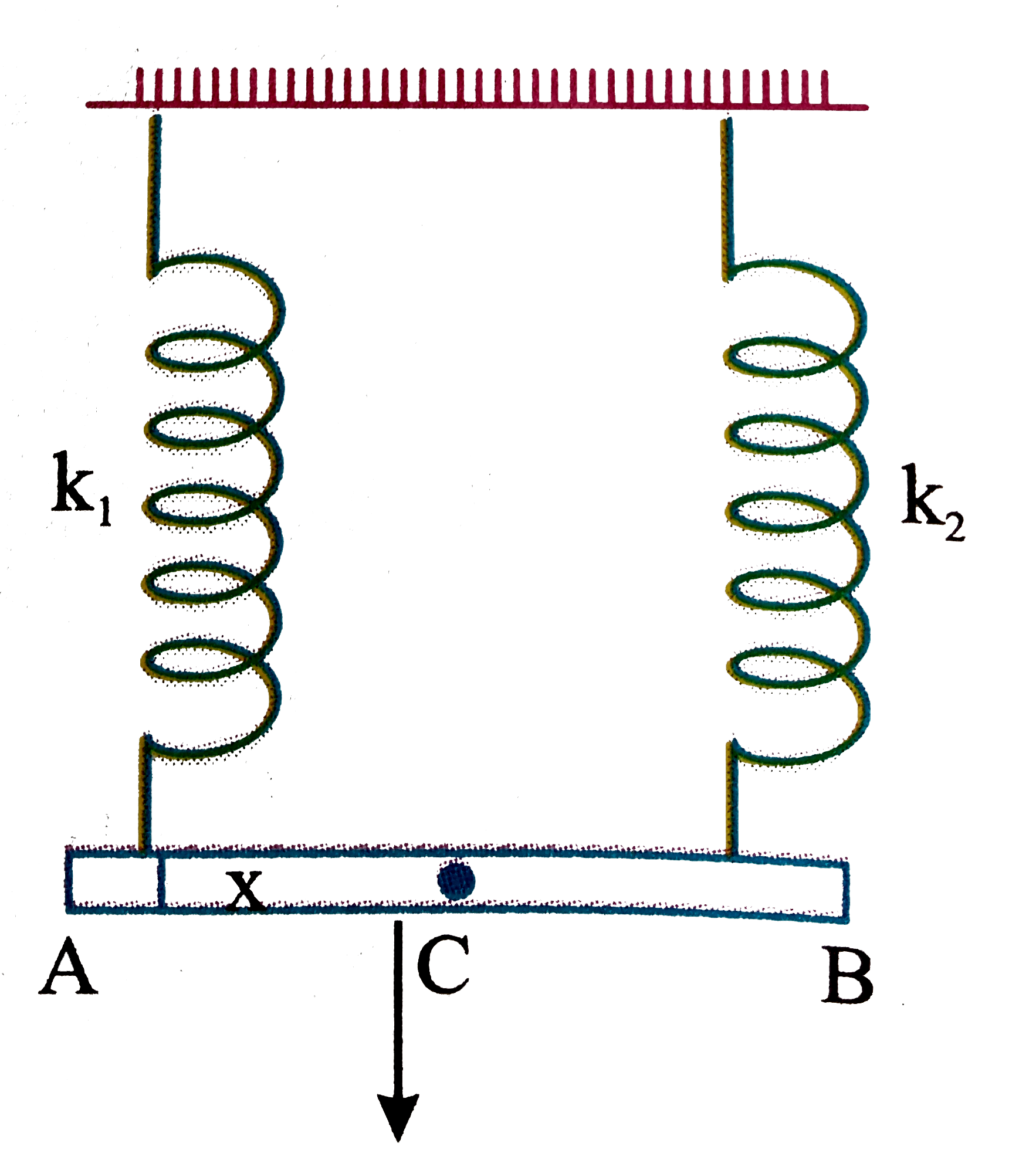
Two light vertical springs with equal natural length and spring constants `k_(1)` and `k_(2)` are separated by a distance`l`. Their upper end the ends `A` and `B` of a light horizontal rod `AB`. A vertical downwards force `F` is applied at point `C` on the rod. `AB` will remain horizontal in equilibrium if the distance `AC` is

Promotional Banner

Similar Questions

Explore conceptually related problems

Two light vertical springs with equal natural length and spring constants k_(1) and k_(2) are separated by a distance l . Their upper ends are rigidly connected and the lower ends are connected to A and B of a light horizontal rod AB . A vertically downwards force F is applied at point C on the rod. AB will remain horizontal in equilibrium if the distance AC is

Two ideal springs of same make (the springs differ in their lengths only) have been suspended from points A and B such that their free ends C and D are at same horizontal level. A massless rod PQ is attached to the ends of the springs. A block of mass m is attached to the rod at point R. The rod remains horizontal in equilibrium. Now the block is pulled down and released. It performs vertical oscillations with time period T =2 pi sqrt((m)/(3k)) where k is the force constant of the longer spring. (a) Find the ratio of length RC and RD. (b) Find the difference in heights of point A and B if it is given that natural length of spring BD is L.

One end a light spring of natural length d and spring constant k ( = mg //d) is fixed on a rigid support and the other end is fixed to a smoth ring of mass m which can slide without friction on a vertical rod fixed at a distance d from the support. Initially , the spring makes an angle of 37^(@) with the horizontal as shown in the figure. The system is released from rest. The speed of the ring at the same angle subtended downward will be

One end a light spring of natural length d and spring constant k ( = mg //d) is fixed on a rigid support and the other end is fixed to a smoth ring of mass m which can slide without friction on a vertical rod fixed at a distance d from the support. Initially , the spring makes an angle of 37^(@) with the horizontal as shown in the figure. The system is released from rest. The speed of the ring at the same angle subtended downward will be

two light identical springs of spring constant K are attached horizontally at the two ends of a uniform horizontal rod AB of length l and mass m. the rod is pivoted at its centre 'o' and can rotate freely in horizontal plane . The other ends of the two springs are fixed to rigid supportss as shown in figure . the rod is gently pushed through a small angle and released , the frequency of resulting oscillation is :

two light identical springs of spring constant K are attached horizontally at the two ends of a uniform horizontal rod AB of length l and mass m. the rod is pivoted at its centre 'o' and can rotate freely in horizontal plane . The other ends of the two springs are fixed to rigid supportss as shown in figure . the rod is gently pushed through a small angle and released , the frequency of resulting oscillation is :

A ring of mass m is attached to a horizontal spring of spring constant k and natural length l_0 . The other end of the spring is fixed and the ring can slide on a horizontal rod as shown. Now the ring is shifted to position B and released Find the speed of the ring when the spring attains its natural length.

A uniform rod AB hinged about a fixed point P is initially vertical. A rod is released from vertical position. When rod is in horizontal position: The acceleration of end B of the rod is

A uniform rod AB hinged about a fixed point P is initially vertical. A rod is released from vertical position. When rod is in horizontal position: The acceleration of end B of the rod is