

Home
Class 12
PHYSICS
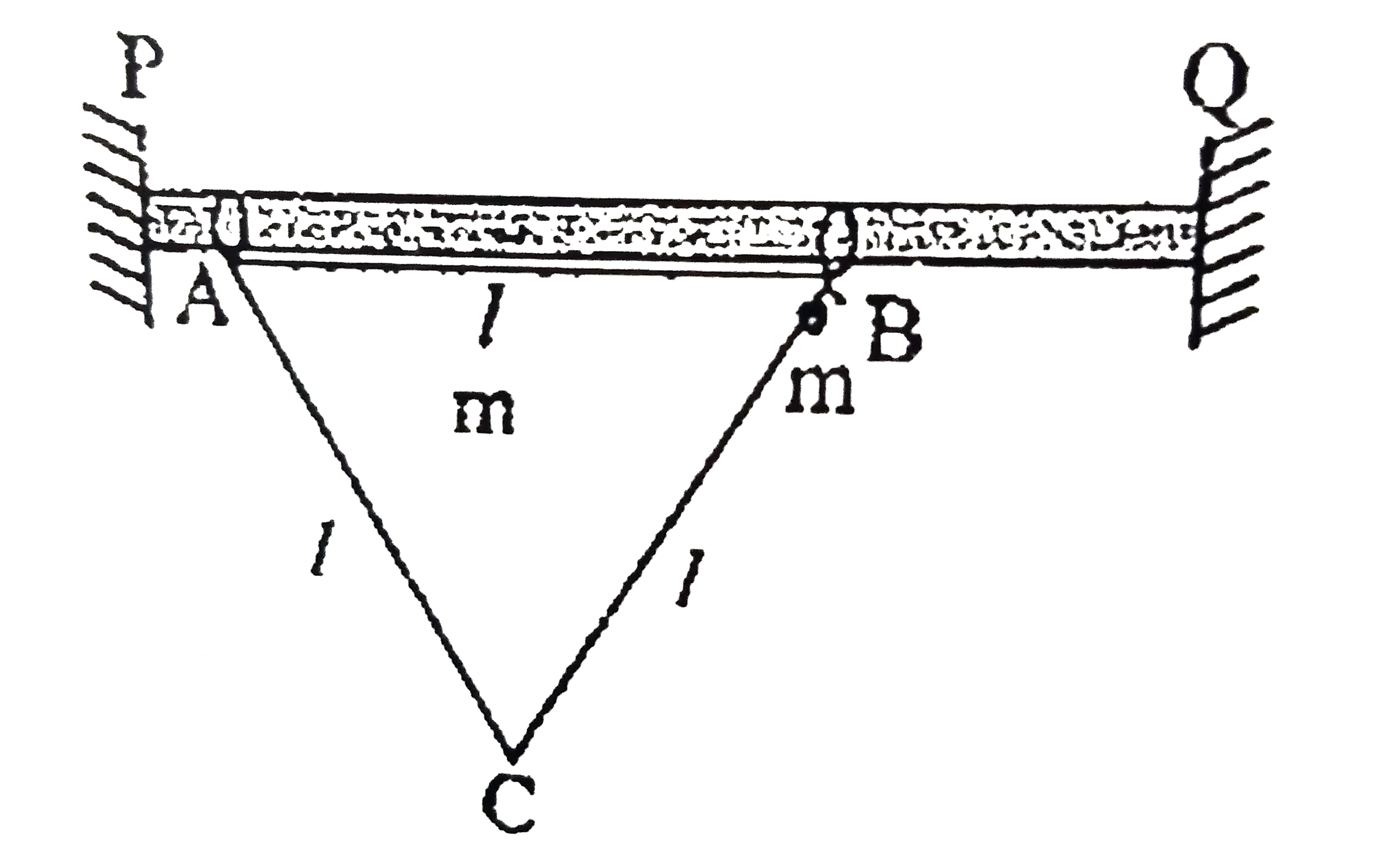
A rigid triangular frame ABC of mass m i...

A rigid triangular frame ABC of mass m is hanging from a rigid horizontal rod PQ. The frame is constrained to move along horizontal without friction. A bead of mass m is released from B that moves along BC. Displacement of frame when bead reaches C is

Promotional Banner

Similar Questions

Explore conceptually related problems

A heavy mass m slides down a triangular prism of mass M . The prism lies on a horizontal surface and can move along it without friction . What will be the direction of motion of m if the inclination of the hypotenuse of the prism is alpha with the horizontal ?

A man of mass m is standing on a stationary flat car of mass M. The car can move without friction along horizontal rails. The man starts walking with velocity v relative to the car. Work done by him

A man of mass m is standing on a stationary flat car of mass M. The car can move without friction along horizontal rails. The man starts walking with velocity v relative to the car. Work done by him

Three massless rods are fixed to form a right angled triangular frame such that AB=BC=1 . Two identical small objects of mass m are fixed at A and C . The frame is hinged about B such that the frame can rotate in vertical plane about an horizontal axis without friction. Initially AB is vertical and BC is horizontal and the system is released from rest. The magnitude of acceleration of mass A when the rod AC becomes horizontal is

Three massless rods are fixed to form a right angled triangular frame such that AB=BC=1 . Two identical small objects of mass m are fixed at A and C . The frame is hinged about B such that the frame can rotate in vertical plane about an horizontal axis without friction. Initially AB is vertical and BC is horizontal and the system is released from rest. The magnitude of acceleration of mass A when the rod AC becomes horizontal is

Three massless rods are fixed to form a right angled triangular frame such that AB=BC=1 . Two identical small objects of mass m are fixed at A and C . The frame is hinged about B such that the frame can rotate in vertical plane about an horizontal axis without friction. Initially AB is vertical and BC is horizontal and the system is released from rest. Tension in the rod AC when it (rod AC) becomes horizontal is

Three massless rods are fixed to form a right angled triangular frame such that AB=BC=1 . Two identical small objects of mass m are fixed at A and C . The frame is hinged about B such that the frame can rotate in vertical plane about an horizontal axis without friction. Initially AB is vertical and BC is horizontal and the system is released from rest. Tension in the rod AC when it (rod AC) becomes horizontal is

A semicircular wire frame of radius R is standing vertical on a horizontal table. It is pulled horizontally towards right with a constant acceleration. A bead of mass m remain in equilibrium (relative to the semicircular wire) at a position where radius makes an angle q with horizontal. There is no friction between the wire and the bead. The bead is displaced a little bit in upward direction and released. Calculate the speed of the bead relative to the wire at the instant it strikes the table. Assume that all throughout the semicircular wire keeps moving with constant acceleration.