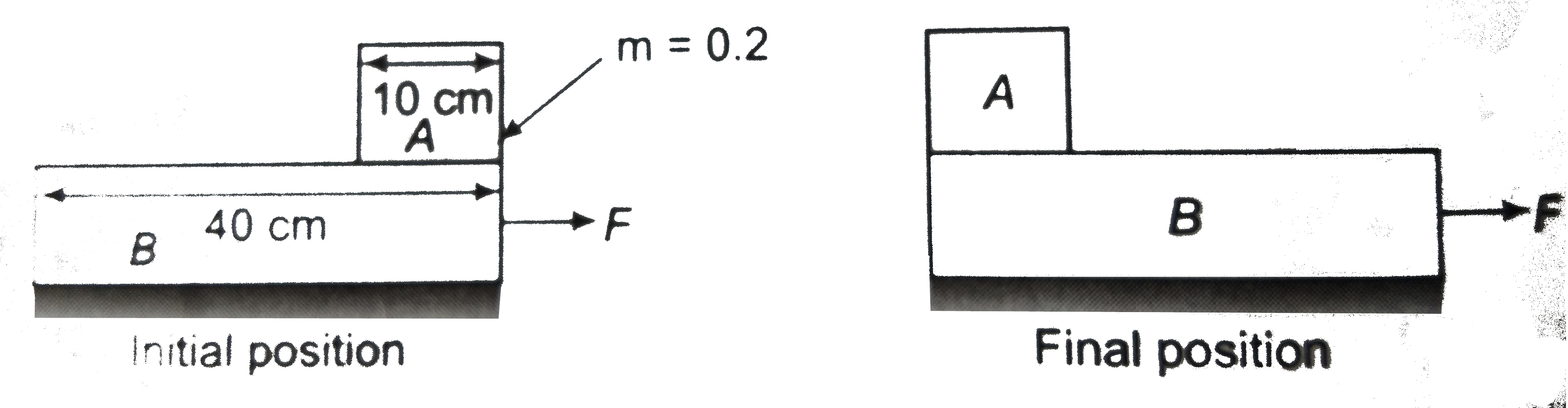
 ,
, 


Similar Questions
Explore conceptually related problems
Recommended Questions
- A block (A) of mass 45kg is placed on another block (B) of mass 123 gk...
Text Solution
|
- A small block B is placed on another block A of mass 5 kg and length ...
Text Solution
|
- A block (A) of mass 45kg is placed on another block (B) of mass 123 gk...
Text Solution
|
- Find the acceleration of block B as shown in fig. (a) and (b) relative...
Text Solution
|
- A block of mass m is placed on the block of mass M as shown in figure....
Text Solution
|
- Three blocks are initially placed as shown in the figure. Block A has ...
Text Solution
|
- Find the acceleration of the block B as shown in figure- 1.95 (a) and ...
Text Solution
|
- Assertion: In the figure shown, linear momentum of system (of blocks A...
Text Solution
|
- A block A slides over an another block B which is placed over a smooth...
Text Solution
|