

Home
Class 12
PHYSICS
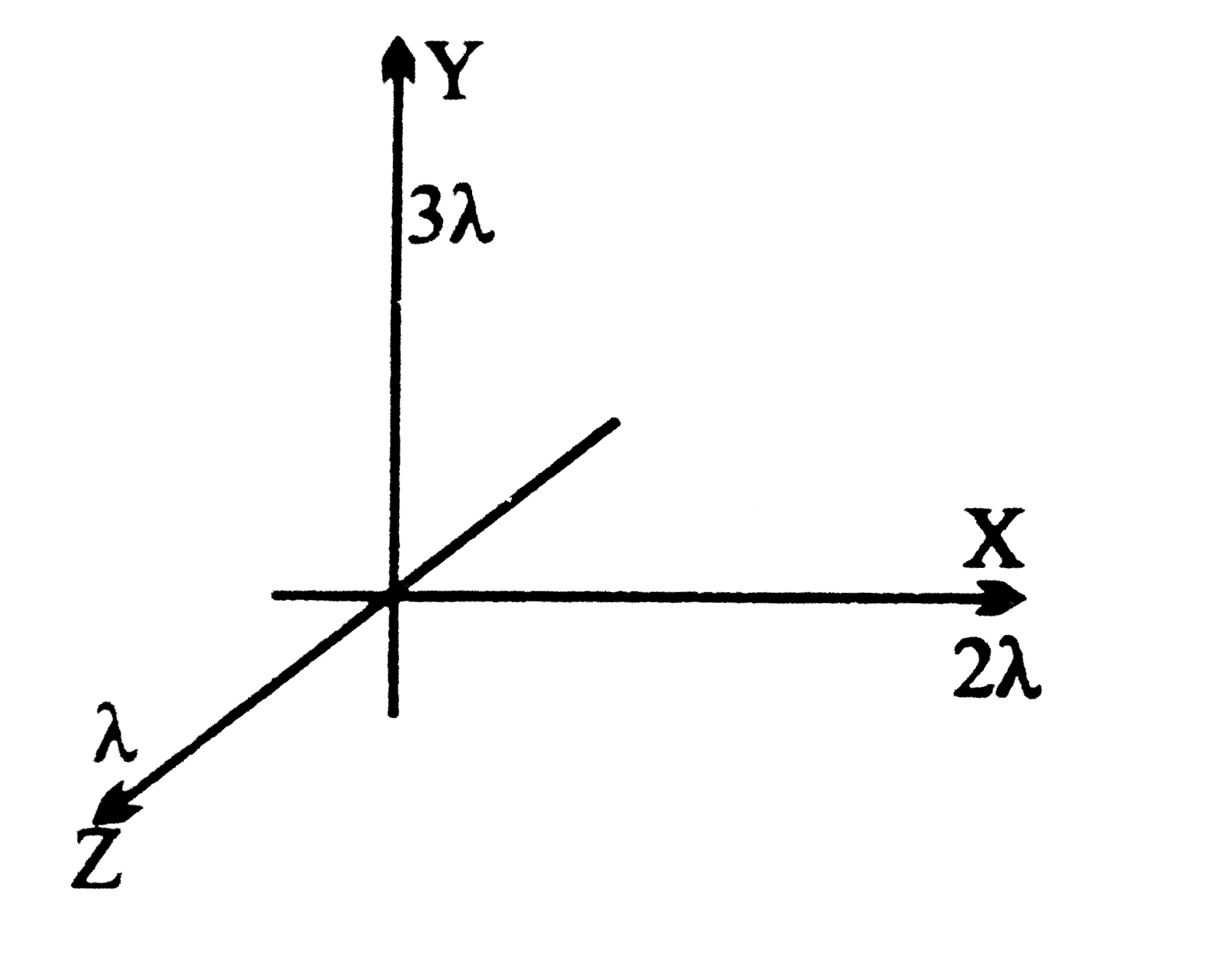
The diagram shows three infinitely long ...

The diagram shows three infinitely long uniform line charges placed on the `X, Y` and ` Z` axis . The word done in moving a unit positive charge from (1,1,1) to (2 , 1,1,) is equal to
.

Promotional Banner

Similar Questions

Explore conceptually related problems

The diagram shows three infinitely long uniform line charges placed on the X, Y and Z axis . The word done in moving a unit positive charge from (1,1,1) to (0 , 1,1,) is equal to .

The diagram shows three infinitely long uniform line charges placed on the X, Y and Z axis . The work done in moving a unit positive charge from (1,1,1) to (2 , 1,1,) is equal to .

The diagram shows three infinitely long uniform line charges placed on the X, Y and Z axis . The work done in moving a unit positive charge from (1,1,1) to (0 , 1,1,) is equal to .

An infinite line of charge lamda per unit length is placed along the y-axis. The work done in moving a charge q from A(a,0) to B (2a,0) is

An infinite line of charge lamda per unit length is placed along the y-axis. The work done in moving a charge q from A(a,0) to B (2a,0) is

Find the electric field vector at P (a,a,a) due to three infinitely long lines of charges along the x-, y- and z-axis, respectively. The charge density i.e. charge per unit length of each wire is (lamba) ,

Find the electric field vector at P (a,a,a) due to three infinitely long lines of charges along the x-, y- and z-axis, respectively. The charge density i.e. charge per unit length of each wire is (lambda) ,

A dipole of 2muC charges each, consists of the positive charge at the point P (1, -1) and the negative charge is placed at the point Q(-1, 1). The work done in displacing a charge of +1muC from point A(-3,-3) to B (4, 4) is

A dipole of 2muC charges each, consists of the positive charge at the point P (1, -1) and the negative charge is placed at the point Q(-1, 1). The work done in displacing a charge of +1muC from point A(-3,-3) to B (4, 4) is