

Home
Class 12
PHYSICS
A system consists of block A and B each ...

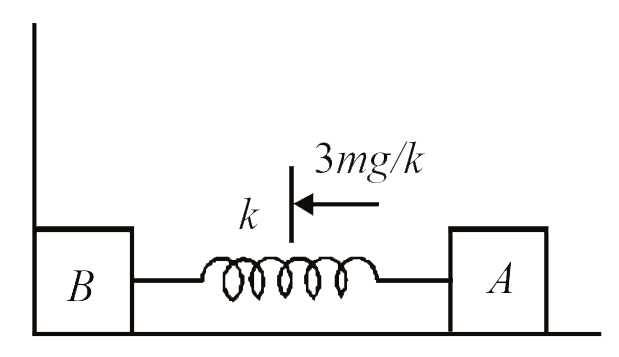
A system consists of block A and B each of mass m connected by a light spring as shown in the figure with block B in contact with a wall. The block A compresses the spring by 3mg/k from natural length of spring and then released from rest. Neglect friction anywhere

Acceleration of centre of mass of system comprising A and B just after A is released is

Promotional Banner

Similar Questions

Explore conceptually related problems

A system consists of block A and B each of mass m connected by a light spring as shown in the figure with block B in contact with a wall. The block A compresses the spring by 3mg/k from natural length of spring and then released from rest. Neglect friction anywhere. Velocity of centre of mass of system comprising A and B when block B just loses contact with the wall

A system consists of block A and B each of mass m connected by a light spring as shown in the figure with block B in contact with a wall. The block A compresses the spring by 3mg/k from natural length of spring and then released from rest. Neglect friction anywhere. Velocity of centre of mass of system comprising A and B when block B just loses contact with the wall

A system consists of block A and B each of mass m connected by a light spring as shown in the figure with block B in contact with a wall. The block A compresses the spring by 3mg/k from natural length of spring and then released from rest. Neglect friction anywhere. Maximum extension in the spring after system loses contact with wall

Two blocks A and B of mass m and 2m are connected together by a light spring of stiffness k . The system is lying on a smooth horizontal surface with block A in contact with a fixed vertical wall as shown in the figure. The block B is pressed towards the wall by a distance x_0 and then released. There is not friction anywhere. If spring takes time Deltat to aquire its natural length then average force on the block A by the wall is

Two blocks A and B of mass m and 2m are connected together by a light spring of stiffness k . The system is lying on a smooth horizontal surface with block A in contact with a fixed vertical wall as shown in the figure. The block B is pressed towards the wall by a distance x_0 and then released. There is not friction anywhere. If spring takes time Deltat to aquire its natural length then average force on the block A by the wall is

The system of the wedge and the block connected by a massless spring as shown in the figure is released with the spring in its natural length. Friction is absent. Maximum elongation in the spring will be

A block of mass m is placed on a smooth block of mass M = m with the help of a spring as shown in the figure. A velocity v_(0) is given to upper block when spring is in natural length. Find maximum compression in the spring.

Two blocks of masses m and m' are connected by a light spring on a horizontal frictionless table . The spring is compressed and then released . Find the ratio of acceleration of masses .

Two blocks of masses m and m' are connected by a light spring on a horizontal frictionless table . The spring is compressed and then released . Find the ratio of acceleration of masses .