

Home
Class 12
PHYSICS
A small coil C with N = 200 turns is mo...

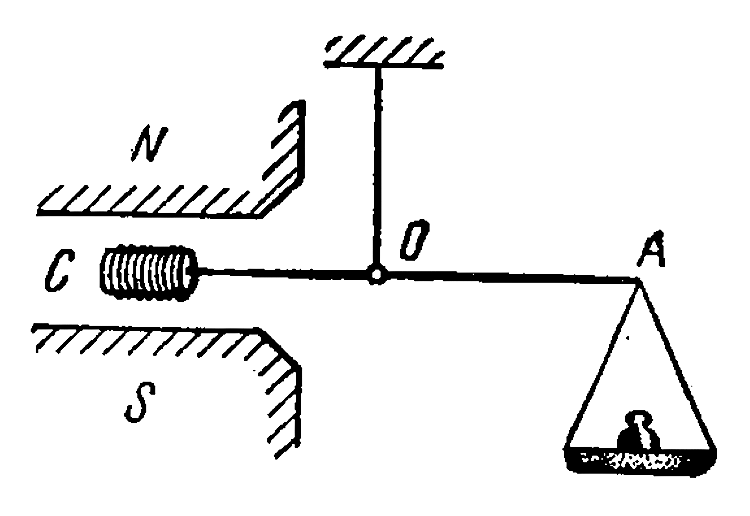
A small coil `C` with N = 200 turns is mounted on one end of a balance beam and introduced between the poles of an electromagnet as shown in Fig. The cross sectinal area of the coil is `S = 1.0 cm^(2)`, the length of the arm `OA` of the balance beam is `l = 30 cm`. When there is no current in the coil the balance is irl equilibrium. On passing a current `I = 22 mA` through the coil the equiibrium is restroed by putting the additional counterweight of mass `Delta m = 60 mg` ont he balnace pan. Find the magnetic induction at the spot where the coil is located.

Promotional Banner

Similar Questions

Explore conceptually related problems

A small coil C with N=200 turns is mounted on one end of a balance beam and introduced between the poles of an electromagnet as shown in figure. The cross sectional area of coil is A=1.0 cm^(2) , length of arm OA of the balance beam is l=30 cm . When there is no current in the coil the balance is in equilibrium. On passing a current I=22 mA through the coil the equilibrium is restored by putting the additional counter weight of mass Deltam=60 mg on the balance pan. Find the magnetic induction at the spot where coil is located.

A small coil C with N = 100 turns is mounted on one end of a balance beam and introduced between the poles of an electromagnet as shown in the figure. The cross-sectional area of coil is A = 1.0 cm^(2) , length of arm OA of the balance beam is l = 20 cm. When there is no current in the coil, the balance is in equilibrium. On passing a current i = 18 mA through the coil, the equilibrium is restored by putting the additional counter weight of mass Delta m = 40 mg on the balance pan. Find the magnetic induction at the spot where coil is located.

A small coil C with N=200 turns is mounted on one end of a balance beam and introduced between the poles of an electromagnetic as shown in Fig. The area of the coils is S=1cm^2 , the length of the right arm of the balance beam is l=30cm. When there is no current in the coil the balance is in equilibrium. On passing is a currentI=22mA through the coil, equilibrium is restored by putting an additional weight of mass m=60mg on the balance pan. Find the magnetic induction field (in terms of x 10^-1T ) between the poles of the electromagnetic assuming it to be uniform.

A small coil C with N=200 turns is mounted on one end of a balance beam and introduced between the poles of an electromagnetic as shown in Fig. The area of the coils is S=1cm^2 , the length of the right arm of the balance beam is l=30cm. When there is no current in the coil the balance is in equilibrium. On passing is a currentI=22mA through the coil, equilibrium is restored by putting an additional weight of mass m=60mg on the balance pan. Find the magnetic induction field (in terms of x 10^-1T ) between the poles of the electromagnetic assuming it to be uniform.

When can a beam balance have static equilibrium?

A small coil is introduced between the poles of an electromagnet so that its axis coincides with the magnetic field direction. The cross-sectional area of the coil is equal to S = 3.0 mm^2 , the number of turns is N = 60 . When the coil turns through 180^@ about its diameter, a galvanometer connected to the coil indicates a charge q = 4.5muC flowing through it. Find the magnetic induction magnitude between the poles, provided the total resistance of the electric circuit equals R = 40 Omega .

A small coil is introduced between the poles of an electromagnet so that its axis coincides with the magnetic field direction. The cross-sectional area of the coil is equal to S = 3.0 mm^2 , the number of turns is N = 60 . When the coil turns through 180^@ about its diameter, a galvanometer connected to the coil indicates a charge q = 4.5muC flowing through it. Find the magnetic induction magnitude between the poles, provided the total resistance of the electric circuit equals R = 40 Omega .

In an experiment with a beam balance, an unknown mass m is balanced by two known masses of 16 kg and 4 kg shown in Fig. The value of the unknown mass m is

In an experiment with a beam balance, an unknown mass m is balanced by two known masses of 16 kg and 4 kg shown in Fig. The value of the unknown mass m is