Home
Class 12
PHYSICS
A metallic rod of 1 m length is rotated ...

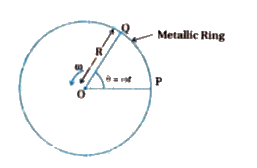
A metallic rod of 1 m length is rotated with a frequency of 50 rev/s, with one end hinged at the centre and the other end at the circumference of a circular metallic ring of radius 1 m, about an axis passing through the centre and perpendicular to the plane of the ring as per figure. A constant and uniform magnetic field of 1T parallel to the axis is present everywhere. What is the emf between the centre and the metallic ring ?

Text Solution

Verified by Experts
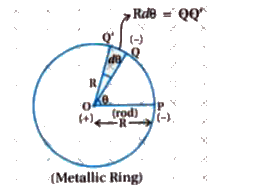

Consider uniform magnetic field `vecB(x)`, perpendicularly inside the plane of figure. Also consider a metallic ring of radius R whose plane is perpendicular to `vecB`. There is a conducting rod (OQ) of length R, with its one end hinged at O (centre of ring) and another end in contact with the ring. Suppose, this rod rotates anticlockwise with constant angular speed `omega` . Because of this motion of rod, free electrons in it acquire velocity `vecv bot vecB` and hence they are exerted upon by magnetic force `vecF_m=e (vecBxxvecv)` in a direction from centre to outer end. Hence, free electrons in the rod start displacing away from centre, making centre positive and outer end negative. After some time when electric force `vecF_e` exerted on free electrons becomes equal and opposite to magnetic force `vecF_m`, a steady state is reached when Lorentz force exerted on electrons becomes zero. At this stage, we get maximum induced emf across the two ends of rod (or between centre and periphery of ring). Let this emf be `epsilon` whose formula can be derived as follows.
Across the elemental length dr of rod chosen at distance r from centre if induced emf is `depsilon` then according to formula of motional emf we can write,
`d epsilon=Bvdr`
`therefore depsilon=B(romega)dr`
`therefore` Total induced emf across the rod will be ,
`epsilon= intd epsilon`
`=intB(romega)dr`
`=Bomega int_0^R r dr`
`therefore epsilon= Bomega{r^2/2}_0^R`
`therefore epsilon=1/2BomegaR^2`
Second Method : In above figure, suppose the rod rotates by extremely small angle `d theta` in time dt. Here, length of arc `Q Q. = Rd theta`. Now, area traversed (or swept) by rod in time dt would be
`dA=1/2` (base)(height)
`=1/2(R)(R d theta)`
`dA=1/2R^2 d theta`
Magnetic flux cut by the rod in time dt is ,
`d phi=B (dA)`
`therefore d phi=B(1/2R^2 d theta)`
`therefore (dphi)/(dt)=1/2BR^2 (d theta)/(dt)`
`therefore (dphi)/(dt)=1/2BR^2 omega` (`because omega=(d theta)/(dt)` = constant angular speed of rod )
Now, induced emf across the rod will be ,
`epsilon=-(dphi)/(dt)`
`therefore epsilon=-1/2 BomegaR^2`
`therefore |epsilon|=1/2BomegaR^2`
Third Method :
At time t=0 , `epsilon_1=0 ( because v=0 rArr epsilon= Bvl=0)`
At time t=t, `epsilon_2=Bvl` ( `because` For l=R, `(v=R omega)`)
`=B(R omega)R`
`epsilon_2=BomegaR^2`
`therefore` Average induced emf
`lt epsilon gt = (epsilon_1+epsilon_2)/2=(0+BomegaR^2)/2`
`therefore lt epsilon gt =1/2 B omegaR^2`
Now , value of induced emf across the rod in the present situation will be ,
`epsilon=1/2 B omegaR^2`
`=1/2B(2pif)R^2`(`because omega = 2pif` where f=frequency of rotation)
`=(1)(3.14)(50)(1)^2`
`therefore epsilon`=157 V
Promotional Banner

Topper's Solved these Questions

  • ELECTROMAGNETIC INDUCTION

    KUMAR PRAKASHAN|Exercise Section B (Numerical) Numerical From Textual Exercise|17 Videos
  • ELECTROMAGNETIC INDUCTION

    KUMAR PRAKASHAN|Exercise Section B (Numerical) Numerical From DARPAN Based on Textbook|10 Videos
  • ELECTROMAGNETIC INDUCTION

    KUMAR PRAKASHAN|Exercise Section A HOTS|2 Videos
  • ELECTRIC CHARGES AND FIELDS

    KUMAR PRAKASHAN|Exercise SECTION D MCQS ASKED IN COMPETITIVE EXAMES (MCQS AKSED IN BOARD EXAM AND GUJCET)|14 Videos
  • ELECTROMAGNETIC WAVES

    KUMAR PRAKASHAN|Exercise BOARD.S QUESTION PAPER MARCH - 2020 (PART - B) SECTION - C|5 Videos

Similar Questions

Explore conceptually related problems

A metallic rod of 1 m length is rotated with a frequency of 50 rev/s, with one end hinged at the centre and the other end at the circumference of a circular metallic ring of radius 1 m, about an axis passing through the centre and perpendicular to the plane of the ring (Fig.). A constant and uniform magnetic field of 1 T parallel to the axis is present everywhere. What is the emf between the centre and the metallic ring?

Find the moment of inertia of ring about an axis passing through the centre and perpendicular to its plane.

A circular disc of radius r and mass m rotates about the axis passing through the centre and perpendicular to its plane. What will if rotational kinetic energy?

Find the moment of inertia of a uniform circular disc about an axis passing through its geometrical centre and perpendicular to its plane and radius of gyration.

A uniform equilateral triangular lamina of side a has mass m. Its moment of inertia about the axis passing through the centroid and perpendicular to the plane of the lamina is :-

A 1.0 m long metallic rod is rotated with an angular frequency of "400 rad s"^(-1) about an axis normal to the rod passing through its one end. The other end of the rod is in contact with a circular metallic ring. A constant and uniform magnetic field of 0.5 T parallel to the axis exists everywhere. Calculate the emf developed between the centre and the ring.

Find the moment of inertia and radius of gyration of uniform cross-section rod of mass 4 kg and length 90 cm about an axis through one end and perpendicular to the length of rod.

Three rods each of mass m and length l are joined together to form an equilateral triangle as shown in figure. Find the moment of inertial of the system about an axis passig through its centre of mass and perpendicular to the plane of the particle.

Find the moment of inertia of thin and massless rod about an axis passing through its centre of mass of rod and pair of mass is suspended on both end of this rod.

KUMAR PRAKASHAN-ELECTROMAGNETIC INDUCTION-Section B (Numerical) Textual Illustrations
  1. Figure shows planar loops of different shapes moving out of or into a ...

    Text Solution

    |

  2. (a) A closed loop is held stationary in the magnetic field between the...

    Text Solution

    |

  3. A metallic rod of 1 m length is rotated with a frequency of 50 rev/s, ...

    Text Solution

    |

  4. A wheel with 10 metallic spokes each 0.5 m long is rotated with a spee...

    Text Solution

    |

  5. Refer to figure the arm PQ of the rectangular conductor is moved from ...

    Text Solution

    |

  6. Two concentric circular coils, one of small radius r1 and the other of...

    Text Solution

    |

  7. (a)Obtain the expression for the magnetic energy stored in a solenoid ...

    Text Solution

    |

  8. Kamla peddles a stationary bicycle. The pedals of the bicycle are atta...

    Text Solution

    |

  9. A square loop of side 10 cm and resistance 0.5 Omega is placed vertica...

    Text Solution

    |

  10. A square loop of side 10 cm and resistance 0.5 Omega is placed vertica...

    Text Solution

    |

  11. A circular coil of radius 10 cm, 500 turns and resistance 2Omega is pl...

    Text Solution

    |

  12. A circular coil of radius 20 cm, 500 turns and resistance 4Omega is p...

    Text Solution

    |

  13. A wheel of radius r having conducting rim and n no. of conducting spok...

    Text Solution

    |

  14. One metallic ring of radius 2 m has a conducting rod connected between...

    Text Solution

    |

  15. One metallic ring of radius 1 m has a conducting rod connected between...

    Text Solution

    |

  16. A wheel with 100 metallic spokes each 1 m long is rotated with a speed...

    Text Solution

    |

  17. A wheel with 10 metallic spokes each 1 m long is rotated with a speed ...

    Text Solution

    |

  18. One U shaped conducting frame is placed in a plane perpendicular to un...

    Text Solution

    |

  19. As shown in the figure, a conducting rod of length I, mass m and resis...

    Text Solution

    |

  20. One extremely small and another extremely big square frames are coplan...

    Text Solution

    |

