Home
Class 12
PHYSICS
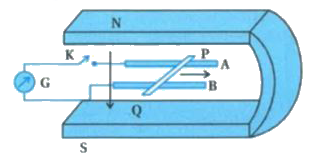
Figure shows a metal rod PQ resting on t...

Figure shows a metal rod PQ resting on the smooth rails AB and positioned between the poles of a permanent magnet. The rails, the rod, and the magnetic field are in three mutual perpendicular directions. A galvanometer G connects the rails through a switch K. Length of the rod =15 cm, B =0.50 T, resistance of the closed loop containing the rod 9.0 m`Omega`. Assume the field to be uniform.
(a) Suppose K is open and the rod is moved with a speed of `12 "cm s"^(-1)` in the direction shown. Give the polarity and magnitude of the induced emf.

(b) Is there an excess charge built up at the ends of the rods when K is open ? What if K is closed ?
(c) With K open and the rod moving uniformly, there is no net force on the electrons in the rod PQ even though they do experience magnetic force due to the motion of the rod. Explain.
(d) What is the retarding force on the rod when K is closed ?
How much power is required (by an external agent) to keep the rod moving at the same speed (= 12 cm `s^(-1)`) when K is closed ? How much power is required when K is open?
(f)How much power is dissipated as heat in the closed circuit ? What is the source of this power ?
(g) What is the induced emf in the moving rod if the magnetic field is parallel to the rails instead of being perpendicular ?

Text Solution

Verified by Experts

(a)Here `vecB bot vecv bot vecl` and so induced emf is ,
`epsilon=Bvl`
=(0.5)(0.12)(0.15)
`therefore epsilon=9xx10^(-3)` V
Here along with the motion of rod, free electrons acquire velocity `vecv` towards right. Magnetic field `vecB` is vertically downward. Now, magnetic force exerted on the free electrons in the rod is `vecF_m=e(vecBxxvecv)` which is in the direction from P to Q. Hence end P of rod will become positive and end Q of rod will become negative because electrons displace from P to Q.
(b) When K is open, induced charge gets accumulated more and more across the two ends P and Q of moving rod, till equilibrium is reached. Here, there is no induced current.
When K is closed, excess charge at Pand Q is steadily maintained by the continuous flow of induced current.
(c) After the induced emf reaches its maximum value `epsilon` = Bvl, electric force `F_e = eE` (from Q to P) and magnetic force `F_m` = Bev (from P to Q) become equal in magnitude and opposite in direction. Hence, there is no net force on the electrons in the rod. Here `F_m` =Bev is constant in magnitude but `F_e = eE` goes on increasing because of increase in E (Because of increase in p.d. across the rod). Finally when `F_e = F_m`, net force on the electron becomes zero.
(d) Here retarding force (also known as Lenz.s force) is given by Ampere.s law,
`vecF=I(veclxxvecB)`
Direction of above force is opposite to `vecv` (velocity of rod)
`therefore F=IlBsin90^@ " " (because vecl bot vecB)`
`=(epsilon/R)lB`
`=(9xx10^(-3))/(9xx10^(-3))xx0.15xx0.5`
`therefore` F=0.075 N
(e) For making velocity of rod constant mechanical power required is equal to electrical power (assuming no resistance provided by the rails on the rod)
`therefore P_m=P_e`
`=epsilon^2/R`
`=(9xx10^(-3))^2/(9xx10^(-3))`
`=9xx10^(-3)` W
If K is open and if rails offer no resistance then no power is required to keep the rod moving with constant velocity.
(f) In the absence of friction, power dissipated in the form of heat will be equal to electrical power produced (= mechanical power spent). Hence, it will be
`P=I^2R=(epsilon/R)^2 R=epsilon^2/R=9xx10^(-3)` W
Source of above power is the external agent which does mechanical work on the rod.
(g)If `vecB || vecv` , no emf gets induced across the rod (because of no magnetic force acting on the electrons in the rod).
Promotional Banner

Topper's Solved these Questions

  • ELECTROMAGNETIC INDUCTION

    KUMAR PRAKASHAN|Exercise Section B (Numerical) Numerical From DARPAN Based on Textbook|10 Videos
  • ELECTROMAGNETIC INDUCTION

    KUMAR PRAKASHAN|Exercise Section C Ncert Exemplar Solution (MCQs)|16 Videos
  • ELECTROMAGNETIC INDUCTION

    KUMAR PRAKASHAN|Exercise Section B (Numerical) Textual Illustrations|26 Videos
  • ELECTRIC CHARGES AND FIELDS

    KUMAR PRAKASHAN|Exercise SECTION D MCQS ASKED IN COMPETITIVE EXAMES (MCQS AKSED IN BOARD EXAM AND GUJCET)|14 Videos
  • ELECTROMAGNETIC WAVES

    KUMAR PRAKASHAN|Exercise BOARD.S QUESTION PAPER MARCH - 2020 (PART - B) SECTION - C|5 Videos

Similar Questions

Explore conceptually related problems

Lenz force acting on a conducting rod moving in a magnetic field is ____

The ends of a rod of length l move on two mutually perpendicular lines. Find the locus of the point on the rod which divides it in the ratio 1 : 2.

Prove that mechanical power which needed to move the rod in uniform magnetic field is converted into electrical power.

Derive equation of induced emf in the rod which is sliding on two sides of U shaped frame placed perpendicular to magnetic field.

As shown in the figure, a conducting rod of length I, mass m and resistance R falls through a magnetic field vecB in a plane perpendicular to plane of figure. Find terminal velocity of rod.

Write equation of mechanical power required to move rod in uniform magnetic field.

When conducting rod moved in magnetic field it will experience a force opposite to its velocity due to which phenomenon ?

Two identical conductors P and Q are placed on two friction less rails R and S in a uniform magnetic field directed into the plane. If P is moved in the direction shown in figure with a constant speed, then rod Q

In the figure shown, the spring are connected to the rod at one end and at the midpoint. The rod is hinged at its lower end. Rotational SHM of the rod (Mass m , length L ) will occur only if-

The following figure shows the magnetic field between two magnets . Which magnetic poles are there at points A and B respectively ?

KUMAR PRAKASHAN-ELECTROMAGNETIC INDUCTION-Section B (Numerical) Numerical From Textual Exercise
  1. Predict the direction of induced current in the situations described ...

    Text Solution

    |

  2. Use Lenz's law to determine the direction of induced current in the si...

    Text Solution

    |

  3. A long solenoid with 15 turns per cm has a small loop of area 2.0 "cm"...

    Text Solution

    |

  4. A rectangular wire loop of sides 8 cm and 2 cm with a small cut is mov...

    Text Solution

    |

  5. A 1.0 m long metallic rod is rotated with an angular frequency of "400...

    Text Solution

    |

  6. A circular coil of radius 8.0 cm and 20 turns is rotated about its ver...

    Text Solution

    |

  7. A horizontal straight wire 10 m long extending from east to west is fa...

    Text Solution

    |

  8. Current in a circuit falls from 5.0 A to 0.0 A in 0.1 s. If an average...

    Text Solution

    |

  9. A pair of adjacent coils has a mutual inductance of 1.5 H. If the curr...

    Text Solution

    |

  10. A jet plane is travelling towards west at a speed of 1800 km/h. What i...

    Text Solution

    |

  11. Suppose the loop is stationary but the current feeding the electromagn...

    Text Solution

    |

  12. A square loop of side 12 cm with its sides parallel to X and Y axes is...

    Text Solution

    |

  13. It is desired to measure the magnitude of field between the poles of a...

    Text Solution

    |

  14. Figure shows a metal rod PQ resting on the smooth rails AB and positio...

    Text Solution

    |

  15. An air-cored solenoid with length 30 cm, area of cross-section 25 "cm"...

    Text Solution

    |

  16. (a) Obtain an expression for the mutual inductance between a long stra...

    Text Solution

    |

  17. A line charge lambda per unit length is lodged uniformly onto the rim ...

    Text Solution

    |
