Home
Class 12
PHYSICS
Consider a closed loop C in a magnetic f...

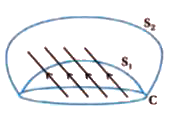
Consider a closed loop C in a magnetic field as shown in figure. The flux passing through the loop is defined by choosing a surface whose edge coincides with the loop and using the formula `phi=vecB_1 . dvecA_1 + vecB_2 . dvecA_2`+…. Now if we choose two different surfaces `S_1` and `S_2` having C as their edge, would we get the same answer for flux. Justify your answer.

Text Solution

Verified by Experts
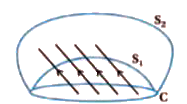

Magnetic flux linked with any surface can also be determine by no. of field lines passing from it.

Here, from surface `S_1` and `S_2` no. of fieldline passing through them are same so flux linked with them is also same.
Promotional Banner

Topper's Solved these Questions

  • ELECTROMAGNETIC INDUCTION

    KUMAR PRAKASHAN|Exercise Section C Ncert Exemplar Solution (Long Answer )|11 Videos
  • ELECTROMAGNETIC INDUCTION

    KUMAR PRAKASHAN|Exercise Section D MCQs (From DARPAN Based on Textbook )|121 Videos
  • ELECTROMAGNETIC INDUCTION

    KUMAR PRAKASHAN|Exercise Section C Ncert Exemplar Solution (MCQs)|16 Videos
  • ELECTRIC CHARGES AND FIELDS

    KUMAR PRAKASHAN|Exercise SECTION D MCQS ASKED IN COMPETITIVE EXAMES (MCQS AKSED IN BOARD EXAM AND GUJCET)|14 Videos
  • ELECTROMAGNETIC WAVES

    KUMAR PRAKASHAN|Exercise BOARD.S QUESTION PAPER MARCH - 2020 (PART - B) SECTION - C|5 Videos

Similar Questions

Explore conceptually related problems

PQ is a current - carrying long straight conductor in the plance of the paper as shown in the following figure. A and B are two points at distances r_(1) and r_(2) from it . If r_(2) gt r_(2) at which point will the strength of the magnetic field be greater ? Justify your answer .

A magnetic field in a certain region is given by vecB = (40hatî - 18 hatk)G . How much flux passes through a 5.0 "cm"^2 area of the loop, if the loop lies flat on the XY Plane ? 1G (gauss) = 10^(-4) T.

This question contains Statement -1 and Stantement -2 Of the four choices given after the statements, choose the one that best desctibes the two statemesnts. Statement -1: For a mass M kept at the center of a cube of side 'a', the flux of gravitational field passing through its sides 4piGM. Statement -2: If the direction of a field due to a point source is radial and its dependence on the distance 'r' from the source is given as (1)/(r^2) , its flux throught a closed surface depends only on the strength of the source enclosed by the surfcae and not on the size or shape of the surface.

Answer carefully: (a) Two large conducting spheres carrying charges Q_(1) and Q_(2) are brought close to each other. Is the magnitude of electrostatic force between them exactly given by Q_(1),Q_(2)//4pi epsilon_(0)r^(2) , where r is the distance between their centres? (b) If Coulomb’s law involved 1//r^(3) dependence (instead of would Gauss’s law be still true ? (c) A small test charge is released at rest at a point in an electrostatic field configuration. Will it travel along the field line passing through that point? (d) What is the work done by the field of a nucleus in a complete circular orbit of the electron? What if the orbit is elliptical? (e) We know that electric field is discontinuous across the surface of a charged conductor. Is electric potential also discontinuous there? (f) What meaning would you give to the capacitance of a single conductor? (g) Guess a possible reason why water has a much greater dielectric constant (= 80) than say, mica (= 6).

A straight wire carrying a current of 12 A is bent into a semicircular arc of radius 2.0 cm as shown in figure (a). Consider the magnetic field vecB at the centre of the arc. (a) What is the magnetic field due to the straight segments ? (b) In what way the contribution to vecB from the semicircle differs from that of a circular loop and in what way does it resemble ? ( c) Would your answer be different if the wire were bent into a semicircular arc of the same radius but in the opposite way as shown in figure (b) ?

When a particle is restricted to move aong x axis between x =0 and x = a , where a is of nanometer dimension. Its energy can take only certain specific values. The allowed energies of the particle moving in such a restricted region, correspond to the formation of standing waves with nodes at its ends x = 0 and x = a . The wavelength of this standing wave is realated to the linear momentum p of the particle according to the de Breogile relation. The energy of the particl e of mass m is reelated to its linear momentum as E = (p^(2))/(2m) . Thus, the energy of the particle can be denoted by a quantum number 'n' taking values 1,2,3,"......." ( n=1 , called the ground state) corresponding to the number of loop in the standing wave. Use the model decribed above to answer the following three questions for a particle moving in the line x = 0 to x =a . Take h = 6.6 xx 10^(-34) J s and e = 1.6 xx 10^(-19) C . If the mass of the particle is m = 1.0 xx 10^(-30) kg and a = 6.6 nm , the energy of the particle in its ground state is closet to

When a particle is restricted to move aong x axis between x =0 and x = a , where a is of nanometer dimension. Its energy can take only certain specific values. The allowed energies of the particle moving in such a restricted region, correspond to the formation of standing waves with nodes at its ends x = 0 and x = a . The wavelength of this standing wave is realated to the linear momentum p of the particle according to the de Breogile relation. The energy of the particl e of mass m is reelated to its linear momentum as E = (p^(2))/(2m) . Thus, the energy of the particle can be denoted by a quantum number 'n' taking values 1,2,3,"......." ( n=1 , called the ground state) corresponding to the number of loop in the standing wave. Use the model decribed above to answer the following three questions for a particle moving in the line x = 0 to x =a . Take h = 6.6 xx 10^(-34) J s and e = 1.6 xx 10^(-19) C . The allowed energy for the particle for a particular value of n is proportional to

When a particle is restricted to move aong x axis between x =0 and x = a , where a is of nanometer dimension. Its energy can take only certain specific values. The allowed energies of the particle moving in such a restricted region, correspond to the formation of standing waves with nodes at its ends x = 0 and x = a . The wavelength of this standing wave is realated to the linear momentum p of the particle according to the de Breogile relation. The energy of the particl e of mass m is reelated to its linear momentum as E = (p^(2))/(2m) . Thus, the energy of the particle can be denoted by a quantum number 'n' taking values 1,2,3,"......." ( n=1 , called the ground state) corresponding to the number of loop in the standing wave. Use the model decribed above to answer the following three questions for a particle moving in the line x = 0 to x =a . Take h = 6.6 xx 10^(-34) J s and e = 1.6 xx 10^(-19) C . The speed of the particle, that can take disrete values, is proportional to

Charges Q_1 and Q_2 lie inside and outside, respectively, of a closed surface S. Let E be the field at any point on S and phi be the flux of E over S.

A point charge causes an electric flux of -1.0 xx 10^3Nm^2C^(-1) to pass through a spherical Gaussian surface of 10.0 cm radius centered on the charge. If the radius of the Gaussian surface were three times, how much flux would pass through the surface ?