Home
Class 12
PHYSICS
Find the current in the wire for the con...

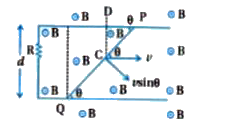
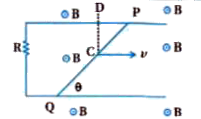
Find the current in the wire for the configuration shown in figure. Wire PQ has negligible resistance. `vecB`, the magnetic field is coming out of the paper. `theta` is a fixed angle made by PQ travelling smoothly over two conducting parallel wires separated by a distance d.

Text Solution

Verified by Experts

Induce emf in rod can be given by ,
`epsilon=Bvl`
Here, `vecB, vecv` and `vecl` all should be mutually perpendicular and if it is not then we consider their perpendicular component.

Here `vecB` and `vecv` is perpendicular to each other but length of rod PQ is not perpendicular to `vecv` and `vecB`. But Isine component is perpendicular to both `vecv` and `vecB`.
From figure , lsin`theta`=perpendicular distance between two wire (d)
`therefore lsintheta =d`
`therefore epsilon=Bvd`
Induced emf `epsilon=Bv(lsin theta) = Bvd`
Induced current `I=epsilon IR`
`=(Bvd)/R`
Direction of this induced current is in clockwise direction according to Lenz.s law.
Promotional Banner

Topper's Solved these Questions

  • ELECTROMAGNETIC INDUCTION

    KUMAR PRAKASHAN|Exercise Section C Ncert Exemplar Solution (Long Answer )|11 Videos
  • ELECTROMAGNETIC INDUCTION

    KUMAR PRAKASHAN|Exercise Section D MCQs (From DARPAN Based on Textbook )|121 Videos
  • ELECTROMAGNETIC INDUCTION

    KUMAR PRAKASHAN|Exercise Section C Ncert Exemplar Solution (MCQs)|16 Videos
  • ELECTRIC CHARGES AND FIELDS

    KUMAR PRAKASHAN|Exercise SECTION D MCQS ASKED IN COMPETITIVE EXAMES (MCQS AKSED IN BOARD EXAM AND GUJCET)|14 Videos
  • ELECTROMAGNETIC WAVES

    KUMAR PRAKASHAN|Exercise BOARD.S QUESTION PAPER MARCH - 2020 (PART - B) SECTION - C|5 Videos

Similar Questions

Explore conceptually related problems

Find the current in the sliding rod AB (resistance = R) for the arrangement shown in figure. vecB is constant and is out of the paper. Parallel wires have no resistance, v is constant. Switch S is closed at time t = 0.

Find the current in the sliding rod AB (resistance = R) for the arrangement shown in figure. vecB is constant and is out of the paper. Parallel wires have no resistance, v is constant. Switch S is closed at time t = 0.

A current of 6 A passes through the wire shown in the figure. Find the magnitude of magnetic field at point C. The radius is 0.2 m. (mu_(0)=4pixx10^(-7)TmA^(-1))

A rod of mass m and resistance R slides smoothly over two parallel conducting wires kept sloping at an angle theta with respect to the horizontal as shown in figure. The circuit is closed through a perfect conductor at the top. There is a constant magnetic field vecB along the vertical direction. If the rod is initially at rest, find the velocity of the rod as a function of time.

A straight wire carrying a current of 12 A is bent into a semicircular arc of radius 2.0 cm as shown in figure (a). Consider the magnetic field vecB at the centre of the arc. (a) What is the magnetic field due to the straight segments ? (b) In what way the contribution to vecB from the semicircle differs from that of a circular loop and in what way does it resemble ? ( c) Would your answer be different if the wire were bent into a semicircular arc of the same radius but in the opposite way as shown in figure (b) ?

A magnetic field vecB=B_0 sin (omegat)hatk covers a large region where a wire AB slides smoothly over two parallel conductors separated by a distance d as in figure. The wires are in the xy-plane. The wire AB (of length d) has resistance R and the parallel wires have negligible resistance. If AB is moving with velocity v, what is the current in the circuit. What is the force needed to keep the wire moving at constant velocity ?

A constant current I flows in a horizontal wire in the plane of paper from east to west as shown in the following figure : At which poit will the direction of the magnetic field be from north to south ?

Two identical balls A and B each of mass 0.1 kg are attached to two identical mass less is springs. The spring-mass system is constrained to move inside a right smooth pipe bent in the form of a circle as shown in figure . The pipe is fixed in a horizontal plane. The center of the balls can move in a circle of radius 0.06 m . Each spring has a natural length of 0.06 pi m and force constant 0.1 N//m . Initially, both the balls are displaced by an angle theta = pi//6 radians with respect to diameter PQ of the circle and released from rest. a. Calculate the frequency of oscillation of the ball B. b. What is the total energy of the system ? c. Find the speed of the ball A when A and B are at the two ends of the diameter PQ.

Figure shows a metal rod PQ resting on the smooth rails AB and positioned between the poles of a permanent magnet. The rails, the rod, and the magnetic field are in three mutual perpendicular directions. A galvanometer G connects the rails through a switch K. Length of the rod =15 cm, B =0.50 T, resistance of the closed loop containing the rod 9.0 m Omega . Assume the field to be uniform. (a) Suppose K is open and the rod is moved with a speed of 12 "cm s"^(-1) in the direction shown. Give the polarity and magnitude of the induced emf. (b) Is there an excess charge built up at the ends of the rods when K is open ? What if K is closed ? (c) With K open and the rod moving uniformly, there is no net force on the electrons in the rod PQ even though they do experience magnetic force due to the motion of the rod. Explain. (d) What is the retarding force on the rod when K is closed ? How much power is required (by an external agent) to keep the rod moving at the same speed (= 12 cm s^(-1) ) when K is closed ? How much power is required when K is open? (f)How much power is dissipated as heat in the closed circuit ? What is the source of this power ? (g) What is the induced emf in the moving rod if the magnetic field is parallel to the rails instead of being perpendicular ?

A conducting wire XY of mass m and neglibile resistance slides smoothly on two parallel conducting wires as shown in figure. The closed circuit has a resistance R due to AC. AB and CD are perfect conductors. There is a magnetic field vecB=B(t)hatk (i) Write down equation for the acceleration of the wire XY. (ii) If vecB is independent of time, obtain v(t), assuming v (0) = u_0 . (iii) For (ii), show that the decrease in kinetic energy of XY equals the heat lost in.