Home
Class 12
PHYSICS
A (current vs time) graph of the current...


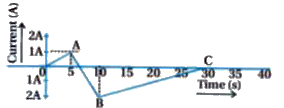
A (current vs time) graph of the current passing through a solenoid is shown in figure. For which time is the back electromotive force (`epsilon`) a maximum. If the back emf at t = 3s is e, find the back emf at 1 = 7 s, 15 s and 40 s. OA, AB and BC are straight line segments.

Text Solution

Verified by Experts

When rate of change of flux is maximum then induced emf is also t = 10 sec maximum. In graph at t = 5 sec. to slope is maximum, hence rate of change of flux is also maximum and induced emf will also be maximum.
For t=0 s to t=5 s , slope `(dI)/(dt)=1/5As^(-1)`
Back emf `epsilon=(-LdI)/(dt)`
So for t=0 to t=5s (At t=3 s also)
Back emf=e=`-L(1/5)=(-L)/5`
`therefore e=(-L)/5` ...(1)
(i)For 5s `lt t lt 10 s` slope `(dI)/(dt)=(-3)/5 As^(-1)`
Back emf for t=5 s to t=10 s,
(At t=7s as well)
`e_1=(-LdI)/(dt)=-L((-3)/5)`
`-3((-L)/5)`
`e_1=-3s [ because e=(-L)/5]`
(ii) For 10s to `t lt 30` s slope
`(dI)/(dt)=2/20=1/10 As^(-1)`
Back emf at t=15 s is ,
`e_2=-L xx (dI)/(dt)`
`-Lxx(+1/10)`
`=(-L)/10=1/2 e [ because e=(-L)/5]`
(iii)At `t ge 30s` , slope =0 ,
So, at t=40 s back emf `e_3=0`
Thus at t=7 s induced emf `e_1=-3e`
at t=15 s induced emf `e_2=e/2`
at t=40 s induced emf `e_3=0`
Promotional Banner

Topper's Solved these Questions

  • ELECTROMAGNETIC INDUCTION

    KUMAR PRAKASHAN|Exercise Section C Ncert Exemplar Solution (Long Answer )|11 Videos
  • ELECTROMAGNETIC INDUCTION

    KUMAR PRAKASHAN|Exercise Section D MCQs (From DARPAN Based on Textbook )|121 Videos
  • ELECTROMAGNETIC INDUCTION

    KUMAR PRAKASHAN|Exercise Section C Ncert Exemplar Solution (MCQs)|16 Videos
  • ELECTRIC CHARGES AND FIELDS

    KUMAR PRAKASHAN|Exercise SECTION D MCQS ASKED IN COMPETITIVE EXAMES (MCQS AKSED IN BOARD EXAM AND GUJCET)|14 Videos
  • ELECTROMAGNETIC WAVES

    KUMAR PRAKASHAN|Exercise BOARD.S QUESTION PAPER MARCH - 2020 (PART - B) SECTION - C|5 Videos

Similar Questions

Explore conceptually related problems

Velocity-time graph of a particle moving in a straight line is shown in figure. Plot the corresponding displacement-time graph of the particle if at time t=0, displacement s=0.

The graph between the displacement x and time t for a particle moving in a straight line is shown in the figure. During the interval OA, AB, BC and CD the acceleration of the particle is OA, AB, BC, CD

A particle starts motion from rest and moves along a straight line. Its acceleration-time graph is shown. Find out speed of particle at t=2s and at t=3s.

Figure shows velocity time graph of a particle moving in straight line. Which of the following statement(s) is / are CORRECT :-

Find the current in the sliding rod AB (resistance = R) for the arrangement shown in figure. vecB is constant and is out of the paper. Parallel wires have no resistance, v is constant. Switch S is closed at time t = 0.

Find the current in the sliding rod AB (resistance = R) for the arrangement shown in figure. vecB is constant and is out of the paper. Parallel wires have no resistance, v is constant. Switch S is closed at time t = 0.

Charge passing through a conductor carrying current is given by Q = 5t^(2) + 3t +1 , How much amount of current will pass in t = 5 s ?

A vessel ABCD of 10 cm width has two small slits S_(1) and S_(2) sealed with idebtical glass plates of equal thickness. The distance between the slits is 0.8 mm . POQ is the line perpendicular to the plane AB and passing through O, the middle point of S_(1) and S_(2) . A monochromatic light source is kept at S, 40 cm below P and 2 m from the vessel, to illuminate the slits as shown in the figure. Calculate the position of the central bright fringe on the other wall CD with respect of the line OQ . Now, a liquid is poured into the vessel and filled up to OQ . The central bright fringe is fiund to be at Q. Calculate the refractive index of the liquid.
