Home
Class 12
PHYSICS
A conducting wire XY of mass m and negli...

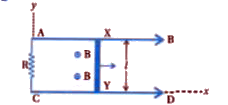
A conducting wire XY of mass m and neglibile resistance slides smoothly on two parallel conducting wires as shown in figure. The closed circuit has a resistance R due to AC. AB and CD are perfect conductors. There is a magnetic field `vecB=B(t)hatk`

(i) Write down equation for the acceleration of the wire XY.
(ii) If `vecB` is independent of time, obtain v(t), assuming v (0) =`u_0`.
(iii) For (ii), show that the decrease in kinetic energy of XY equals the heat lost in.

Text Solution

Verified by Experts

Suppose two parallel wire are at y = 0 and y = l
Suppose at t = 0 time wire xy is at x = 0 and at t = t time it is at x = x place.
(i) Magnetic flux linked with closed loop,
`phi=vecB.vecA=BA cos 0=BA`
=[B(t)](lx)
Induced emf,
`epsilon=-(dphi)/(dt)`
`epsilon=-d/(dt)[B(t)lx]`
`=-l[B(t)(dx)/(dt)+x d/(dt)B(t)]`
`epsilon=-lB(t)v-lx(dB(t))/(dt)`....(1)
(Motional emf) (emf due to variation in magnetic field)
Magnetic force on wire ,
F=IlB(t)
`=epsilon/R lB(t) [ because I=epsilon/R]`
`=[-lB(t)v-lx(dB(t))/(dt)]l/R B(t)`
`ma=-l^2/R B(t) [vB(t)+x(dB(t))/(dt)]`
Acceleration of wire,
`a=-(l^2B(t))/(mR)[vB(t)+x(dB(t))/(dt)]` ...(2)
(ii) If magnetic field does not change with time `(dB(t))/(dt)=0`
`therefore a=(-l^2B^2)/(mR)v`
`therefore (dv)/(dt)=(-l^2B^2)/(mR)v`
`therefore 1/v dv=(-B^2l^2)/(mR)dt`
Taking integration and at t=0, v=`u_0`
`int_(u_0)^v 1/v dv = int_0^t (-B^2l^2)/(mR)dt`
`[ln v]_(u_0)^v =(-B^2l^2)/(mR)[t]_0^t`
`ln v- m u_0=(-B^2l^2t)/(mR)`
`ln v/u_0=e^(-(B^2l^2)/(mR)t)`
`v=u_0 e^(-(B^2l^2)/(mR)t)`
`v(t)=u_0 exp (-(B^2l^2t)/(mR))`...(3)
(iii) Change in kinetic energy of wire,
`DeltaK=1/2m u_0^2 -1/2 mv^2`
`=1/2m u_0^2-1/2 m u_0^2 e^(-(2B^2l^2t)/(mR))`
`DeltaK=1/2 m u_0^2[1-e^(-(2B^2l^2t)/(mR))]`...(4)
Power dissipated in the terms of heat,
`P=I^2R`
`(dH)/(dt)=I^2R = epsilon^2/R`
`dH=epsilon^2/R dt`
`H=int_0^t epsilon^2/R dt`...(5)
If B is constant then from equation (1),
`epsilon=-B vl`
`H=int_0^t (B^2v^2l^2)/R dt`
`H=(B^2l^2)/R int_0^t v^2dt`
`=(B^2l^2)/R int_0^t u_0^2 e^(-(2B^2l^2t)/(mR))dt`
`=(B^2l^2)/R u_0^2([e^(-(2B^2l^2t)/(mR))]_0^t)/(((-2B^2l^2)/(mR)))`
`=-m/2u_0^2[e^(-(2B^2l^2t)/(mR)-1)]`
`H=1/2 m u_0^2 [1-e^(-(2B^2l^2t)/(mR))]`...(6)
From equation (5) and (6) it is clear that change in kinetic energy is equal to produced heat energy.
Promotional Banner

Topper's Solved these Questions

  • ELECTROMAGNETIC INDUCTION

    KUMAR PRAKASHAN|Exercise Section D MCQs (From DARPAN Based on Textbook )|121 Videos
  • ELECTROMAGNETIC INDUCTION

    KUMAR PRAKASHAN|Exercise Section D MCQs (MCQs asked in Competitive Exams )|38 Videos
  • ELECTROMAGNETIC INDUCTION

    KUMAR PRAKASHAN|Exercise Section C Ncert Exemplar Solution (Short Answer )|5 Videos
  • ELECTRIC CHARGES AND FIELDS

    KUMAR PRAKASHAN|Exercise SECTION D MCQS ASKED IN COMPETITIVE EXAMES (MCQS AKSED IN BOARD EXAM AND GUJCET)|14 Videos
  • ELECTROMAGNETIC WAVES

    KUMAR PRAKASHAN|Exercise BOARD.S QUESTION PAPER MARCH - 2020 (PART - B) SECTION - C|5 Videos

Similar Questions

Explore conceptually related problems

Consider circuit as shown in figure. The current through wire AB is

A rod of mass m and resistance R slides smoothly over two parallel conducting wires kept sloping at an angle theta with respect to the horizontal as shown in figure. The circuit is closed through a perfect conductor at the top. There is a constant magnetic field vecB along the vertical direction. If the rod is initially at rest, find the velocity of the rod as a function of time.

Name the substances used to make a conducting wire, resistive wire and resistor.

Obtain equation for force between two parallel currents carrying wire.

A current carrying wire AB of the length L is turned along a circle, as shown in figure. The magnetic field at the centre O.

I - V graph for a resistance Wire is shown in the figure given below: What will be resistance of this wire?

A cube is constructed by connecting 12 wires of equal resistance as shown in figure. The equivalent resistance between the points A and B shown in the figure is..... . The resistance of each wire is of r Omega . A and B are the midpoints of the sides PQ and VU respectively.

The magnetic field produced by a straight conducting wire on passing the current through it is ……

A wire having resistance 20 Omega is bent in the form of a circle as shown in the following figure: What will be the resistance between two end points A and B located on the diameter?
