

Home
Class 11
PHYSICS
Two uniform solid cylinders A and B each...

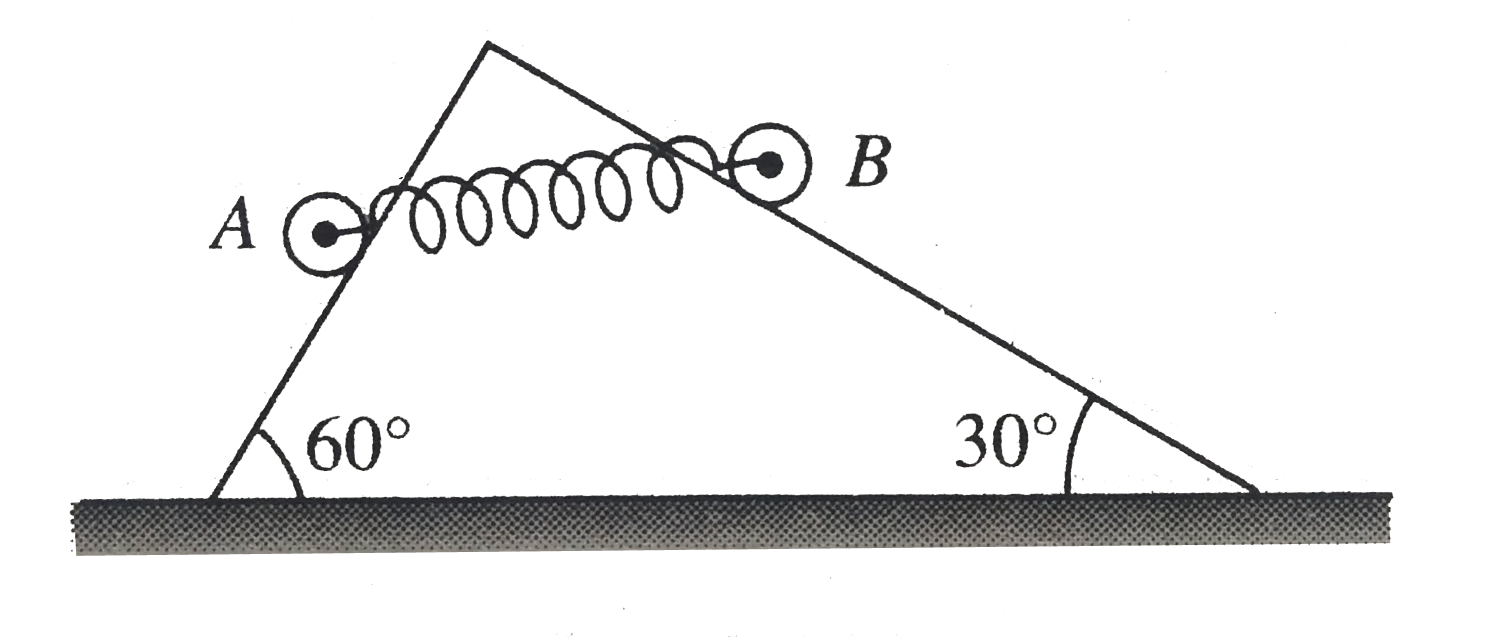
Two uniform solid cylinders A and B each of mass 1 kg are connected by a spring of constant `200Nm^(-1)` at their axles and are placed on a fixed wedge as shown in fig.There is no friction between cylinders and wedge. The angle made by the line AB with the horizontal, in equilibirum is

Promotional Banner

Similar Questions

Explore conceptually related problems

Two blocks A and B of masses 5 kg and 2 kg respectively connected by a spring of force constant = 100Nm^(-1) are placed on an inclined plane of inclined 30^(@) as shown in figure If the system is released from rest

Two blocks A and B of masses 5 kg and 2 kg respectively connected by a spring of force constant = 100Nm^(-1) are placed on an inclined plane of inclined 30^(@) as shown in figure If the system is released from rest

A block of mass 1 kg is placed on a wedge shown in figure. Find out minimum coefficient of friction between wedge and block to stop the block on it.

Two uniform cylinders, each of mass m = 10 kg and radius r = 150 mm, are connected by a rough belt as shown. If the system is released from rest, determine the tension in the portion of the belt connecting the two cylinders.

Two wedges, each of mass m , are placed next to each other on a flat horizontal floor. A cube of mass M is balanced on the wedges as shown in figure. Assume no friction between the cube and the wedges, but a coefficent of static friction mult1 between the wedges and the floor. What is the largest M that can be balanced as shown without motion of the wedges ?

Two uniform solid cylinders, each of mass m = 10 kg and radius r = 150 mm, are connected by a rough belt as shown. If the system is released from rest, determine the velocity of the centre of cylinder A after it has moved through 1.2 m & the tension in the portion of the belt connecting the two cylinders.

Two very small particles 1 and 2 each of mass 0.5kg and of charge q_(1)=1mc and q_(2)=1muC resepectivley are connected by a mass less spring of spring constant 200Nm^(-1) and placed on a horizontal rough surface.The particle 1 is fixed and 2 is free to move ,Initially the spring is in its natural length (2m) where q_(2) is released.If coefficient of static friction between 2 and horizontal surface is 0.5 the separation between the charges when they are in equilibrium will be (Neglect gravitational interactions between 1 and 2g=10ms^(-2)

A uniform plank of mass m = 1kg , free to move in the horizontal direction only, is placed at the top of a solid cylinder of mass 2m and radius R . The plank is attched to a fixed wall by means of light spring of spring constant k = 7N//m^(2) . There is no slipping between the cylinder and the plank, and between the cylinder and the ground. the angular frequency of small oscillations of the system is