

Home
Class 11
PHYSICS
The diagram shows a tall cylindrical con...

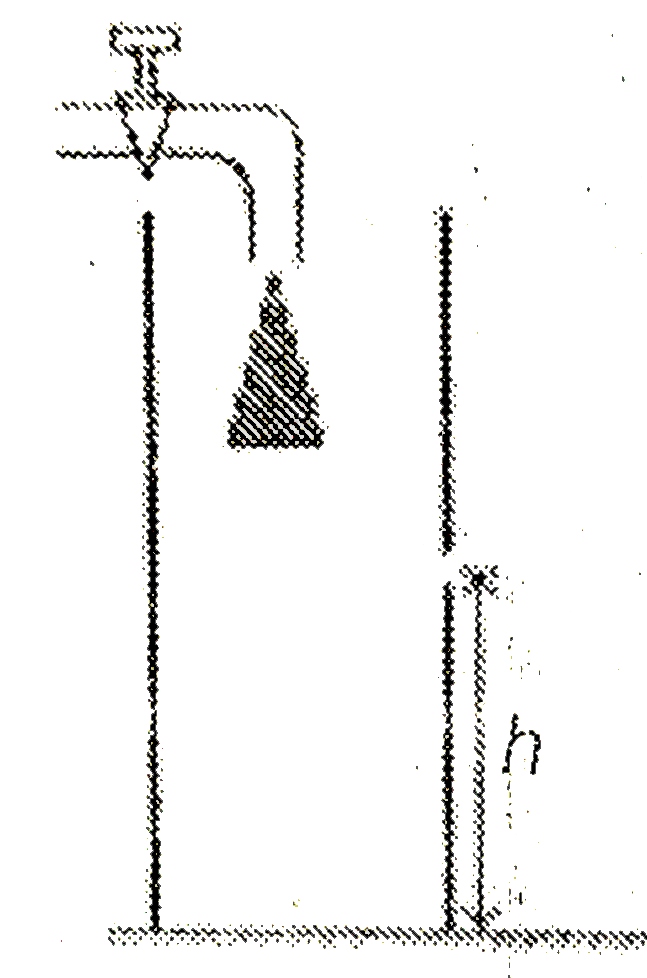
The diagram shows a tall cylindrical container kept on a horizontal surface. From a tap, water come with constant rate `q m^(3)//s`. Initially the container was empty. An orifice of area of cross section A is made at some height h in the side wall of the container. If the horizontal range of the water jet in steady is found to be 2h, then the relation between h and q is

Promotional Banner

Similar Questions

Explore conceptually related problems

If a small orifice is made at a height of 0.25 m from the ground, the horizontal range of water stream will be : -

A tank contains water up to a height H. A hole is made at a depth h from the upper surface. The horizontal range of the jet of water coming out from the hole is

A tank if filled with water upto height H. When a hole is made at a distance h below the level of water. What will be the horizontal range of water jet ?

A tank if filled with water upto height H. When a hole is made at a distance h below the level of water. What will be the horizontal range of water jet ?

Water is filled to a height in a long container. From what height below the free surface a hole should be bored in the wall of a container so that the horizontal range is maximum?

A cylindrical vessel of cross section A contains water to a height h. There is a hole in the bottom of radius 'a'. The time in which it will be emptied is:

In the figure shown, a light container is kept on a horizontal rough surface of coefficient of friction mu=(Sh)/V . A very small hole of area S is made at depth 'h'. Water of volume 'V' is filled in the container. The friction is not sufficient to keep the container at rest. The acceleration of the container initially is

In the figure shown, a light container is kept on a horizontal rough surface of coefficient of friction mu=(Sh)/V . A very small hole of area S is made at depth 'h'. Water of volume 'V' is filled in the container. The friction is not sufficient to keep the container at rest. The acceleration of the container initially is