

Home
Class 12
PHYSICS
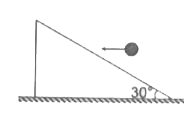
A ball of mass 1kg strikes a wedge of ma...

A ball of mass 1kg strikes a wedge of mass 4kg horzontally with a velocity of `10m//s`. Just after collision, velocity of wedge becomes `4m//s`.Friction is absent everywhere and collision is elastic. Select the correct alternative.

Promotional Banner

Similar Questions

Explore conceptually related problems

A small ball of mass 1kg strikes a wedge of mass 4kg horizontally with a velocity of 10m//s . Friction is absent everywhere and collision is elastic. Select the incorrect answer:

A small ball of mass 1kg strikes a wedge of mass 4kg horizontally with a velocity of 10m//s . Friction is absent everywhere and collision is elastic. Select the incorrect answer:

A ball of mass 10 kg is moving with a velocity of 10 m / s . It strikes another ball of mass 5 kg which is moving in the same direction with a velocity of 4 m / s . If the collision is elastic, their velocities after the collision will be, respectively

A ball mass 2 kg moving horizontally with velocity 10 m/s hits a wedge of mass 5 kg placed on a horizontal surface as shown in the figure. Just after collision klvelocity of wedge is 3.2 m/s. There is no friction at any contact surface. Then (take sin 30^(@)=3//5 )

A ball mass 2 kg moving horizontally with velocity 10 m/s hits a wedge of mass 5 kg placed on a horizontal surface as shown in the figure. Just after collision klvelocity of wedge is 3.2 m/s. There is no friction at any contact surface. Then (take sin 30^(@)=3//5 )

A sphere of mass 0.3 kg moving with a velocity of 4 m/s collides with another sphere of mass 0.5 kg which is at rest. Assuming the collision to be elastic, their velocities after the impact are

A block of mass 1 kg is pushed towards another block of mass 2 kg from a 6 m distance as shown in the figure. If just after the collision, the velocity of 2 kg block is 4ms^(-1) , then