

Home
Class 11
PHYSICS
A frictionless track ABCDE ends in a cir...

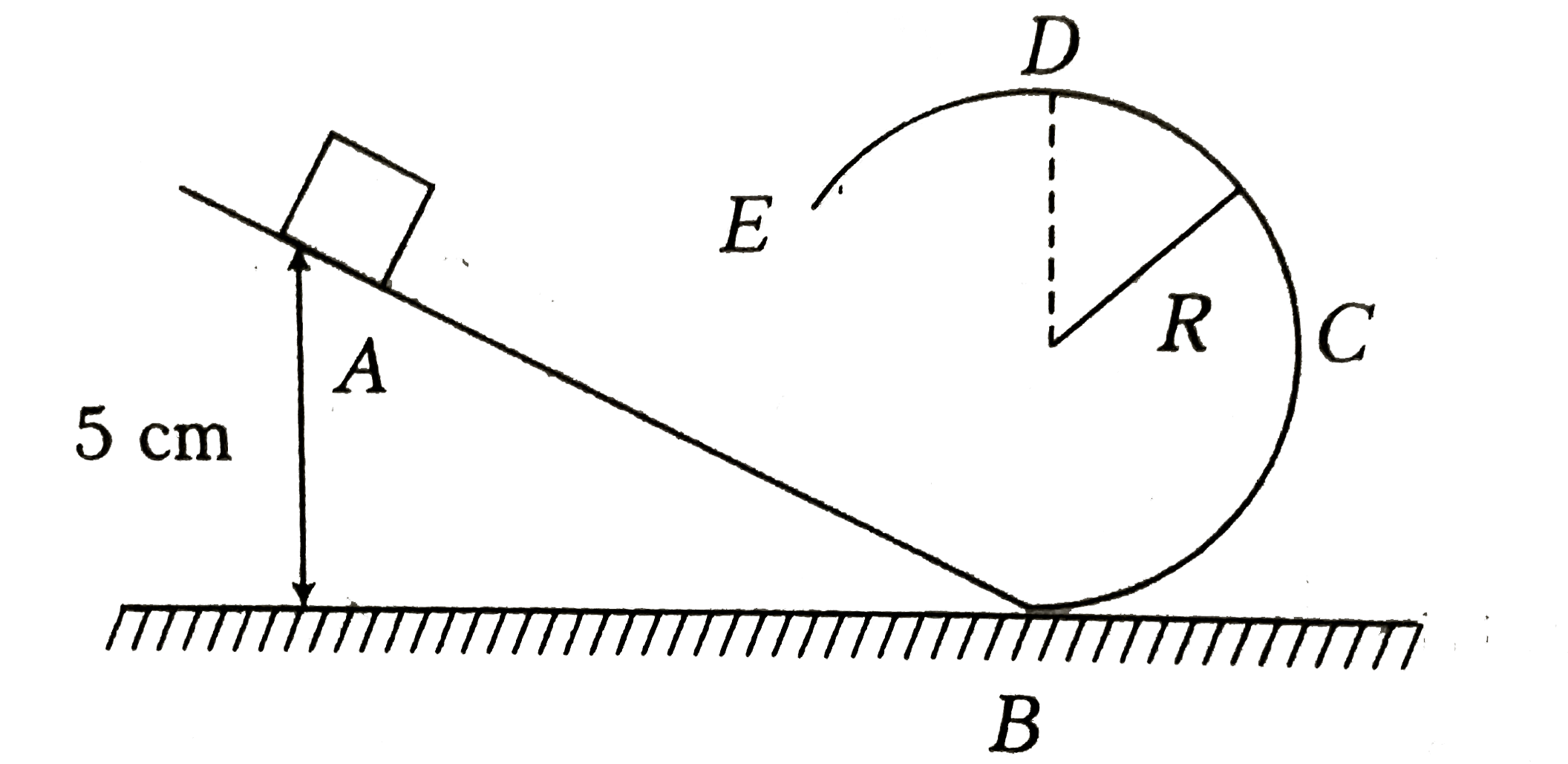
A frictionless track ABCDE ends in a circular loop of radius R. A body slides down the track from point A which is at height h = 5cm. Maximum value of R for a body to complete the loop successfully is

Promotional Banner

Similar Questions

Explore conceptually related problems

A frictionless track ABCDE ends in a circular loop of radius R . A body slides down the track from point A which is at a height h = 5 cm . Maximum value of R for the body to successfully complete the loop is

A frictionless track ABCDE ends in a circular loop of radius R. A body slides down the track form point A which is at a height h=5 cm. Maximum value of R for the body to successfully complete the loop is

A frictionless tracke ABCDE ends in a circular loop of radius 'r' A body slides down the track from the point 'A' which is at a height h=10 cm . The maximum value of 'r' for the body to successful complete the loop is

A frictionless track ABCD ends in a semicircular loop of radius R.A body slides down the track from point A which is at a value of R which is at a height h=5 cm. Maximum value of R for the body to successfully complete the loop is

A body slides down on a frictionless track which ends in a circular loop of diameter D. The minimum height h in terms of D so that the body may just complete the circular loop, is

A body slides down on a frictionless track which ends in a circular loop of diameter D. The minimum height h in terms of D so that the body may just complete the circular loop, is

An inclined track ends in a circular loop of radius 'r'. From what height on the track a particle should be released so that it completes that loop in the vertical plane?

An inclined track ends in a circular loop of radius r. From what height on the track a particle should be released so that it completes the loop, assuming there is no friction ?

An inclined track ends in a circular loop of radius r. From what height on the track a particle should be released so that it completes the loop, assuming there is no friction ?