

Home
Class 12
PHYSICS
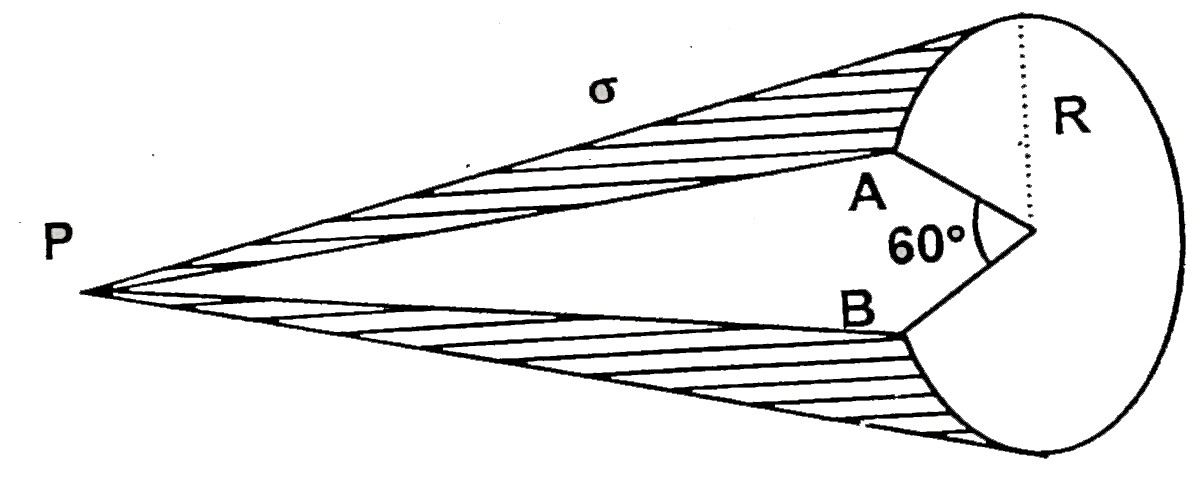
A non-conducting hollow cone has charge ...

A non-conducting hollow cone has charge density `sigma` A path `ABP` is cut and removed from the cone. The potential due to the remaining portion of the cone at point `'P'` is

Promotional Banner

Similar Questions

Explore conceptually related problems

An infinite conducting sheet has surface charge density sigma . The distance between two points is r. The potential difference (V_A - V_B) between these point is

An infinite conducting sheet has surface charge density sigma . The distance between two points is r. The potential difference (V_A - V_B) between these point is

An infinitely large non-conducting plane of uniform surface charge density sigma has circular aperture of certain radius carved out from it. The electric field at a point which is at a distance 'a' from the centre of the aperture (perpendicular to the plane) is (sigma)/(2 sqrt(2) in_(0)) . Find the radius of aperture :

An infinitely large non-conducting plane of uniform surface charge density sigma has circular aperture of certain radius carved out from it. The electric field at a point which is at a distance 'a' from the centre of the aperture (perpendicular to the plane) is (sigma)/(2 sqrt(2) in_(0)) . Find the radius of aperture :

Three non-conducting large parallel plates have surface charge densities sigma, -2 sigma and 4 sigma respectively as shown in the figure. The electric field at the point P is

Three non-conducting large parallel plates have surface charge densities sigma, -2 sigma and 4 sigma respectively as shown in the figure. The electric field at the point P is

A charge Q is given to a conducting cone. Is charge density on the cone it all the points is same?

A non-conducting semi circular disc (as shown in figure) has a uniform surface charge density sigma . The ratio of electric field to electric potential at the centre of the disc will be

A non-conducting semi circular disc (as shown in figure) has a uniform surface charge density sigma . The ratio of electric field to electric potential at the centre of the disc will be