Home
Class 11
PHYSICS
How to get thermal equilibrium in the sy...

How to get thermal equilibrium in the system ?

Text Solution

Verified by Experts
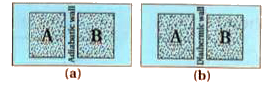
Consider two gases A and B occupying two different containers. The pressure and volume of a given mass of gas can be chosen to be its two independent variables.

(a) Two system A and B (two gases) are separated by an insulating wall that does not allow flow of heat.
(b) The system are insulated from the rest of the surrounding also by similar an insulating wall. In this case thermal equilibrium can be obtained after some time.
Suppose, pressure and volume of gas A and B are (`P_A,V_A`) and (`P_B, V_B`) respectively.
First that the two systems are put in proximity but are separated by an adiabatic wall that does not allow flow of heat energy from one to another.
It is found that any possible pair of values `(P_A, V_A)` will be in equilibrium with any other possible pair of values `(P_B, V_B)`. This is shown in figure (a).
Now suppose, that the adiabatic wall separating the gases A and B is replaced by a diathermic wall (conducting wall) which allows heat energy to flow from one gas to another.
It is then found that the macroscopic variables of the system A and B change spontaneously until both the system attain equilibrium states. After that there is no change in their states. This is shown in figure (b).
The pressure and volume variables of the two gases change to `(P._B, V._B)` and `(P._A,V._A)` such that the new states of A and B are in equilibrium with each other. There is no more energy flow from one to another. It is called that system A is in thermal equilibrium with system B.
No need to change the pressure and volume for attaining equilibrium for both the system. It depend on the control factors. For example, if gases are in container with contact of volume then attaining thermal equilibrium any pressure will be changed.
In thermal equilibrium the temperature of two systems are equal.
Promotional Banner

Topper's Solved these Questions

  • THERMODYANMICS

    KUMAR PRAKASHAN|Exercise Section-A (Try Your self )|90 Videos
  • THERMODYANMICS

    KUMAR PRAKASHAN|Exercise Section-B Numericals (Numerical From Textual Exercise)|10 Videos
  • THERMAL PROPERTIES OF MATTER

    KUMAR PRAKASHAN|Exercise Question Paper (Section - D) (Answer following in brief :) Each carry 4 marks|1 Videos
  • UNITS AND MEASUREMENT

    KUMAR PRAKASHAN|Exercise Section -F (Questions from Module )|20 Videos

Similar Questions

Explore conceptually related problems

Is it necessary to change the volume and pressure to bring the equilibrium of the system ? Why ?

Assertion: The heat supplied to a system is always equal to the increase in its internal energy. Reason: When a system changes from one thermal equilibrium to another some heat is absorbed by it.

Give the characteristics of thermal equilibrium of two system.

Find the de-Broglie wavelength of a neutron ,in thermal equilibrium with matter,having an average kinetic energy of ((3)/(2)) kT at 300 K.

When does the systems at different temperature attained thermal equilibrium after time goes on ?

Three bodies A, B and C are in thermal equilibrium. The temperature of B is 45^@ C. then the temperature of C is

If A and B are in thermal equilibrium independently then what can be said about the system A and B ?

