Home
Class 11
PHYSICS
Explain Quasi-static process....

Explain Quasi-static process.

Text Solution

Verified by Experts
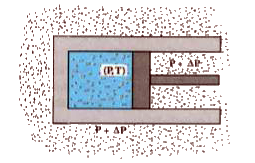
Suppose, the external pressure is suddenly reduced (by lifting the weight on the movable piston in the container).
So, piston will accelerate outward. During the process the gas passes through states that are not equilibrium states. The non-equilibrium states do not have well-defined pressure and temperature.
If the finite temperature difference exists between the gas and its surroundings there will be a rapid exchange of heat during which the gas will pass through non-equilibrium states and after some time the gas will settle to an equilibrium state.
An idealist process in which at every stage the system is an equilibrium state such process is infinitely slow. This process is known as Quasi-static process.
A quasi-static process is obviously a hypothetical construct. In practice, processes that are sufficiently slow and do not involve accelerated motion of the piston, large temperature gradient are approximation to an ideal quasi-static process.
The system changes its variables (P, T, V) so slowly that it remains in thermal and mechanical equilibrium with its surrounding throughout.
In a quasi-static process, at every stage the difference in the pressure of the system and the external pressure is infinitesimally small.
To take a gas from the state (P, T) to another state (P., T.) via a quasi-static process we change the external pressure change by a very small amount allow the system to equalise its pressure with that of the surrounding and continue the process infinitely slowly until the system achieves the pressure P..
Similarly to change the temperature we introduce an infinitesimal temperature difference between the system and the surrounding reservoirs and by choosing reservoirs of progressively different temperatures T to T., the system achieves the temperature T".

In a quasi-static process, the temperature of the surrounding reservoir and the external pressure differ only infinitesimally from the temperature and pressure of the system.
Promotional Banner

Topper's Solved these Questions

  • THERMODYANMICS

    KUMAR PRAKASHAN|Exercise Section-A (Try Your self )|90 Videos
  • THERMODYANMICS

    KUMAR PRAKASHAN|Exercise Section-B Numericals (Numerical From Textual Exercise)|10 Videos
  • THERMAL PROPERTIES OF MATTER

    KUMAR PRAKASHAN|Exercise Question Paper (Section - D) (Answer following in brief :) Each carry 4 marks|1 Videos
  • UNITS AND MEASUREMENT

    KUMAR PRAKASHAN|Exercise Section -F (Questions from Module )|20 Videos

Similar Questions

Explore conceptually related problems

A gas is enclosed in a cylinder with a movable frictionless piston. Its initial thermodynamic state at pressure P_i=10^5 Pa and volume V_i=10^-3m^3 changes to a final state at P_f=(1//32)xx10^5Pa and V_f=8xx10^-3m^3 in an adiabatic quasi-static process, such that P^3V^3=constant. Consider another thermodynamic process that brings the system form the same initial state to the same final state in two steps: an isobaric expansion at P_i followed by an isochoric (isovolumetric ) process at volume V_r. The amount of heat supplied to the system i the two-step process is approximately

What is quasi-static ?

Explain thermite process with equation.

Explain Endocranial regulation of digestion process.

