Home
Class 11
PHYSICS
Explain working of refrigerators/heat pu...

Explain working of refrigerators/heat pumps and its coefficient of performance.

Text Solution

Verified by Experts
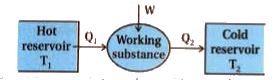
If a cyclic process performed in a heat engine is reversed, it acts as a refrigerator or a heat pump. Below schematic diagram represents working of a refrigerator/heat pump.

Working substance in a refrigerator/heat pump draws heat `Q_2` from a cold reservoir at lower temperature `T_2`, external work W is perform on the working substance and heat `Q_1` is released into the hot reservoir at higher temperature `T_1`. This is shown in above figure.
In a refrigerator the working substance (in gaseous form) goes through the following steps. (a) Sudden expansion of the gas from high to low pressure which cools it and converts it into a vapour-liquid mixture.
(b) Absorption by the cold fluid of heat from the region to be cooled converting it into vapour.
(c) Heating up of the vapour due to external work done on the system, and
(d) Release of heat by the vapour to the surroundings bringing it to the initial state completing the cycle.
If it is used to cool a space inside a chamber when its surroundings are at higher temperature it is called a refrigerator.
If it is used to heat a space or a room when its surrounds are at lower temperature, then it is called a heat pump.
The ratio of the quantity of heat `Q_2` extracted from the cold reservoir and W is the work done on the system (the refrigerant) is known as the coefficient of performance (`alpha`) of a refrigerator.
`alpha=Q_2/W`...(1)
Coefficient of performance of a heat pump
`alpha=Q_1/W`
In heat engine `eta` can never exceed 1, while for heat pump `alpha` can be more than 1.
From the law of conversation of energy
`Q_1=W+Q_2`
`therefore W=Q_1-Q_2`
From equation (1), `alpha=Q_2/(Q_1-Q_2)`
In a heat engine, heat cannot be fully converted to work, likewise a refrigerator cannot work without some external work done on the system. That means, the coefficient of performance cannot be infinite.
For an ideal heat engine Q = W and for an ideal refrigerator `Q_1=Q_2`, hence W=0 .
Promotional Banner

Topper's Solved these Questions

  • THERMODYANMICS

    KUMAR PRAKASHAN|Exercise Section-A (Try Your self )|90 Videos
  • THERMODYANMICS

    KUMAR PRAKASHAN|Exercise Section-B Numericals (Numerical From Textual Exercise)|10 Videos
  • THERMAL PROPERTIES OF MATTER

    KUMAR PRAKASHAN|Exercise Question Paper (Section - D) (Answer following in brief :) Each carry 4 marks|1 Videos
  • UNITS AND MEASUREMENT

    KUMAR PRAKASHAN|Exercise Section -F (Questions from Module )|20 Videos

Similar Questions

Explore conceptually related problems

Explain working of cyclotron.

Refrigerator is an apparatus which takes heat from a cold body, work is done on it and the work done together with the heat absorbed is rejected to the source. An ideal refrigerator can be regarded as Carnot's ideal heat engine working in the reverse direction. The coefficient of performance of refrigerator is defined as beta = ("Heat extracted from cold reservoir")/("work done on working substance") = (Q_(2))/(W) = (Q_(2))/(Q_(1)- Q_(2)) = (T_(2))/(T_(1) - T_(2)) A Carnot's refrigerator takes heat from water at 0^(@)C and discards it to a room temperature at 27^(@)C . 1 Kg of water at 0^(@)C is to be changed into ice at 0^(@)C. (L_(ice) = 80"kcal//kg") What is the work done by the refrigerator in this process ( 1 "cal" = 4.2 "joule" )

Refrigerator is an apparatus which takes heat from a cold body, work is done on it and the work done together with the heat absorbed is rejected to the source. An ideal refrigerator can be regarded as Carnot's ideal heat engine working in the reverse direction. The coefficient of performance of refrigerator is defined as beta = ("Heat extracted from cold reservoir")/("work done on working substance") = (Q_(2))/(W) = (Q_(2))/(Q_(1)- Q_(2)) = (T_(2))/(T_(1) - T_(2)) A Carnot's refrigerator takes heat from water at 0^(@)C and discards it to a room temperature at 27^(@)C . 1 Kg of water at 0^(@)C is to be changed into ice at 0^(@)C. (L_(ice) = 80"kcal//kg") How many calories of heat are discarded to the room?

Write the formula of coefficient of performance of a heat pump.

Refrigerator is an apparatus which takes heat from a cold body, work is done on it and the work done together with the heat absorbed is rejected to the source. An ideal refrigerator can be regarded as Carnot's ideal heat engine working in the reverse direction. The coefficient of performance of refrigerator is defined as beta = ("Heat extracted from cold reservoir")/("work done on working substance") = (Q_(2))/(W) = (Q_(2))/(Q_(1)- Q_(2)) = (T_(2))/(T_(1) - T_(2)) A Carnot's refrigerator takes heat from water at 0^(@)C and discards it to a room temperature at 27^(@)C . 1 Kg of water at 0^(@)C is to be changed into ice at 0^(@)C. (L_(ice) = 80"kcal//kg") What is the coefficient of performance of the machine?

Explain work energy theorem .

When does any refrigerator or heat pump work ?

What is coefficient of performance of a refrigerator ?

Explain work done by torque.

