Home
Class 11
PHYSICS
Show four steps of carnot engine in P-V ...

Show four steps of carnot engine in P-V graph write the equation of each step and obtain the work done by the system. Also obtain the efficiency of a carnot engine.

Text Solution

Verified by Experts
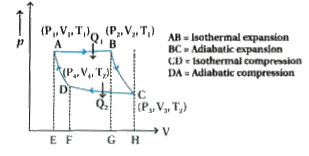
There are four reversible process occur in carnot engine.
(1) isothermal expansion
(2) Adiabatic expansion
(3) Isothermal compression
(4) Adiabatic compression
A cylic process is obtain by these four processes is shown in below P `to` V diagram.

(a) Step 1: Isothermal expansion of gas taking its state from `(P_1, V_1, T_1)` to `(P_2, V_2, T_1)`. For this, the conducting bottom of the cylinder is brought into contact with the heat and the gas is slowly allowed to expand isothermally.
(b) The heat absorbed by the gas `Q_1` from the reservoir, hence work done by gas (or on surrounding)
`W_1=Q_1=muRT_1 ln (V_2/V_1)`...(1)
Where `mu` is amount of gas in mole
R=Gas constant or `W_1=Q_1`=Area of ABGEA
(b) Step 2: (Adiabatic expansion) : Now, the cylinder is placed on a thermally insulated stand and gas is adiabatically expanded from state `(P_2, V_2, T_1)` to `(P_3, V_3, T_2)` (Here temperature decreases due to expansion). The work done by the gas in adiabatic expansion (or on surrounding)
`W_2=(muR(T_1-T_2))/(gamma-1)`...(2)
OR
`therefore W_2`= Area of BCHGB
(c) Step 3: (Isothermal compression): Now the cylinder is brought in contact with heat sink and isothermally compressed slowly and brought from `(P_3, V_3, T_2)` to `(P_4, V_4, T_2)`. During this process heat released `Q_2` by the gas to the reservoir (sink) at temperature `T_2`. The work done on the gas (or by surrounding)
`W_3=-Q_2=-muRT_2 ln (V_4/V_3)`
`therefore W_3=Q_2=muRT_2 ln (V_3/V_4)`...(3)
(Here work done on the system and system rejected heat so W and `Q_2` are negative)
OR `W_3=Q_2` =Area of CDFHC
(d) Step 4: (Adiabatic compression): Now the cylinder is placed on a thermally insulated stand and the gas is compressed adiabatically and is taken from state to `[P_4,V_4,T_2]` to `[P_1,V_1,T_1]`
The work done on the gas (work done by surrounding) in adiabatic compression.
`W_4=-(muR[T_2-T_1])/(gamma-1)`
`therefore W_4=(muR[T_1-T_2])/(gamma-1)`....(4)
OR `W_4` = Area of ADFEA
Total work done by the gas in one complete cycle from equation (1),(2),(3) and (4) ,
`W=W_1+W_2 to (-W_3)+(-W_4)`
But `W_2=W_4`
[`because W_2` is the work done by gas and `W_4` is the work done on the gas]
`therefore W=W_1-W_3`...(5)
`[because W_1 gt 0, W_3 lt 0]`
=Area of ABCDA
Now efficiency of engine,
`eta=W/Q_1`
`=(W_1-W_3)/Q_1=(Q_1-Q_2)/Q_1`
`=1-Q_2/Q_1`
`therefore eta=1-(muRT_2 ln (V_3/V_4))/(muRT_1 ln (V_2/V_1))`
`therefore eta=1-(T_2 ln (V_3/V_4))/(T_1 ln (V_2/V_1))` ...(6)
(From equ. (1) and (3))
For adiabatic process `TV^(gamma-1)` = constant
`therefore` For step `to` 2
`T_1V_2^(gamma-1)=T_2V_3^(gamma-1)`
`therefore (V_2/V_3)^(gamma-1) =T_2/T_1`
`therefore V_2/V_3=(T_2/T_1)^(1/(gamma-1))` ...(7)
and for step `to` 4
`V_1/V_4=(T_2/T_1)^(1/(gamma-1))` ....(8)
From equation (7) and (8) ,
`V_2/V_3=V_1/V_4`
`therefore V_2/V_1=V_3/V_4`....(9)
From equation (6) and (9) ,
`eta=1-T_2/T_1` is the efficiency of carnot engine
Promotional Banner

Topper's Solved these Questions

  • THERMODYANMICS

    KUMAR PRAKASHAN|Exercise Section-A (Try Your self )|90 Videos
  • THERMODYANMICS

    KUMAR PRAKASHAN|Exercise Section-B Numericals (Numerical From Textual Exercise)|10 Videos
  • THERMAL PROPERTIES OF MATTER

    KUMAR PRAKASHAN|Exercise Question Paper (Section - D) (Answer following in brief :) Each carry 4 marks|1 Videos
  • UNITS AND MEASUREMENT

    KUMAR PRAKASHAN|Exercise Section -F (Questions from Module )|20 Videos

Similar Questions

Explore conceptually related problems

Obtain the formula for the coefficient of performance of carnot engine.

By which one of the following working temperature the efficiency of a carnot engine obtained maximum ?

A diatomic ideal gas is used in a Carnot engine as the working substance. If during the adiabatic expansion part of the cycle the volume of the gas increase from V to 32V, the efficiency of the engine is

The efficiency of a heat engine is defined as the ratio of the mechanical work done by the engine in one cycle to the heat absorbed from the high temperature source . eta = (W)/(Q_(1)) = (Q_(1) - Q_(2))/(Q_(1)) Cornot devised an ideal engine which is based on a reversible cycle of four operations in succession: isothermal expansion , adiabatic expansion. isothermal compression and adiabatic compression. For carnot cycle (Q_(1))/(T_(1)) = (Q_(2))/(T_(2)) . Thus eta = (Q_(1) - Q_(2))/(Q_(1)) = (T_(1) - T_(2))/(T_(1)) According to carnot theorem "No irreversible engine can have efficiency greater than carnot reversible engine working between same hot and cold reservoirs". Efficiency of a carnot's cycle change from (1)/(6) to (1)/(3) when source temperature is raised by 100K . The temperature of the sink is-

A cycle followed by an engine (made of one mole of perfect gas in a cylinder with a piston) is shown in figure. A to B: volume constant B to C: adiabatic C to D: volume constant D to A: adiabatic V_C=V_D=2V_A=2V_B (a) In which part of the cycle heat is supplied to the engine from outside ? (b) In which part of the cycle heat is being given to the surrounding by the engine ? (c) What is the work done by the engine in one cycle ? Write your answer in term of P_A,P_B,V_A (d) What is the efficiency of the engine ? ( gamma=5/3 for the gas , C_V=3/2R for one mole )

A carnot engine having an efficiency of eta=1/10 as heat engine is used as a refrigerator. If the work done on the system is 10 J, the amount of energy absorbed from the reservoir at lower temperature is _____

What is the efficiency of a carnot's engine working between boiling point and freezing point of water ?

A Carnot engine takes 3xx10^6 cal of heat from a reservoir at 627^@C and gives it to a sink at 27^@C . The work done by the engine is:

An ideal gas having initial pressure p, volume V and temperature T is allowed to expand adiabatically until its volume becomes 5.66V, while its temperature falls to T//2 . (a) How many degrees of freedom do the gas molecules have? (b) Obtain the work done by the gas during the expansion as a function of the initial pressure p and volume V. Given that (5.66)^0.4=2

A Carnot engine, having an efficiency of eta=1//10 as heat engine, is used as a refrigerator. If the work done on the system is 10J, the amount of energy absorbed from the reservoir at lower temperature is

