Home
Class 11
PHYSICS
Consider a cycle followed by an engine a...

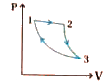
Consider a cycle followed by an engine as shown in figure,
1 to 2 is isothermal
2 to 3 is adiabatic
3 to 1 is adiabatic
Such a process does not exist because

A

heat is completely converted to mechanical energy in such a process, which is not possible.

B

mechanical energy is completely converted to heat in this process, which is not possible.

C

curves representing two adiabatic processes don't intersect.

D

curves representing an adiabatic process and an isothermal process don't intersect.

Text Solution

Verified by Experts

The correct Answer is:

A, C

(A) The given process is cyclic which starts from 1 and ends up at 1 again.
So , dU=0
Now, from first law of thermodynamics ,
dQ=dU+dW
`therefore` dQ=0+dW
`therefore` dQ=dW
Hence, heat energy supply to system converts totally into mechanical work which is not possible by second law of thermodynamics verifies option (A).
(C) Here, two curves are intersecting when the gas expands adiabatically from 2 to 3. It is not possible to return to the same state without being heat supplied. Hence, the process 3 to 1 cannot be adiabatic.
Promotional Banner

Topper's Solved these Questions

  • THERMODYANMICS

    KUMAR PRAKASHAN|Exercise Section-D Ncert Exemplar Solution (Very Short Answer )|5 Videos
  • THERMODYANMICS

    KUMAR PRAKASHAN|Exercise Section-D Ncert Exemplar Solution (Short Answer )|6 Videos
  • THERMODYANMICS

    KUMAR PRAKASHAN|Exercise Section-D Ncert Exemplar Solution (MCQs)|6 Videos
  • THERMAL PROPERTIES OF MATTER

    KUMAR PRAKASHAN|Exercise Question Paper (Section - D) (Answer following in brief :) Each carry 4 marks|1 Videos
  • UNITS AND MEASUREMENT

    KUMAR PRAKASHAN|Exercise Section -F (Questions from Module )|20 Videos

Similar Questions

Explore conceptually related problems

Consider a heat engine as shown in figure. Q_1 and Q_2 are heat added both to T_1 and heat taken from T_2 in one cycle of engine. W is the mechanical work done on the engine. If W gt 0 , then possibilities are :

A cycle followed by an engine (made of one mole of perfect gas in a cylinder with a piston) is shown in figure. A to B: volume constant B to C: adiabatic C to D: volume constant D to A: adiabatic V_C=V_D=2V_A=2V_B (a) In which part of the cycle heat is supplied to the engine from outside ? (b) In which part of the cycle heat is being given to the surrounding by the engine ? (c) What is the work done by the engine in one cycle ? Write your answer in term of P_A,P_B,V_A (d) What is the efficiency of the engine ? ( gamma=5/3 for the gas , C_V=3/2R for one mole )

The PT diagram for an ideal gas is shown in the figure, where AC is an adiabatic process, find the corresponding PV diagram.

The efficiency of a heat engine is defined as the ratio of the mechanical work done by the engine in one cycle to the heat absorbed from the high temperature source . eta = (W)/(Q_(1)) = (Q_(1) - Q_(2))/(Q_(1)) Cornot devised an ideal engine which is based on a reversible cycle of four operations in succession: isothermal expansion , adiabatic expansion. isothermal compression and adiabatic compression. For carnot cycle (Q_(1))/(T_(1)) = (Q_(2))/(T_(2)) . Thus eta = (Q_(1) - Q_(2))/(Q_(1)) = (T_(1) - T_(2))/(T_(1)) According to carnot theorem "No irreversible engine can have efficiency greater than carnot reversible engine working between same hot and cold reservoirs". Efficiency of a carnot's cycle change from (1)/(6) to (1)/(3) when source temperature is raised by 100K . The temperature of the sink is-

The efficiency of a heat engine is defined as the ratio of the mechanical work done by the engine in one cycle to the heat absorbed from the high temperature source . eta = (W)/(Q_(1)) = (Q_(1) - Q_(2))/(Q_(1)) Cornot devised an ideal engine which is based on a reversible cycle of four operations in succession: isothermal expansion , adiabatic expansion. isothermal compression and adiabatic compression. For carnot cycle (Q_(1))/(T_(1)) = (Q_(2))/(T_(2)) . Thus eta = (Q_(1) - Q_(2))/(Q_(1)) = (T_(1) - T_(2))/(T_(1)) According to carnot theorem "No irreversible engine can have efficiency greater than carnot reversible engine working between same hot and cold reservoirs". An inventor claims to have developed an engine working between 600K and 300K capable of having an efficiency of 52% , then -

One mole of an ideal monoatomic gas undergoes a cyclic process as shown in figure . Temperature at point 1 = 300K and process 2-3 is isothermal . Heat capacity of process 1rarr 2 is

The efficiency of a heat engine is defined as the ratio of the mechanical work done by the engine in one cycle to the heat absorbed from the high temperature source . eta = (W)/(Q_(1)) = (Q_(1) - Q_(2))/(Q_(1)) Cornot devised an ideal engine which is based on a reversible cycle of four operations in succession: isothermal expansion , adiabatic expansion. isothermal compression and adiabatic compression. For carnot cycle (Q_(1))/(T_(1)) = (Q_(2))/(T_(2)) . Thus eta = (Q_(1) - Q_(2))/(Q_(1)) = (T_(1) - T_(2))/(T_(1)) According to carnot theorem "No irreversible engine can have efficiency greater than carnot reversible engine working between same hot and cold reservoirs". A carnot engine whose low temperature reservoir is at 7^(@)C has an efficiency of 50% . It is desired to increase the efficiency to 70% . By how many degrees should the temperature of the high temperature reservoir be increased?

The slope of graph as shown in figure at points 1,2 and 3 is m_(1), m_(2) and m_(3) respectively then

Statement - 1 : In following figure curve (i) and (iv) represent isothermal process while (ii) & (iii) represent adiabatic process. Statement - 2 :The adiabatic at any point has a steeper slope than the isothermal through the same point .

A gas is expanded from volume V_(0) = 2V_(0) under three different processes. Process 1 is isobaric process, process 2 is isothermal and process 3 is adiabatic. Let DeltaU_(1), DeltaU_(2) and DeltaU_(3) be the change in internal energy of the gas in these three processes. then
