Home
Class 11
PHYSICS
A cycle followed by an engine (made of o...

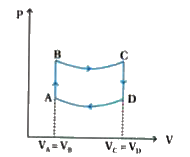
A cycle followed by an engine (made of one mole of perfect gas in a cylinder with a piston) is shown in figure.

A to B: volume constant
B to C: adiabatic
C to D: volume constant
D to A: adiabatic
`V_C=V_D=2V_A=2V_B`
(a) In which part of the cycle heat is supplied to the engine from outside ?
(b) In which part of the cycle heat is being given to the surrounding by the engine ?
(c) What is the work done by the engine in one cycle ? Write your answer in term of `P_A,P_B,V_A`
(d) What is the efficiency of the engine ? (`gamma=5/3` for the gas , `C_V=3/2R` for one mole )

Text Solution

Verified by Experts

(a) For the process A to B, volume is constant
So, dV = 0 `therefore` dW = 0
From first law of thermodynamics in,
dQ = dU + đW, dW = 0
`therefore` dQ=dU
Hence, in this process heat supplied is utilised to increases internal energy of the system.
As pressure is increased at constant volume (From Gay-Lussac.s law) i.e. P`prop` T and internal energy is proportional to temperature and hence internal energy increases with temperature `therefore dU gt 0`
`therefore` From dQ=dU, dQ `gt` 0 , so in process AB heat is supplied to the system.
(b)From dQ = dU, dQ > 0, so in process AB heat is supplied to the system. (b) In CD process, volume remains constant but pressure decreases. Hence, from P`prop` T, temperature also decreases so heat is being given to the surrounding by the engine.
(c) To calculate work done by the engine in one cycle , we should calculate work done in each part separately.
`therefore W_(AB)=int_A^P P dV=0` ...(1)
`W_(CD)=int_(V_C)^(V_D) P dV=0`...(2)
`W_(BC)=int_(V_B)^(V_C) P dV=K int_(V_B)^(V_C) (dV)/V^gamma=K/(1-gamma)[V^(1-gamma)]_(V_B)^(V_C)`
`=1/(1-gamma)[PV]_(V_B)^(V_C)` (adiabatic)
`=(P_C V_C -P_B V_B)/(1-gamma)`...(3)
Similarly , `W_(DA)=(P_AV_A-P_DV_D)/(1-gamma)` (adiabatic) ...(4)
B and C are along adiabatic curve BC,
`therefore P_B V_B^gamma =P_C V_C^gamma`
`therefore P_C=P_B(V_B/V_C)^gamma=P_B(1/2)^gamma =2^(-gamma)P_B`...(5)
Similarly, `P_D=2^(-gamma)P_A` ...(6)
Total work done by the engine in one cycle ABCDA
`W=W_(AB)+W_(BC)+W_(CD)+W_(DA)`
`=0+W_(BC)+0+W_(DA)`
`W=1/(1-gamma)(P_C V_C-P_B V_B)+1/(1-gamma)(P_AV_A-P_DV_D)`
`W=1/(1-gamma)[2^(-gamma)P_B(2V_B)-P_BV_B]+1/(1-gamma)[P_A V_A-2^(-gamma)P_A (2V_A)]`
`W=1/(1-gamma)[P_B V_B 2^(-gamma+1) - P_B V_B +P_A V_A -2^(-gamma+1)P_A V_A]`
`therefore W=1/(1-gamma) [P_B V_B (2^(gamma-1)-1) -P_A V_A (2^(1-gamma)-1)]` but `V_A=V_B`
`therefore W=(2^(1-gamma)-1)/(1-gamma)[P_B V_A-P_A V_A]`
`=(2^(1-gamma)-1)/(1-gamma)V_A(P_B-P_A)`
Putting `gamma=5/3` and simplifying
`W=3/2 [1-(1/2)^(2/3)](P_B-P_A)V_A`
(D) Efficiency `eta="Net work"/"Heat supplied"`
`=(3/2[1-(1/2)^(2/3)](P_B-P_A)V_A)/(3/2(P_B-P_A)V_A)`
`=[1-(1/2)^(2/3)]`
Promotional Banner

Topper's Solved these Questions

  • THERMODYANMICS

    KUMAR PRAKASHAN|Exercise Section-E MCQs|42 Videos
  • THERMODYANMICS

    KUMAR PRAKASHAN|Exercise Section-F Questions from Module|20 Videos
  • THERMODYANMICS

    KUMAR PRAKASHAN|Exercise Section-D Ncert Exemplar Solution (Short Answer )|6 Videos
  • THERMAL PROPERTIES OF MATTER

    KUMAR PRAKASHAN|Exercise Question Paper (Section - D) (Answer following in brief :) Each carry 4 marks|1 Videos
  • UNITS AND MEASUREMENT

    KUMAR PRAKASHAN|Exercise Section -F (Questions from Module )|20 Videos

Similar Questions

Explore conceptually related problems

A cycle followed by an engine (made of one mole of an ideal gas in a cylinder with a piston) is shown in figure. Find heat exchanged by the engine, with the surroundings for each section of the cycle. C_V=3/2R (a) A to B : constant volume (b) B to C: constant pressure (c) C to D: adiabatic (d) D to A: constant pressure

A diatomic ideal gas is used in a Carnot engine as the working substance. If during the adiabatic expansion part of the cycle the volume of the gas increase from V to 32V, the efficiency of the engine is

Consider a cycle followed by an engine as shown in figure, 1 to 2 is isothermal 2 to 3 is adiabatic 3 to 1 is adiabatic Such a process does not exist because

Consider one mole of perfect gas in a cylinder of unit cross section with a piston attached as shown in figure. A spring (spring constant k) is attached (unstretched length L ) to the piston and to the bottom of the cylinder. Initially the spring is unstretched and the gas is in equilibrium. A certain amount of heat Q is supplied to the gas causing an increase of value from V_0 to V_1 . (a) What is the initial pressure of the system ? (b) What is the final pressure of the system ? (c) Using the first law of thermodynamics, write down a relation between Q, P_a , V, V_0 and k.

Consider a P-V diagram in which the path followed by one mole of perfect gas in a cylindrical container is shown in figure. (a) Find the work done when the gas is taken from state 1 to state 2. (b) What is the ratio of temperature T_1/T_2 if V_2=2V_1 ? (c) Given the internal energy for one mole of gas at temperature T is 3/2RT , find the heat 2 supplied to the gas when it is taken from state 1 to 2, with V_2 = 2V_1

From the given figure identify A,B,C and D

From the given figure identify A,B,C and D

Two moles of an ideal monoatomic gas, initially at pressure p_1 and volume V_1 , undergo an adiabatic compression until its volume is V_2 . Then the gas is given heat Q at constant volume V_2 . (i) Sketch the complete process on a p-V diagram. (b) Find the total work done by the gas, the total change in its internal energy and the final temperature of the gas. [Give your answer in terms of p_1,V_1,V_2, Q and R ]

A weightless piston divides a thermally insulated cylinder into two parts of volumes V and 3V. 2 moles of an ideal gas at pressure P = 2 atmosphere are confined to the part with volume V =1 litre. The remainder of the cylinder is evacuated. The piston is now released and the gas expands to fill the entire space of the cylinder. The piston is then pressed back to the initial position. Find the increase of internal energy in the process and final temperature of the gas. The ratio of the specific heats of the gas, gamma =1.5 .

Two moles of helium gas ( gamma = 5 / 3 ) are initially at 27^@C and occupy a volume of 20 litres . The gas is first expanded at constant pressure until the volume is doubled. Then it undergoes an adiabatic change until the temperature returns to its initial value. (a) Sketch the process in a p_V diagram. (b) What is the final volume and pressure of the gas ? (c) What is the work done by the gas?
