Home
Class 11
PHYSICS
Consider one mole of perfect gas in a cy...

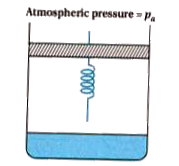
Consider one mole of perfect gas in a cylinder of unit cross section with a piston attached as shown in figure. A spring (spring constant k) is attached (unstretched length L ) to the piston and to the bottom of the cylinder. Initially the spring is unstretched and the gas is in equilibrium. A certain amount of heat Q is supplied to the gas causing an increase of value from `V_0` to `V_1`.

(a) What is the initial pressure of the system ?
(b) What is the final pressure of the system ?
(c) Using the first law of thermodynamics, write down a relation between Q, `P_a`, V, `V_0` and k.

Text Solution

Verified by Experts

(a) Initially system is in equilibrium hence pressure on piston will be the atmospheric pressure.
`therefore P_i=P_a`…(1)
(b)On supply of heat, volume of gas increases from `V_0` to `V_1`
`therefore` So increase in volume `Axxx =V_1-V_0`
(A=area of cross section of cylinder)
If displacement of piston is x then volume increase in cylinder = Area of base x height = `A xx x`
`therefore A xx x =DeltaV=V_1-V_0` (A=Area of cross section of cylinder)
`therefore x=V_1-V_0`...(2) [`because` A=1 unit]
`rArr` The force on piston by spring ,
F=kx
`therefore F=k(V_1-V_0)`....(3)
`therefore` Final pressure on the system ,
`P_f=P_i+F_A`
`therefore P_f=P_a+k(V_1-V_0)`...(4)
[`because` A=1 unit and from equ. (1) and (3)]
It is the final pressure on the gas.
(c) If the final temperature of gas is T, because the walls of cylinder are insulated then increase in internal energy,
`DeltaU=C_V DeltaT` [ `because mu`=1 mole]
`therefore DeltaU=C_V (T-T_0)`..(5)
`rArr` Equation of gas at final state,
`P_f V_f =RT`
`therefore T=(P_fV_l)/R [ because V_f =V_1]`
`therefore T=[(P_a+k(V_1-V_0))/R]V_1`
`rArr` Volume of gas increased so work done by gas
`DeltaW=P_a DeltaV` + increase in potential energy of spring
`therefore DeltaW=P_a (V_1-V_0)+1/2kx^2`
`=P_0(V_1-V_0)+1/2k(V_1-V_0)^2` ...(6)
From first law of thermodynamics ,
`DeltaQ=DeltaU+DeltaW`
`therefore DeltaQ=C_V (T-T_0)+P_a (V_1-V_0)+1/2k(V_1-V_0)^2` (From equation (5) and (6) is required relation.
Promotional Banner

Topper's Solved these Questions

  • THERMODYANMICS

    KUMAR PRAKASHAN|Exercise Section-E MCQs|42 Videos
  • THERMODYANMICS

    KUMAR PRAKASHAN|Exercise Section-F Questions from Module|20 Videos
  • THERMODYANMICS

    KUMAR PRAKASHAN|Exercise Section-D Ncert Exemplar Solution (Short Answer )|6 Videos
  • THERMAL PROPERTIES OF MATTER

    KUMAR PRAKASHAN|Exercise Question Paper (Section - D) (Answer following in brief :) Each carry 4 marks|1 Videos
  • UNITS AND MEASUREMENT

    KUMAR PRAKASHAN|Exercise Section -F (Questions from Module )|20 Videos

Similar Questions

Explore conceptually related problems

Two springs are connected to a block of mass M is placed on a frictionless surface as shown in figure. If both springs have a spring constant k, the frequency of oscillation of the block is………

A spring with one end attached to a mass and the other to a rigid support is stretched and released.

A spring has spring constant k and l. If it cut into piece spring in the proportional to alpha : beta : gamma then obtain the spring constant of every piece in term of spring constant of original spring (Here, alpha, beta " and "gamma are integers).

A block of mass m suspended from a spring of spring constant k . Find the amplitude of S.H.M.

Assertion : Oscillations of hard spring are slow than soft spring. Reason : For hard spring constant is larger than soft spring constant.

Two cylinders A and B fitted with pistons contain equal amounts of an ideal diatomic gas at 300K. The piston of A is free to move, while that B is held fixed. The same amount of heat is given to the gas in each cylinder. If the rise in temperature of the gas in A is 30K, then the rise in temperature of the gas in B is

Two cylinders A and B fitted with pistons contain equal amounts of an ideal diatomic gas at 300K. The piston of A is free to move, while that B is held fixed. The same amount of heat is given to the gas in each cylinder. If the rise in temperature of the gas in A is 30K, then the rise in temperature of the gas in B is

A block of mass m lies on a horizontal frictionless surface and is attached to one end of a horizontal spring (with spring constant k ) whose other end is fixed . The block is intinally at rest at the position where the spring is unstretched (x=0) . When a constant horizontal force vec(F) in the positive direction of the x- axis is applied to it, a plot of the resulting kinetic energy of the block versus its position x is shown in figure. What is the magnitude of vec(F) ?

A block of mass m lies on a horizontal frictionless surface and is attached to one end of a horizontal spring (with spring constant k ) whose other end is fixed . The block is intinally at rest at the position where the spring is unstretched (x=0) . When a constant horizontal force vec(F) in the positive direction of the x- axis is applied to it, a plot of the resulting kinetic energy of the block versus its position x is shown in figure. What is the magnitude of vec(F) ?
