Home
Class 12
PHYSICS
Two charges - q and +q are located at po...

Two charges - q and +q are located at points (0, 0, - a) and (0,0, a), respectively.
How much work is done in moving a small test charge from the point (5, 0, 0) to (-7,0,0) along the x-axis ? Does the answer change if the path of the test charge between the same points is not along the x-axis ?

Text Solution

Verified by Experts
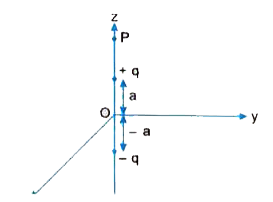
The given charges behave as an electric dipole and the dipole length is 2a, hence dipole moment `p = q.2a`.
As the motion of test charge from the point (5, 0, 0) to (-7,0,0) is along x-axis and electric potential is only along z-axis, hence work done = 0.
The answer does not change because the electric field is a conservative field and the work done simply depends on the position of initial and final points only.
Promotional Banner

Topper's Solved these Questions

  • ELECTROSTATIC POTENTIAL AND CAPACITANCE

    U-LIKE SERIES|Exercise CASE BASED/SOURCE-BASED INTEGRATED QUESTIONS|18 Videos
  • ELECTROSTATIC POTENTIAL AND CAPACITANCE

    U-LIKE SERIES|Exercise MULTIPLE CHOICE QUESTIONS|35 Videos
  • ELECTROSTATIC POTENTIAL AND CAPACITANCE

    U-LIKE SERIES|Exercise SELF ASSESSMENT TEST|1 Videos
  • ELECTROMAGNETICE INDUCTION

    U-LIKE SERIES|Exercise Self Assessment Test Section -D|1 Videos
  • EXAMINATION PAPER 2020 (SOLVED)

    U-LIKE SERIES|Exercise SECTION D|6 Videos

Similar Questions

Explore conceptually related problems

Two charges -q and + q are located at points A (0, 0, -a ) and B(0, 0 + a ) . How much work is done in moving a test charge from point (b, 0, 0 ) to Q (-b, 0, 0) ?

Two charges +q and -q are located at points A(0,0. -2) and B(0,0,2) respectively. How much work will be done in moving a test charge from point P (4,0,0) and Q(-5,0,0) ?

Two charges -q and +q are located at points (0, 0, –a) and (0, 0, a), respectively. (a) What is the electrostatic potential at the points (0, 0, z) and (x, y, 0) ? (b) Obtain the dependence of potential on the distance r of a point from the origin when r//a gt gt 1 . (c) How much work is done in moving a small test charge from the point (5,0,0) to (–7,0,0) along the x-axis? Does the answer change if the path of the test charge between the same points is not along the x-axis?

Two point charges q and - q are located at points (0 , 0 , - a ) and (0 , 0 , a) respectively : (a) Find the electrostatic potential at (0 , 0 , z) and ( x , y , 0). (b) How much work is done in moving a small test charge from the point (5 , 0 , 0 , ) to (-7 , 0 , 0 ) along the x - axis ? (c) How would your answer change if the path of the test charge between the same points is not along the x axis but along any other random path ? (d) If the above point charges are now placed in the same position in a uniform external electric field vecE , what would be the potential energy of the charge system in its orientation of unstable equilibrium ? Justify your answer in each case .

Two point charges -q and +q are located at points (0,0-a) and (0,0,a) resepctively.The electric potential at point (0,0,z) is (Z gt a)

Two fixed charges -2Q and +Q are located at points (-3a,0) and (+3a,0) respectively. Then which of the following statement is correct?

U-LIKE SERIES-ELECTROSTATIC POTENTIAL AND CAPACITANCE -ADDITIONAL EXERCISES
  1. Two charges - q and +q are located at points (0, 0, - a) and (0,0, a),...

    Text Solution

    |

  2. Two charges - q and +q are located at points (0, 0, - a) and (0,0, a),...

    Text Solution

    |

  3. Two charges - q and +q are located at points (0, 0, - a) and (0,0, a),...

    Text Solution

    |

  4. Figure shows a charge array known as an 'electric quadrupole'. For a p...

    Text Solution

    |

  5. An electrical technician requires a capacitance of 2 uF in a circuit a...

    Text Solution

    |

  6. What is the area of the plates of a 2 F parallel plate capacitor, give...

    Text Solution

    |

  7. Obtain the equivalent capacitance of the network in Fig. For a 300 V s...

    Text Solution

    |

  8. The plates of a parallel plate capacitor have an area of 90 cm^2? each...

    Text Solution

    |

  9. The plates of a parallel plate capacitor have an area of 90 cm^2? each...

    Text Solution

    |

  10. A 4 muF capacitor is charged by a 200 V supply. It is then disconnecte...

    Text Solution

    |

  11. Show that the force on each plate of a parallel plate capacitor has a ...

    Text Solution

    |

  12. Two large conducting spheres carrying charges Q1 and Q2 are brought cl...

    Text Solution

    |

  13. If Coulomb's law involved 1//r^3 dependence (instead of 1//r^2), would...

    Text Solution

    |

  14. A small test charge is released at rest at a point in an electrostatic...

    Text Solution

    |

  15. What is the work done by the field of a nucleus in a complete circular...

    Text Solution

    |

  16. We know that electric field is discontinuous across the surface of a c...

    Text Solution

    |

  17. What meaning would you give to the capacitance of a single conductor ?

    Text Solution

    |

  18. Guess a possible reason why water has a much greater dielectric consta...

    Text Solution

    |

  19. A parallel plate capacitor is to be designed with a voltage rating 1 k...

    Text Solution

    |

  20. Describe schematically the equipotential surfaces corresponding to ...

    Text Solution

    |

