

Home
Class 12
PHYSICS
Two identical pates P(1) and P(2) of cro...

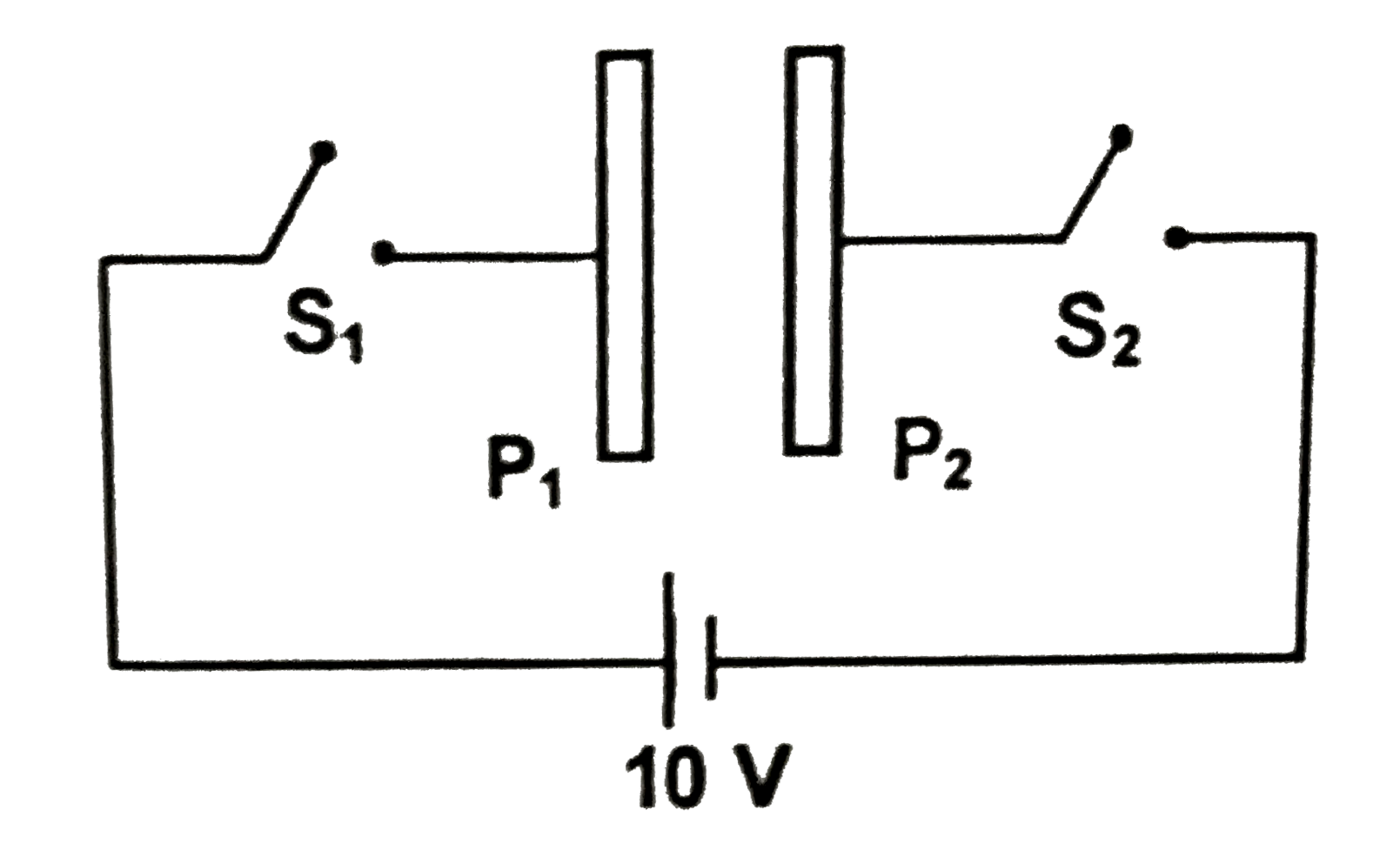
Two identical pates `P_(1)` and `P_(2)` of cross sectional area `A` are separated at a very small disance, `d`, where `(epsilon_(0)A)/d=2-SI` unit. Initially charge on the plate `P_(1)` is `-10C` and charge on the plate `P_(2)` is `+30C`. Now plate `P_(1)` and `P_(2)` are connected to positive and negative terminals of battery of potential difference 10 Volts with the help of switches `S_(1)` and `S_(2)` respectively. Choose the correct option (s)

Promotional Banner

Similar Questions

Explore conceptually related problems

Charges Q_0 and 2Q_0 are given to parallel plates A and B, respectively, and they are separated by a small distance. The capacitance of the given arrangement is C. Now, plates A and B are connected to positive and negative terminals of battery of potential difference V = 2Q_0//C respectively, as shown, then the work done by the battery is

Two identies conducting very large plates P_(1) and P_(2) having charges +4Q and +6Q are placed very closed to each other at separation d .The plate area of either face of the plate is A.the potential difference between plates P_(1) and P_(2) is

A charge of 2 C moves between two plates maintained at a potential difference of 1 volt. What is the energy acquired by the charge?

Two identical capacitor C_(1) and C_(2) are connected in series with a battery. They are fully charged. Now a dielectric slab is inserted between the plates of C_(2) . The potential across C_(1) will :

Two identical capacitor C_(1) and C_(2) are connected in series with a battery. They are fully charged. Now a dielectric slab is inserted between the plates of C_(2) . The potential across C_(1) will :

Two identical conducting very large plates P_1 and P_2 having charges +4Q and +6Q are placed very closed to each other at separation d. The plate area of either face of the plate is A. The potential difference between plates P_1 and P_2 is

Two identical conducting very large plates P_1 and P_2 having charges +4Q and +6Q are placed very closed to each other at separation d. The plate area of either face of the plate is A. The potential difference between plates P_1 and P_2 is