

Home
Class 12
PHYSICS
A stick of length L and mass M lies on a...

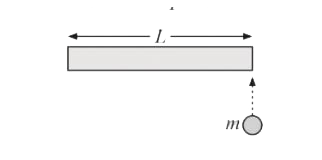
A stick of length L and mass M lies on a frictionless horizontal surface on which it is free to move in any way. A ball of mass m moving with speed v collides elastically with the stick as shown in the figure. If after the collision the ball comes to rest, then what would be the mass of the ball?

Promotional Banner

Similar Questions

Explore conceptually related problems

A Stick of length L and mass M lies on a fnctionless horizontal surface on which it is free to move in any way. A ball of mass m moving with speed v collides elastically with the stick as shownin figure-5.115. If after the collision ball comes to rest, then what should be the mass of the ball ?

A Stick of length L and mass M lies on a fnctionless horizontal surface on which it is free to move in any way. A ball of mass m moving with speed v collides elastically with the stick as shownin figure-5.115. If after the collision ball comes to rest, then what should be the mass of the ball ?

A ball of mass m moving with velocity v collides head on elastically with another identical ball moving with velocity - V. After collision

A ball of mass m moving with velocity v collides head on elastically with another identical ball moving with velocity - V. After collision

A ball of mass m, moving with a speed 2v_0 collides inelastically (e>0) with an identical ball at rest. Show that for head-on collision, both the balls move forward.

A ball of mass m moving with velocity v , collide with the wall elastically as shown in the figure. After impact the change in angular momentum about P is : .

A ball of mass m moving with velocity v , collide with the wall elastically as shown in the figure. After impact the change in angular momentum about P is : .

A mass m moving with a speed u collides on a similar stationary mass and sticks to it. What is the velocity after collision?

A ball of mass M moving with speed v collides perfectly inelastically with another ball of mass m at rest. The magnitude of impulse imparted to the first ball is