

Home
Class 12
PHYSICS
As shown, there is no friction between h...

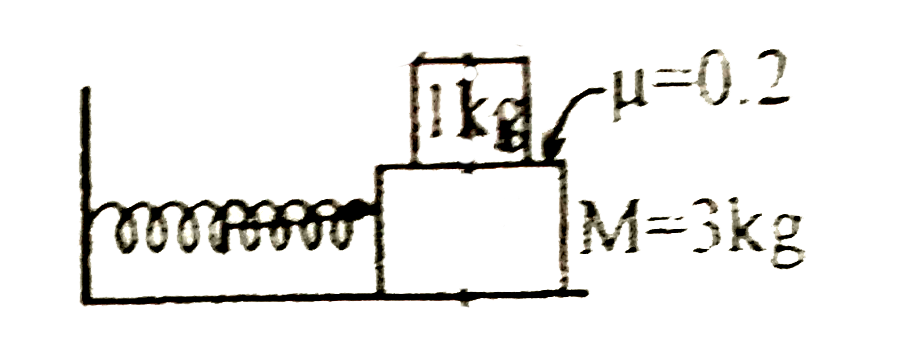
As shown, there is no friction between horizontal surface and the lower block `(M = 3 kg)`. But friction coefficient between both the block is `0.2`. Both the blocks move together with initial speed v towards the spring of force constant `k = 400 N//m` and compresses it. What can be the maximum valure of v, so that during the notion there is no slipping between the blocks ?

Promotional Banner

Similar Questions

Explore conceptually related problems

If coefficient of friction between both the block is mu- (1)/(2) . Find friction force acting between both block.

For the arrangement shown in the figure the coefficient of friction between the two blocks is mu . If both the blocks are identical and moving ,then the acceleration of each block is

For the arrangement shown in the figure the coefficient of friction between the two blocks is mu . If both the blocks are identical and moving ,then the acceleration of each block is

A small block of mass 2 kg is placed on a bigger block of mass 4 kg which is attached to horizontal spring of spring constant K = 500 N //m as shown in figure, coefficient of friction between block is 0.2 .Maximum amplitude of system so that there is no relative slipping between blocks.

A small block of mass 2 kg is placed on a bigger block of mass 4 kg which is attached to horizontal spring of spring constant K = 500 N //m as shown in figure, coefficient of friction between block is 0.2 .Maximum amplitude of system so that there is no relative slipping between blocks.

Find out the distance travelled by the block as shown in figure. If the initial speed of the block is v and mu is the friction coefficient between the surface of block and ground.

A block of mass m =1 kg placed on top of another block of mass M = 5 kg is attached to a horizontal spring of force constant K = 20 N/m as shown in figure. The coefficient of friction between the blocks is µ where as the lower block slides on a frictionless surface. The amplitude of oscillation is 0.4 m. What is the minimum value of µ such that the upper block does not slip over the lower block ?