

Home
Class 12
PHYSICS
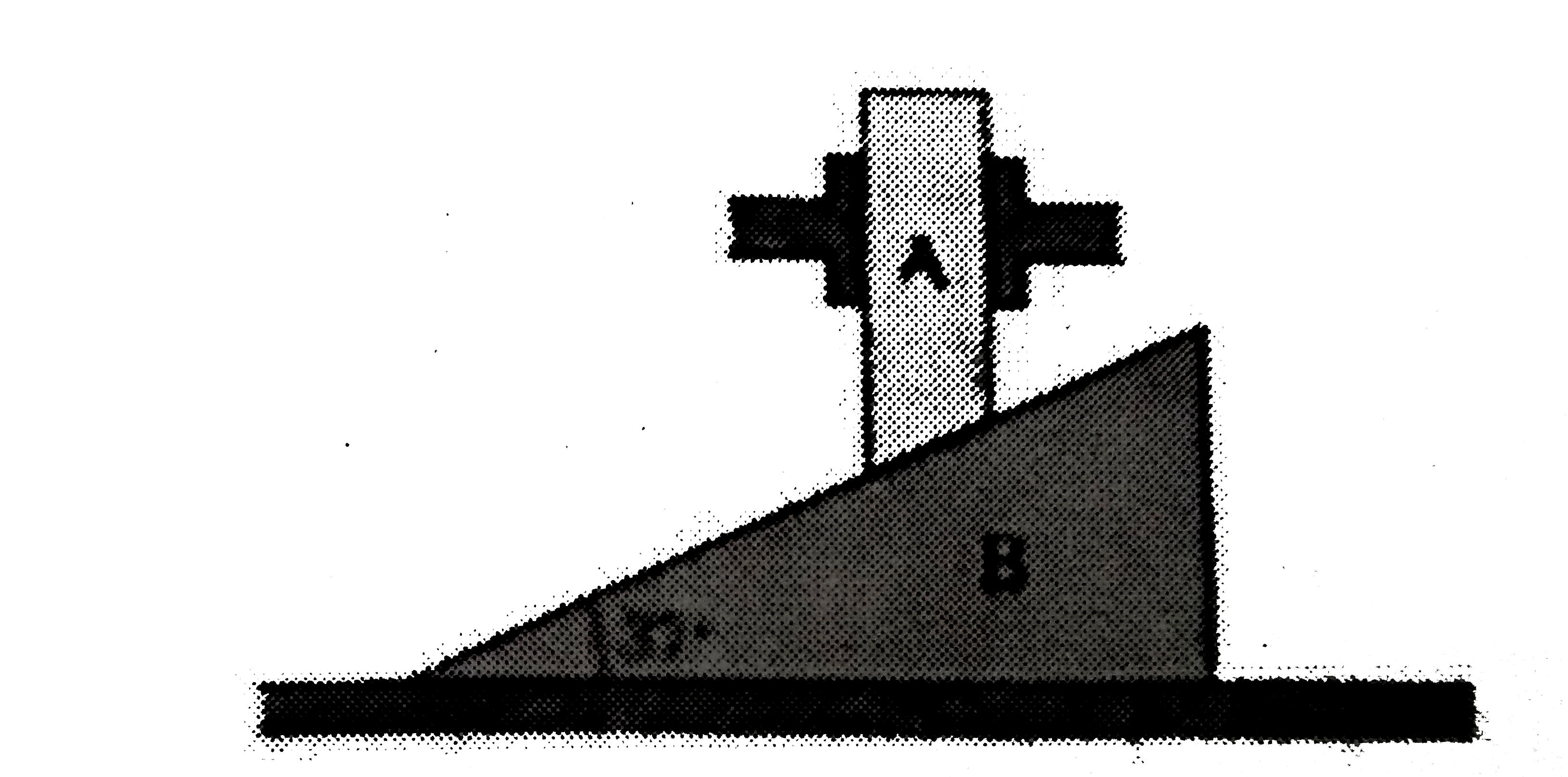
Rod A can slide in vertical direction pu...

Rod A can slide in vertical direction pushing the triangular wedge B towards right. The wedge is moving toward right with uniform acceleration `a_(s).` Find acceleration of the rod A.

Promotional Banner

Similar Questions

Explore conceptually related problems

If block B moves towards right with acceleration b, find the net acceleration of block A.

If block B moves towards right with acceleration b, find the net acceleration of block A.

Figure shows a block A constrained to slide along the inclined plane of the wedge B shown. Block A is attached with a string which passes through three ideal pulleys and connected to the wedge B. If wedge is pulled toward right with an acceleration a, find (a) the acceleration of the block with respect to wedge (b) the acceleration of the block with respect to ground.

Figure shows a block A constrained to slide along the inclined plane of the wedge B shown. Block A is attached with a string which passes through three ideal pulleys and connected to the wedge B. If wedge is pulled toward right with an acceleration a, find (a) the acceleration of the block with respect to wedge (b) the acceleration of the block with respect to ground.

Wedge B is pulled by an acceleration 2g towards left. Find the acceleration of block A-

In the arrangement shown in figure wedge of mass M moves towards left with an acceleration a. All surfaces are smooth. The acceleration of mass m relative to wedge is

A bead kept at the bottom of a wedge moves towards right with a velocity 2v on a frictionless surface. If the wedge moves towards left with a velocity v while accelerating towards right with an acceleration a as shown then the magnitude of acceleration of the bead is x units. Find x if v = 3 m/s a = a = 16 m/s2 R = 9 m ? 2v 기

A small body is placed at rest at the bottom B of a smooth hemispherical surface of wedge as shown. If the wedge is shifted horizontally towards right with acceleration a_(0) = 3g , find speed of the body w.r.t the wedge at the instant the body reaches points A.

A block A and wedge B connected through a string as shown. The wedge B is moving away from the wall with acceleration 2m//s^(2) horizontally and acceleration of block A is vertical upwards. Then