

Home
Class 12
PHYSICS
As shown in figure, when a spherical cav...

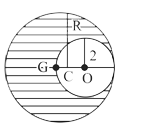
As shown in figure, when a spherical cavity (centered at O) of radius 2 is cut out of a uniform sphere of radius R (centered at C), the centre of mass of remaining (shaded) part of sphere is at G, i.e, on the surface of the cavity. R can be determined by the equation:

Promotional Banner

Similar Questions

Explore conceptually related problems

A hemispherical cavity of radius R is created in a solid sphere of radius 2R as shown in the figure . Then y -coordinate of the centre of mass of the remaining sphere is

A hemispherical cavity of radius R is created in a solid sphere of radius 2R as shown in the figure . They y -coordinate of the centre of mass of the remaining sphere is

A uniform solid sphere of radius R has a cavity of radius 1m cut from it if centre of mass of the system lies at the periphery of the cavity then

A uniform solid sphere of radius R has a cavity of radius 1m cut from it if centre of mass of the system lies at the periphery of the cavity then

A uniform solid sphere of radius R has a cavity of radius 1m cut from it if centre of mass of the system lies at the periphery of the cavity then

A uniform metal disck of radius R is taken and out of it a disc of diameter R is cut-off from the end. The center of mass of the remaining part will be

A uniform metal disck of radius R is taken and out of it a disc of diameter R is cut-off from the end. The center of mass of the remaining part will be

If a solid cavity whose diameteris removed from a solid sphere of radius R then the com of remaining part is at

Inside a uniform sphere of mass M and radius R, a cavity of radius R//3 , is made in the sphere as shown :

A non-conducting solid sphere has radius R and uniform charge density. A spherical cavity of radius R/4 is hollowed out of the sphere. The distance between center of cavity is R/2 . If the charge of the sphere is Q after the creation of the cavity and the magnitude of electric field at the center of the cavity is E=K((Q)/(4 pi in_(0)R^(2))) , determined the approximate value of K.