

Home
Class 11
PHYSICS
A body A of mass m(1)=1kg and a body B o...

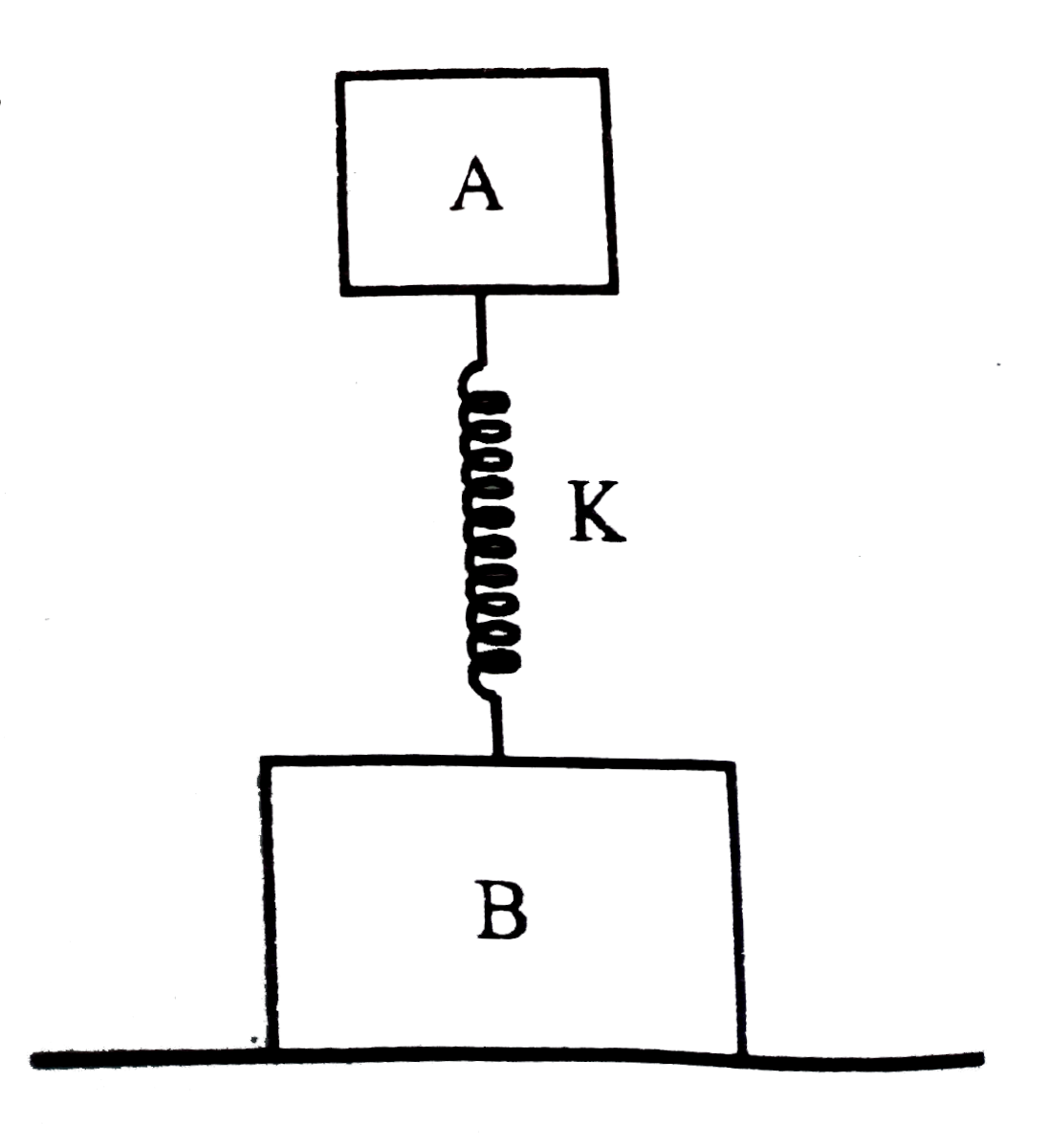
A body `A` of mass `m_(1)=1kg` and a body `B` of mass `m_(2)=4kg` are attached to the ends of a spring. The body `A` performs vertical simple harmonic oscillations of amplitude `a=1.6 cm` and angular frequency`omeg=25rads`. Neglecting the mass of the sppring determine the maximum and minimum values of force the system exerts on the surface on which in rests.
`["Take g"=10 m//s^(2)]`

Promotional Banner

Similar Questions

Explore conceptually related problems

A body A mass m_(1) = 1 kg and body B of mass m_(2) = 4.1 kg . The body A perform free vertical harmonic oscillations with the amplitude 1.6 cm and frequency 25 Hz . Neglecting the mass of the spring , find the maximum and m inimum value of force that the system exerts on the hearing surface.

A body A mass m_(1) = 1 kg and body B of mass m_(2) = 4.1 kg . The body A perform free vertical harmonic oscillations with the amplitude 1.6 cm and frequency 25 Hz . Neglecting the mass of the spring , find the maximum and m inimum value of force that the system exerts on the hearing surface.

A body A of mass m_(1) and body B of mass m_(2) are interconnected by a massless spring as shown. The body A performs free vertical harmonic oscillations with the amplitude A and frequency f . The maximum value of f such that body B does not leave the surface is

A body of mass m_1=4 kg moves at 5 hati m//s and another body of mass m_2=2 kg moves at 10 hati m//s . The kinetic energy of center of mass is

A body of mass 1 kg oscillates on a spring of force constant 16 N/m. Calculate the angular frequency.

Two bodies of masses 1 kg and 4 kg are connected to a vertical spring, as shown in the figure. The smaller mass executes simple harmonic motion of angular frequency "25 rad s"^(-1) , and amplitude 1.6 cm while the bigger mass remains stationary on the ground. The maximum force exerted by the system on the floor is ("take "g=10ms^(-2)) .

Two bodies of masses 1 kg and 4 kg are connected to a vertical spring, as shown in the figure. The smaller mass executes simple harmonic motion of angular frequency "25 rad s"^(-1) , and amplitude 1.6 cm while the bigger mass remains stationary on the ground. The maximum force exerted by the system on the floor is ("take "g=10ms^(-2)) .

A body A mass m_(1) exerts a force on another body B of mass m_(2) . If the acceleration of B be a_(2) , then the acceleration (in magnitude) of A is

A body A mass m_(1) exerts a force on another body B of mass m_(2) . If the acceleration of B be a_(2) , then the acceleration (in magnitude) of A is

A body A mass m_(1) exerts a force on another body B of mass m_(2) . If the acceleration of B be a_(2) , then the acceleration (in magnitude) of A is