


Topper's Solved these Questions
CIRCLES
ZEN PUBLICATION|Exercise ZEN ADDITIONAL QUESTIONS (MCQs)|1 VideosCIRCLES
ZEN PUBLICATION|Exercise ZEN ADDITIONAL QUESTIONS (VERY SHORT ANSWER [VSA] TYPE QUESTIONS)|14 VideosCIRCLES
ZEN PUBLICATION|Exercise TEXTUAL ( Exercise 4.1 )|7 VideosARITHMETIC PROGRESSIONS
ZEN PUBLICATION|Exercise ZEN ADDITIONAL QUESTIONS (HOTS [HIGHER ORDER THINKING SKILLS] - QUESTIONS)|4 VideosCO-ORDINATE GEOMETRY
ZEN PUBLICATION|Exercise ZEN ADDITIONAL QUESTIONS - HIGHER ORDER THINKING SKILLS [HOTS] QUESTIONS|14 Videos
Similar Questions
Explore conceptually related problems
ZEN PUBLICATION-CIRCLES-TEXTUAL ( Exercise 4.2 )
- Prove that the tangents drawn at the ends of a diameter fo a circle ar...
Text Solution
|
- Prove that the perpendicular at the point of contact to the tangen...
Text Solution
|
- The length of a tangent from a point A at distance 5 cm from the centr...
Text Solution
|
- Two concentric circle of radii 5 cm and 3cm are drawn. Find the length...
Text Solution
|
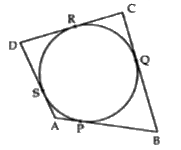
- Quadrilateral ABCD is drawn to circumscribe a circle. Prove that AB+CD...
Text Solution
|
- In the given figure PQ & RS are two parallel tangents to a circle o an...
Text Solution
|
- Prove that the angle between the two tangents drawn from an external ...
Text Solution
|
- Prove that the parallelogram circumscribing a circle is a rhombus.
Text Solution
|
- A triangle ABC is drawn to circumscribe a circle of radius 4 cm such t...
Text Solution
|