

Home
Class 12
PHYSICS
A uniform cylinder of radius 1 m, mass 1...

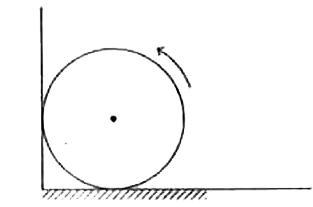
A uniform cylinder of radius 1 m, mass 1 kg spins about its axis with an angular velocity 20 rad/s. At certain moment, the cylinder is placed into a corner as shown in the figure. The coefficient of friction between the horizontal wall and the cylinder is `mu` , whereas the vertical wall is frictionless. If the number of rounds made by the cylinder is 5 before it stops, then the value of `mu` is (acceleration due to gravity, `g = 10 m//s^2` )

Promotional Banner

Similar Questions

Explore conceptually related problems

A uniform cylinder of radius R is spinned about it axis to the angular velocity omega_(0) and then placed into a corner,. The coeficient of friction between the corner walls and the cylinder is mu_(k) How many turns will the cylinder accomplish before it stops?

A uniform cylinder of radius R is spinned about it axis to the angular velocity omega_(0) and then placed into a corner,. The coeficient of friction between the corner walls and the cylinder is mu_(k) How many turns will the cylinder accomplish before it stops?

A uniform cylinder of the radius R ( = 3 m) is spin about its axis at an angular velocity omega_(0)(=40 sqrtpi" rad s"^(-1)) and placed between two perpendicular walls. The coefficient of friction between the walls and cylinder is mu(=2). Then, how many rotations will the cylinder make before it comes to rest?

An solid cylinder of mass 20 kg and radius 20 cm rotates about its axis with a angular speed 100 rad s^-1 . The angular momentum of the cylinder about its axis is.

A hollow cylinder of radius R rotates about its axis which is vertical. A block remains in contact with the inner wall if the frequency of rotation is f hertz, but falls at lower frequaencies. The coefficient of friction between the block and the cylinder is

A solid cylinder of mass 20 kg rotates about its axis with angular speed 100 rad/s. The radius of the cylinder is 0.25 m. Calculate the kinetic energy associated with the rotation of the cylinder.

An cylinder of mass m is rotated about its axis by an angular velocity omega and lowered gently on an inclined plane as shown in figure. Then : .