

Home
Class 11
PHYSICS
Soap bubble of radius R is blown at one ...

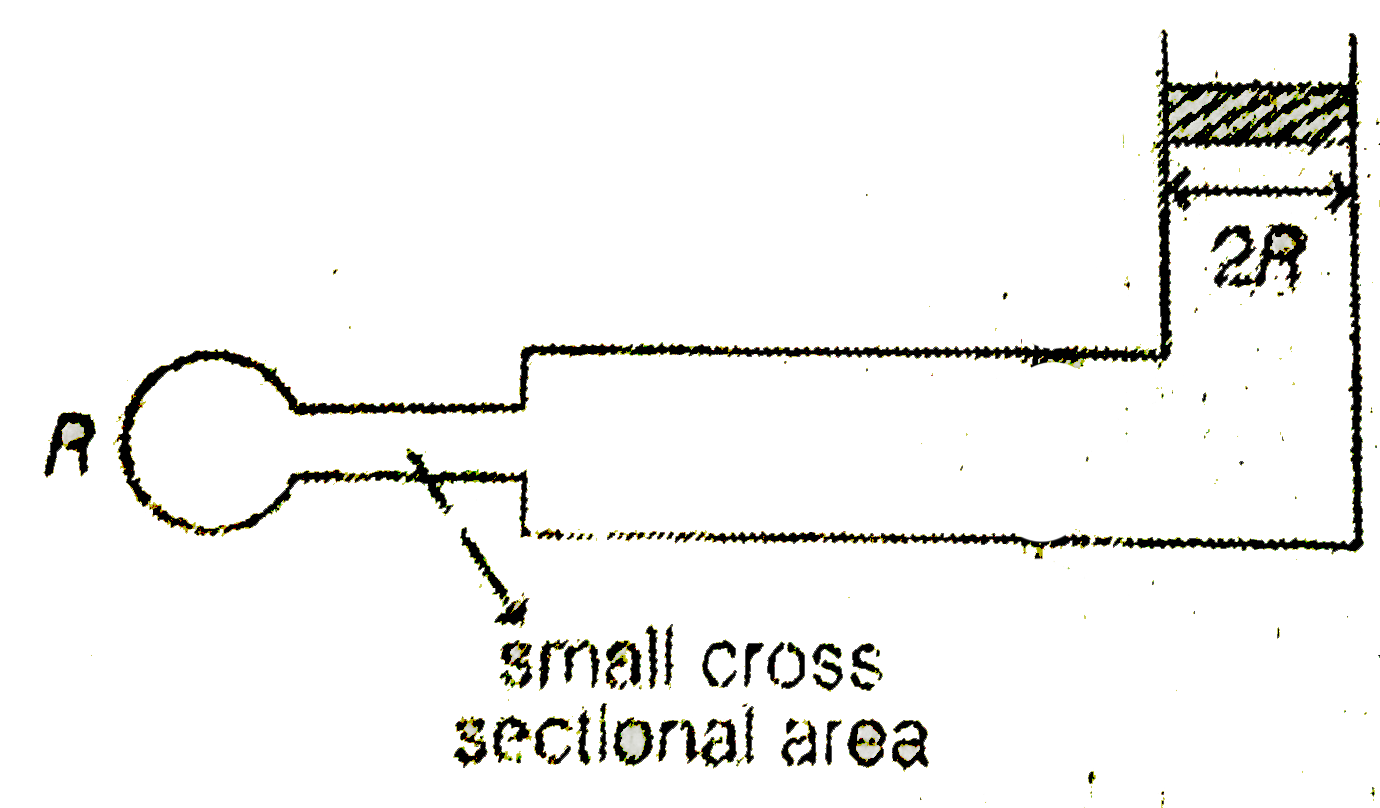
Soap bubble of radius R is blown at one end of a pipe of circular of circular cross-section of radius R as shown in diagram. On the vertical portion of pipe, there is a piston of mass m. T is surface tension of liquid.

Find the mass of piston for which it remain in equilibrium

Promotional Banner

Similar Questions

Explore conceptually related problems

Soap bubble of radius R is blown at one end of a pipe of circular of circular cross-section of radius R as shown in diagram. On the vertical portion of pipe, there is a piston of mass m. T is surface tension of liquid. If piston is slightly displaced in downward direction, then its acceleration when radius of bubble grows to 2R is

Soap bubble of radius R is blown at one end of a pipe of circular of circular cross-section of radius R as shown in diagram. On the vertical portion of pipe, there is a piston of mass m. T is surface tension of liquid. If piston is slightly displaced in downward direction, then its acceleration when radius of bubble grows to 2R is

A soap bubble of radius R is surrounded by another soap bubble of radius 2R, as shown. Take surface tension = S.

Excess pressure inside a soap bubble of radius r and surface tension T is

A soap bubble of radius r si blown up to form of bubble of radius 3r under isothermal conditions . What is the energy spent in doing so if the surface tension of soap solution is S.

A soap bubble of radius 'r' is blown up to form a bubble of radius 2r under isothemal conditions. If sigma be the surface tension of soap solution , the energy spent in doing so is

A soap bubble of radius 'r' is blown up to form a bubble of radius 2r under isothemal conditions. If sigma be the surface tension of soap solution , the energy spent in doing so is

A soap bubble of radius 'r' is blown up to form a bubble of radius 2r under isothemal conditions. If sigma be the surface tension of soap solution , the energy spent in doing so is

A soap bubble of radius r is blown up to form a bubble of radius 2r under isothermal conditions . If T is the surface tension of soap solution , the energy spent in blowing