

Home
Class 11
PHYSICS
A strange cat with a mass m(c ) is sitti...

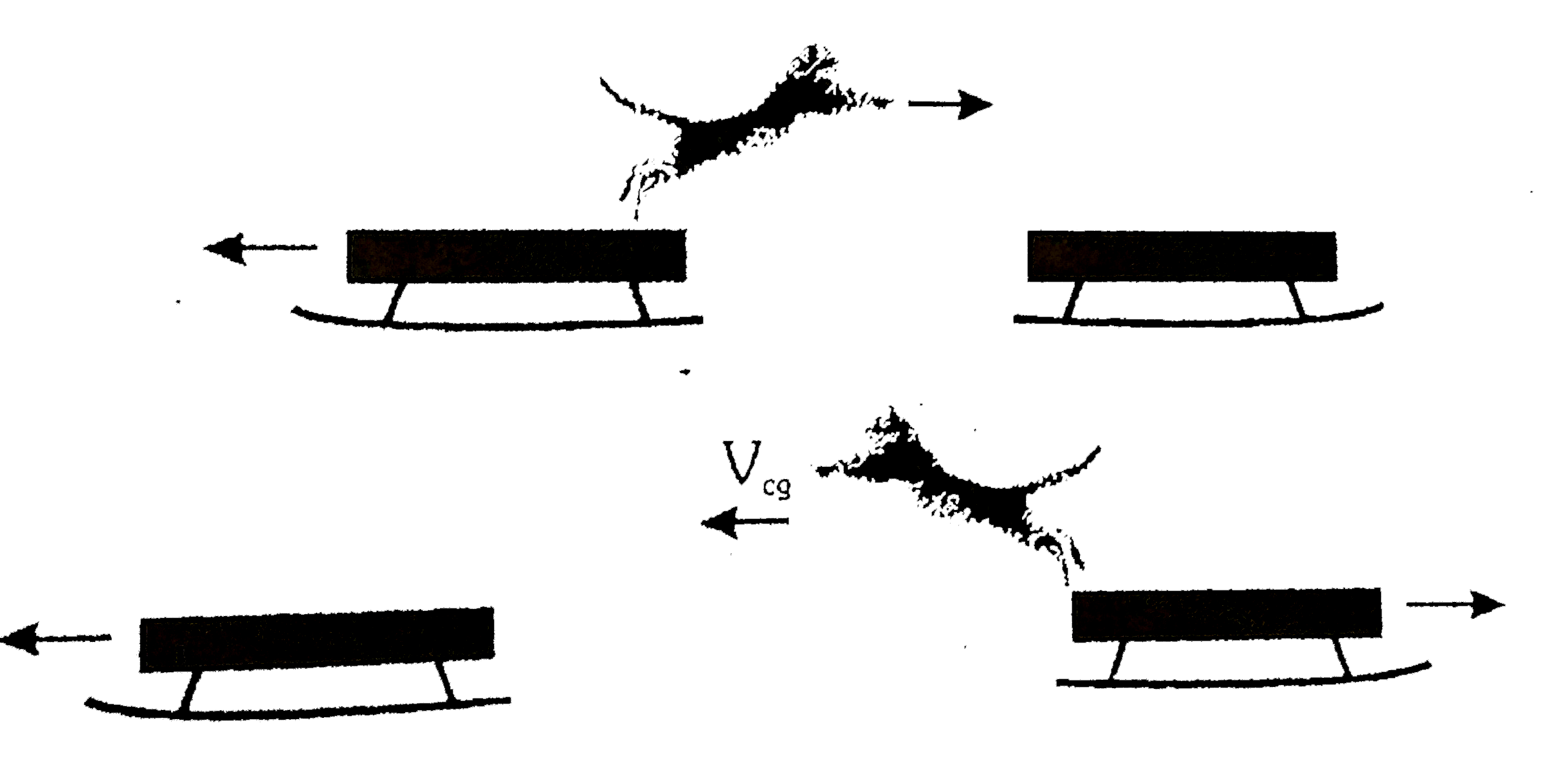
A strange cat with a mass `m_(c )` is sitting at rest on the left sled of a pair of identical sleds. The sleds hace mass `m_(s)` and sit on frictionless ice. Suddenly, the cat leaps to the right sled, traveling with a horizontal speed `v_(cg)` measured with respect ot the groun. The instant the cat reaches the right sled, it turns around and leaps back to the left sled. The horizontal component of the cat's speed is again `v_(cg)` measured with respect to the ground. The final speed of right sled in terms of the masses of the cat and sleds and the cat's leaping speed is (The cat remains on the left sled after its return) :-

Promotional Banner

Similar Questions

Explore conceptually related problems

A penguin of mass m stands at the right edge of a sled of mass 3m and length l . The sled lies on frictionless ice. The penguin starts moving towards left,reaches the left end and jumps with a velocity u and at an angle theta relative to ground. ( Neglect the height of the sled )

A penguin of mass m stands at the right edge of a sled of mass 3m and length l . The sled lies on frictionless ice. The penguin starts moving towards left,reaches the left end and jumps with a velocity u and at an angle theta relative to ground. ( Neglect the height of the sled )

A cat takes 5 leaps for every 4 leaps of a dog but 3 leaps of the dog are equal to 4 leaps of the cat. What is the ratio of the speeds of the cat to that of the dog?

The pulley shown in the diagram is frictionless. A cat of mass 1 kg moves up on the massless string so as to just lift a block of mass 2 kg. After some time, the cat stops moving with respect to the string. The magnitude of the change in the cat's acceleration is:

The pulley shown in the diagram is frictionless. A cat of mass 1kg moves up on the massless string so as to just lift a block of mass 2 kg, after some time, the cat stops moving with respect to the string. The magnitude of the change in the cat's accelerations is:

At the foot of a hill a certain velocity is imparted to a sled, as a result of which the sled moves up the hill to a point A and then down the hill. What are the directions of the normal and tangential components of the acceleration at point A ?

Calculate the work done if a sled is pulled forward 50m along a frictionless surface by a force of 250N at an angle of 60^@ to the horizontal.

A rabit takes 22 leaps for every 17 leaps of cat and 22 leaps of a rabit are equal to 17 leaps of the cat. What is the ratio of the speeds of rabit and cat?

A rabit takes 22 leaps for every 17 leaps of cat and 22 leaps of a rabit are equal to 17 leaps of the cat. What is the ratio of the speeds of rabit and cat?