


Similar Questions
Explore conceptually related problems
Recommended Questions
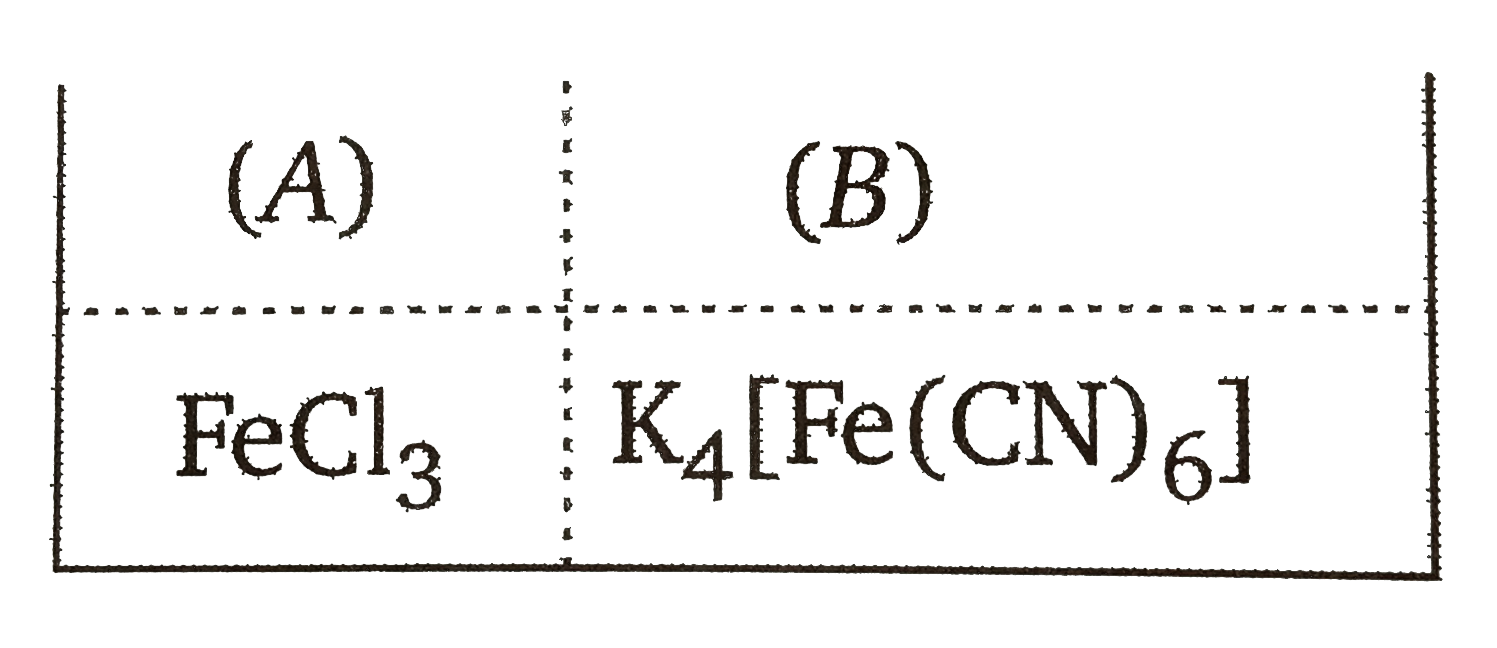
- Two solution (A) containing FeCl(3(aq.)) and separated by semipermea...
Text Solution
|
- FeCl(3) on reaction with K(4)[Fe(CN)(6)] in aqueous solution gives blu...
Text Solution
|
- Two solution (A) containing FeCl(3(aq.)) and separated by semipermeabl...
Text Solution
|
- Two solution (A)containing Fecl(3)(aq) and(B) semipermeable membrance ...
Text Solution
|
- FeCI(3) on reaction with K(4)[Fe(CN)(6)] in aqueous solution gives blu...
Text Solution
|
- F(3)CI(3) on reaction with K(4)[Fe(CN)(6)] in aqueous solution gives b...
Text Solution
|
- Addition of K(4)[Fe(CN)(6)] solution to FeCl(3) solution gives
Text Solution
|
- K(3)[Fe(CN)(6)]+FeCl(2) to Fe(3)[Fe(CN)(6)](2)darr
Text Solution
|
- Solution (A) containing FeCl(3) is separated from solution (B) contain...
Text Solution
|