

Home
Class 12
PHYSICS
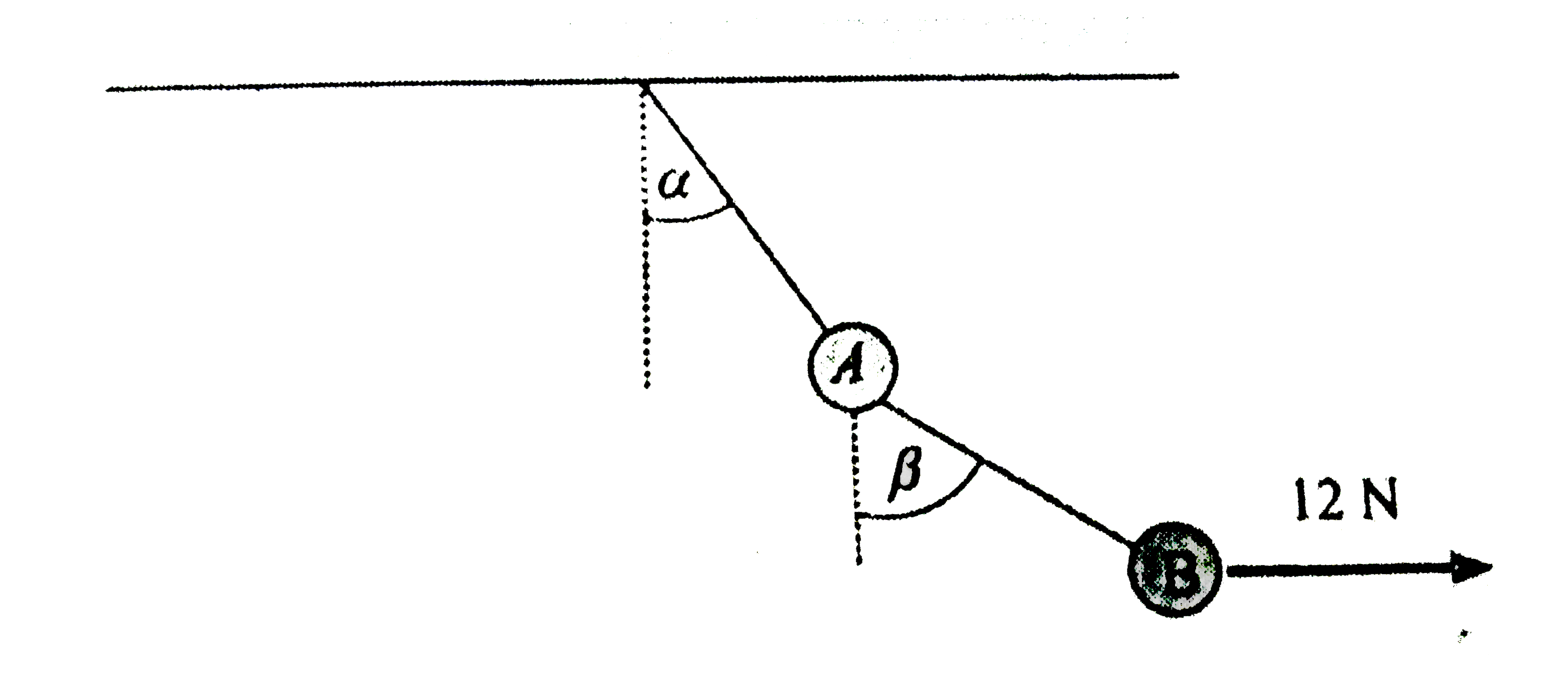
Two balls A and B weighing 7 N and 9 N a...

Two balls A and B weighing 7 N and 9 N are connected by a light code. The system is suspended from a fixed support by connecting the ball A with another ligh cord. The ball B is pulled aside by a horizontal force 12 N and equilibrium is established. Angles `alpha and beta` respectively are

Promotional Banner

Similar Questions

Explore conceptually related problems

Two small balls, each of mass m are connected by a light rigid rod of length L. The system is suspended from its centre by a thin wire of torsional constant k. The rod is rotated about the wire through an angle theta_0 and released. Find the tension in the rod as the system passes through the mean position.

Two small balls, each of mass m are connected by a light rigid rod of length L. The system is suspended from its centre by a thin wire of torsional constant k. The rod is rotated about the wire through an angle theta_0 and released. Find the tension in the rod as the system passes through the mean position.

Two blocks A and B each of 20 kg lying on a frictionless table are connected by a light string. The system is pulled horizontally with an acceleration of 2 ms ^ ( - 2 ) by a force F on B. The tension in the string will be

Two identical balls A and B each of mass 0.1 kg are attached to two identical mass less is springs. The spring-mass system is constrained to move inside a right smooth pipe bent in the form of a circle as shown in figure . The pipe is fixed in a horizontal plane. The center of the balls can move in a circle of radius 0.06 m . Each spring has a natural length of 0.06 pi m and force constant 0.1 N//m . Initially, both the balls are displaced by an angle theta = pi//6 radians with respect to diameter PQ of the circle and released from rest. a. Calculate the frequency of oscillation of the ball B.

Two identical balls A and B each of mass 0.1 kg are attached to two identical mass less is springs. The spring-mass system is constrained to move inside a right smooth pipe bent in the form of a circle as shown in figure . The pipe is fixed in a horizontal plane. The center of the balls can move in a circle of radius 0.06 m . Each spring has a natural length of 0.06 pi m and force constant 0.1 N//m . Initially, both the balls are displaced by an angle theta = pi//6 radians with respect to diameter PQ of the circle and released from rest. a. Calculate the frequency of oscillation of the ball B. b. What is the total energy of the system ? c. Find the speed of the ball A when A and B are at the two ends of the diameter PQ.

Two identical balls A and B each of mass 0.1 kg are attached to two identical mass less is springs. The spring-mass system is constrained to move inside a right smooth pipe bent in the form of a circle as shown in figure . The pipe is fixed in a horizontal plane. The center of the balls can move in a circle of radius 0.06 m . Each spring has a natural length of 0.06 pi m and force constant 0.1 N//m . Initially, both the balls are displaced by an angle theta = pi//6 radians with respect to diameter PQ of the circle and released from rest. a. Calculate the frequency of oscillation of the ball B. b. What is the total energy of the system ? c. Find the speed of the ball A when A and B are at the two ends of the diameter PQ.

Two small balls A and B of positive charge Q each and masses m and 2m, respectively, are connected by a nonconducting light rod of length L. This system is released in a uniform electric field of strength E as shown. Just after the release (assume no other force acts on the system)

Two very small balls A and B of masses 4.0kg and 5.0kg are affixed to the ends of a light inextensible cord that passes through a frictionless ring of radius negligible compared to the length of the cord. The ring is fixed at some height above the ground . Ball A is pulled aside and given a horizontal velocity so that it stars moving on a circular path parallel to the ground, keeping ball B in euilibrium as shown. speed of the ball A is closest to