

Home
Class 11
PHYSICS
The concave surface of a thin concavo -c...

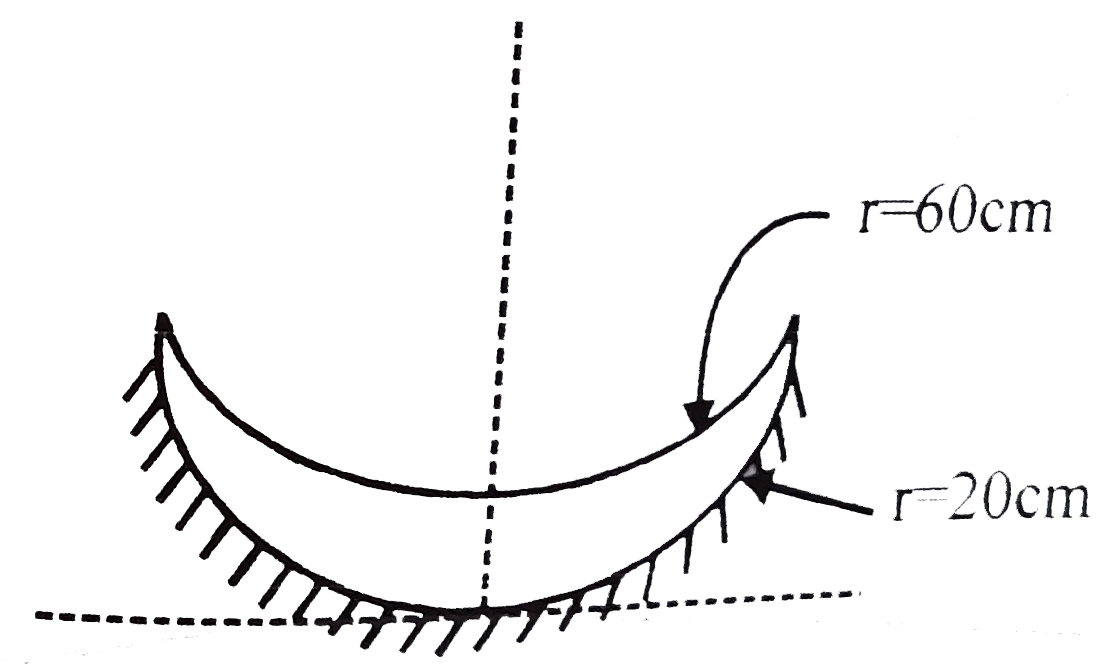
The concave surface of a thin concavo -convex lens of glass of refractive index`1.5`has a radius of curvature of `20cm`.The concave surface has a radius of curvature of `60cm`.The covnex side is silvered and placed on a horizontal surface as shown in the figure.

The focal length of the combibnation has the magnitude.

Promotional Banner

Similar Questions

Explore conceptually related problems

The concave surface of a thin concavo -convex lens of glass of refractive index 1.5 has a radius of curvature of 20cm .The concave surface has a radius of curvature of 60cm .The covnex side is silvered and placed on a horizontal surface as shown in the figure. The combination behaves like

The concave surface of a thin concavo -convex lens of glass of refractive index 1.5 has a radius of curvature of 20cm .The concave surface has a radius of curvature of 60cm .The covnex side is silvered and placed on a horizontal surface as shown in the figure. A small object is placed on the principal axis of the combination,at a distance of 30cm in front of the mirror.The magnification of the image is

The convex surface of a thin concave-convex lens of glass of refractive index 1.5 has a radius of curvature 20 cm. The concave surface has a radius of curvature 60 cm. The convex side is silvered and placed on a horizontal surface as shown in figure. (a) Where should a pin be placed on the axis so that its image is formed at the same place ? (b) If the concave part is filled with water (mu = 4/3), find the distance through which the pin should be moved so that the image of the pin again coincides with the pin.

The convex surface of a thin concave-convex lens of glass of refractive index 1.5 has a radius of curvature 20 cm. The concave surface has a radius of curvature 60 cm. The convex side is silvered and placed on a horizontal surface as shown in figure. (a) Where should a pin be placed on the axis so that its image is formed at the same place ? (b) If the concave part is filled with water (mu = 4/3), find the distance through which the pin should be moved so that the image of the pin again coincides with the pin.

The convex surface of a thin concave-convex lens of glass of refractive index 1.5 has a radius of curvature 20 cm. The concave surface has a radius of curvature 60 cm. The convex side is silvered and placed on a horizontal surface as shown in figure. (a) Where should a pin be placed on the axis so that its image is formed at the same place ? (b) If the concave part is filled with water (mu = 4/3), find the distance through which the pin should be moved so that the image of the pin again coincides with the pin.

The convex surface of a thin concavo-convex lens of glass of refractive index 1.5 has radius of curvature 10 cm. The concave surface has a radius of curvature 30 cm. The convex side is silvered and placed on a horizontal surface. Then where should a pin be placed on the optic axis such that its image is formed at the same place?

The convex side of a thin concavo-convex lens of glass of refractive index 1.5 has a radius of curvature of 20cm. The concave surface has a radius of curvature of 60cm. What is the focal length of the lens? The convex side is silvered and placed on a horizontal surface. What is the effective focal length of the silvered lens? The concave part is filled with water with refractive index 1.33. What is the effective focal length of the combined glass and water lens? If the convex side is silvered what is the new effective focal length of the silvered compound lens?