

Home
Class 11
PHYSICS
Mass m(1) moves on a slope making an ang...

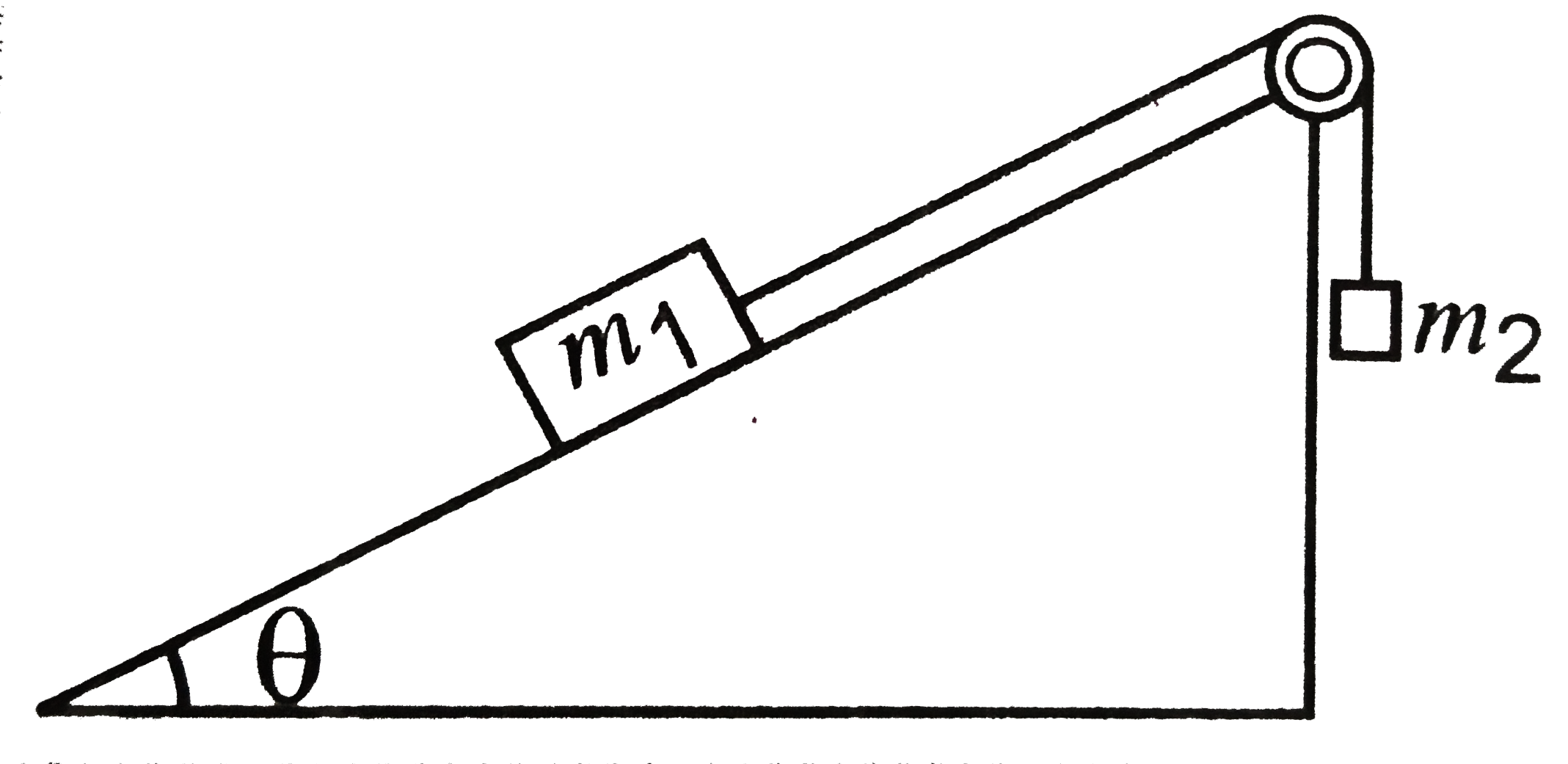
Mass `m_(1)` moves on a slope making an angle `theta` with the horizontal and is attached to mass `m_(2)` by a string passing over a frictionless pulley as shown in The co-efficient of friction between `m_(1)` and the slopping surface is `mu` Which of the following statements are true ? .

Promotional Banner

Similar Questions

Explore conceptually related problems

Mass m_1 moves on a slope making an angle theta with the horizontal and is attached to mass m_2 by a string passing over a frictionless pulley as shown in the figre. The co-efficient of frition between m_1 and the slopping surfaace is mu . Which of the following statements are true?

Mass moves on a slope making an angle 9 with the horizontal and is attached to mass m_(2) by a string passing over a frictionless pulley . The coefficient of friction between nq and the sloping surface is mu . Which of the following statements are true ?

A trolley of mass M is attached to a block of mass m by a string passing over a frictionless pulley as shown in the figure. If the coefficient of friction between the horizontal surface and wheels of trolley is mu , then acceleration of the block m and that of trolley M on releasing the system is :-

A block with mass m_(1) is placed on an inclined plane with slope angle alpha and is connected to a second hunging block with mass m_(2) by a cord passing over a small . Friction less pulley as shown in fig 7.247 . The coefficient of static friction is mu_(2) and the coefficient of kinetic friction is mu_(s) a. Find the mass m_(2) for which block m_(1) moves up plane at constant speed once it is set in motion b. Find the mass m_(2) for which block m_(1) moves down the plane at constant speed once it is set in motion c.For what range of m_(2) will the blocks remain at rest if they are released from rest?

A block with mass m_(1) is placed on an inclined plane with slope angle alpha and is connected to a second hunging block with mass m_(2) by a cord passing over a small . Friction less pulley as shown in fig 7.247 . The coefficient of static friction is mu_(2) and the coefficient of kinetic friction is mu_(s) a. Find the mass m_(2) for which block m_(1) moves up plane at constant speed once it is set in motion b. Find the mass m_(2) for which block m_(1) moves down the plane at constant speed once it is set in motion c.For what range of m_(2) will the blocks remain at rest if they are released from rest?

Three masses m, 2m and 3m are attached with light string passing over a fixed frictionless pulley as shown in the figure. The tension in the string between 2m and 3m is (g is acceleration due to gravity)

Two blocks of masses M_(1)=4 kg and M_(2)=6kg are connected by a string of negligible mass passing over a frictionless pulley as shown in the figure below. The coefficient of friction between the block M_(1) and the horizontal surface is 0.4. when the system is released, the masses M_(1) and M_(2) start accelrating. What additional mass m should be placed over M_(1) so that the masses (M_(1)+m) slide with a uniform speed?

Two blocks of masses M_(1)=4 kg and M_(2)=6kg are connected by a string of negligible mass passing over a frictionless pulley as shown in the figure below. The coefficient of friction between the block M_(1) and the horizontal surface is 0.4. when the system is released, the masses M_(1) and M_(2) start accelrating. What additional mass m should be placed over M_(1) so that the masses (M_(1)+m) slide with a uniform speed?

If two masses m_1 and m_2 (m_1 gt m_2) tied to string moving over a frictionless pulley, then acceleration of masses