

Home
Class 12
PHYSICS
A solid sphere is set into motion on a r...

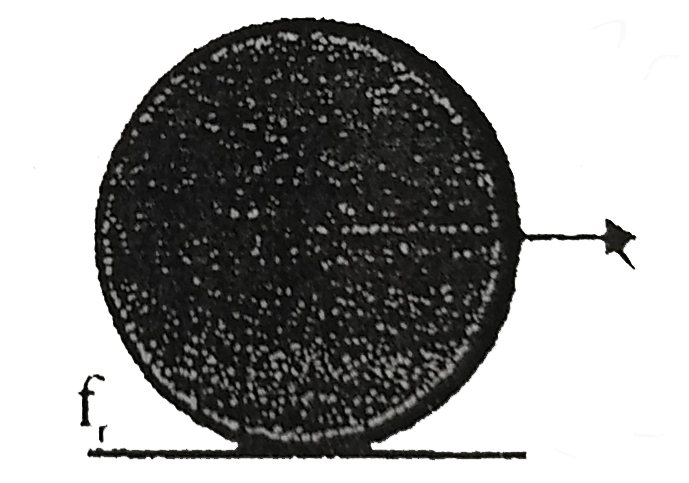
A solid sphere is set into motion on a rough horizontal surface with a linear velocity v in the forward direction and an angular velocity v/R in the anticlockwise direction as shown in the figure. Find the linear speed of the sphere, when it stops rotating.

Promotional Banner

Similar Questions

Explore conceptually related problems

A solid sphere is set into motion on a rough horizontal surfce with a linar speed v in the forward direction and an angular speed v/R in the anticlockwise direction as shown infigure . Find the linear speed of the sphere a. where it stops rotating and b. when slipping finally ceases sand pure rolling starts.

A solid sphere is set into motion on a rough horizontal surfce with a linar speed v in the forward direction and an angular speed v/R in the anticlockwise direction as shown infigure . Find the linear speed of the sphere a. where it stops rotating and b. when slipping finally ceases sand pure rolling starts.

A cicular disc of mass m and radius R is set into motion on a horizontal floor with a linear speed v in the forward direction and an angular speed omega=(v)/(R) in clockwise direction as shown in figure. Find the magnitude of the total angular momentum of the disc about bottom most point O of the disc.

A cicular disc of mass m and radius R is set into motion on a horizontal floor with a linear speed v in the forward direction and an angular speed omega=(v)/(R) in clockwise direction as shown in figure. Find the magnitude of the total angular momentum of the disc about bottom most point O of the disc.

A cicular disc of mass m and radius R is set into motion on a horizontal floor with a linear speed v in the forward direction and an angular speed omega=(v)/(R) in clockwise direction as shown in figure. Find the magnitude of the total angular momentum of the disc about bottom most point O of the disc.

A rigid body I = CMR^(2) is set into a motion on a rough horizontal surface with a linear speed v_(0) in the forward direction at time t = 0 as shown in figure. After what time slipping finally stop and pure rolling starts. Find the linear speed of the body after it starts pure rolling on the surface.

A solid sphere of radius R is set into motion on a rough horizontal surface with a inear speed v_(0) in forward direction and an angular with a linear speed v_(0) in forward directioin and an angular velocity omega_(0)=v_(0)//2R in counter clockwise direction as shown in figure. If coefficient of friction mu then find a. the time after which sphere starts pure rolling, b. the linear speed of sphere when it starts rolling and c. the work down by friction over a long time.

A solid sphere of radius R is set into motion on a rough horizontal surface with a inear speed v_(0) in forward direction and an angular with a linear speed v_(0) in forward directioin and an angular velocity omega_(0)=v_(0)//2R in counter clockwise direction as shown in figure. If coefficient of friction mu then find a. the time after which sphere starts pure rolling, b. the linear speed of sphere when it starts rolling and c. the work down by friction over a long time.

(i) A solid sphere of radius R is released on a rough horizontal surface with its top point having thrice the velocity of its bottom point A (V_(A) = V_(0)) as shown in figure. Calculate the linear velocity of the centre of the sphere when it starts pure rolling. (ii) Solid sphere of radius R is placed on a rough horizontal surface with its centre having velocity V_(0) towards right and its angular velocity being omega_(0) (in anticlockwise sense). Find the required relationship between V_(0) and omega_(0) so that - (a) the slipping ceases before the sphere loses all its linear momentum. (b) the sphere comes to a permanent rest after some time. (c) the velocity of centre becomes zero before the spinning ceases.

A sphere is rolling without slippin on a horizontal surface and velocity of its CM.w.r.t,the ground is v,What is linear velocity of : the point Q highest point as shown in the fig. .