

Home
Class 12
PHYSICS
Resistance value of an unknown resistor ...

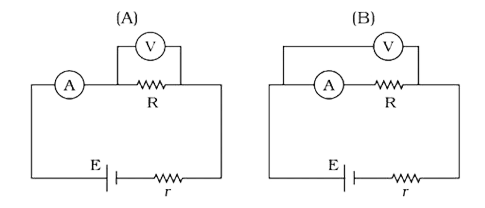
Resistance value of an unknown resistor is calculated using the formula `R=V/I` where V and I be the readings of the voltmeter and the ammeter respectively. Consider the circuits below. The internal resistances of the voltmeter and the ammeter (`R_v and R_B`respectively ) are finite and non zero.

Let `R_A and R_B` be the calculated values in the two cases A and B respectively.
The relation between `R_A` and the actual value R is

Promotional Banner

Similar Questions

Explore conceptually related problems

Resistance value of an unknown resistor is calculated using the formula R=V/I where V and I be the readings of the voltmeter and the ammeter respectively. Consider the circuits below. The internal resistances of the voltmeter and the ammeter ( R_v and R_G respectively ) are finite and non zero. Let R_v and R_G be the calculated values in the two cases A and B respectively. The relation between R_B and the actual value of R is:

The value of resistance of an unknown resistor is calculated using the formula R = V//I where V and I are the readings of the voltmeter and the ammeter, respectivley. Consider the circuits below. The internal resistances of the voltmeter and the ammeter (R_V and R_G, respectively) are finite and nonzero. , Let R_(A) and R_(B) be the calculated values in the two cases A and B , respectively. The relation between R_A and the actual value of R is

Resistance value of an unknown resistor is calculated using the formula R=V/I where V and I be the readings of the voltmeter and the ammeter respectively. Consider the circuits below. The internal resistances of the voltmeter and the ammeter ( R_v and R_G respectively ) are finite and non zero. Let R_v and R_G be the calculated values in the two cases A and B respectively. If the resistance of voltmeter is R_v=1kOmega and that of ammeter is R_G=1Omega the magnitude of the percentage error in the measurement of R (the value of R is nearly 10Omega ) is:

The value of resistance of an unknown resistor is calculated using the formula R = V//I where V and I are the readings of the voltmeter and the ammeter, respectivley. Consider the circuits below. The internal resistances of the voltmeter and the ammeter (R_V and R_G, respectively) are finite and nonzero. , Let R_(A) and R_(B) be the calculated values in the two cases A and B , respectively. If the resistance of voltmeter is R_(V) = 1k Omega and the percentage error in the measurement of R (the value of R is nearly 10 Omega )is

The value of resistance of an unknown resistor is calculated using the formula R = V//I where V and I are the readings of the voltmeter and the ammeter, respectivley. Consider the circuits below. The internal resistances of the voltmeter and the ammeter (R_V and R_G, respectively) are finite and nonzero. , Let R_(A) and R_(B) be the calculated values in the two cases A and B , respectively. If the resistance of voltmeter is R_(V) = 1k Omega and the percentage error in the measurement of R (the value of R is nearly 10 Omega )is

Let V and I be the readings of the voltmeter and the ammeter respectively as shown in the figure. Let R_(V) " and "R_(A) be their corresponding resistancce Therefore,

Let V and I be the readings of the voltmeter and the ammeter respectively as shown in the figure. Let R_(V) " and "R_(A) be their corresponding resistancce Therefore,

In the circuit shon below , the ammeter and the voltmeter readings are 3 A and 6 V respectively . Then the value of the resistance R is

In the circuit shown below, the ammeter and the voltmeter readings are 3 A and 6 V respectively . Then, the value of the resistance R is