

Home
Class 12
PHYSICS
A thin rod of mass 0.9 kg and length ...

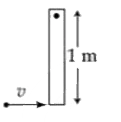
A thin rod of mass 0.9 kg and length 1 m is suspended , at rest form one end so that it can freely oscillate in the vertical plane. A particle of move 0.1 kg moving in a striaght line with velcoity 80 n/s hits the rod at is bottom most point and sticks to it (see figure) . The angluar speed ( in rad/s) of the rod immediately after the collision will be .

Promotional Banner

Similar Questions

Explore conceptually related problems

A thin rod of mass 0.9 kg and length 1 m is suspended, at rest, from one end so that it can freely oscillate in the vertical plane. A particle of mass 0.1 kg moving in a straight line with velocity 80 m/s hits the rod at is bottom most point and sticks to it (see figure) . The angular speed ( in rad/s) of the rod immediately after the collision will be .

A uniform rod of mass 20 Kg and length 1.6 m is piovted at its end and swings freely in the vertical plane. Angular acceleration of the rod just after the rod is relased from rest in the horizontal position is

A uniform rod of mass 20 Kg and length 1.6 m is piovted at its end and swings freely in the vertical plane. Angular acceleration of the rod just after the rod is relased from rest in the horizontal position is

A uniform rod is resting freely over a smooth horizontal plane. A particle moving horizontally strikes at one end of the rod normally and gets stuck. Then

A uniform rod is resting freely over a smooth horizontal plane. A particle moving horizontally strikes at one end of the rod normally and gets stuck. Then

Consider a rod of mass M and length L pivoted at its centre is free to rotate in a vertical position plane. The rod is at rest in the vertical position. A bullet of mass M moving horizontally at a speed v strikes and embedded in one end of the rod. The angular velocity of the rod just after the collision will be.

A uniform rod of mass m and length L is at rest on a smooth horizontal surface. A ball of mass m, moving with velocity v_0 , hits the rod perpendicularly at its one end and sticks to it. The angular velocity of rod after collision is

A rod of mass 12 m and length l lying on a smooth horizontal plane can rotate freely about a stationary, vertical axis passing through the rod's end. A particle of mass m moving along the plane with speed v_(0) hits the rod's end perpendicularly and gets stuck there. Find the angular velocity of the system.